

Most computer displays feature underpowered speakers that produce hollow dialogue and flat bass. Placing dedicated bookshelf speakers on either side of a screen often demands desk surface that many setups cannot spare, especially beside ultrawide monitors or multi-display configurations. A dedicated desktop soundbar solves this layout problem by sliding into the unused clearance beneath your display panel.
Choosing the best soundbars for monitors requires balancing physical height against driver size, power delivery methods, and input flexibility. While some models use separate power and 3.5mm analog connections, modern units can stream audio and draw power across a single digital cable. Below are 4 soundbars evaluated across form factor, connectivity, and driver layout to match distinct desktop spaces.

Pros
- Convertible design switches between satellite and soundbar setups
- Simple plug-and-play installation with no drivers required
- Touch control makes switching lighting modes effortless
- Dedicated knob provides smooth volume and power control
- Generous cable lengths accommodate wider desk layouts
Cons
- Requires both USB power and 3.5mm audio cables
- Lacks Bluetooth or other wireless connectivity options
- Modest 10W total output limits volume in larger spaces
Pros
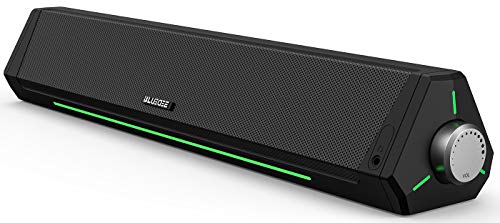
- Versatile Bluetooth 5.0 and 3.5mm AUX inputs
- Compact low-profile design fits under monitors
- Driver-free plug-and-play USB power
- Braided Y-cable reduces desktop cord clutter
Cons
- Requires a continuous USB connection for power
- Lacks a dedicated AC wall power adapter

Pros
- Dual Bluetooth 5.0 and 3.5mm AUX inputs
- Convenient plug-and-play USB-powered operation
- Single side knob for simplified control
- Four speaker drivers with two bass diaphragms
Cons
- No internal battery for cord-free portability
- Requires continuous connection to a USB power source

Pros
- Single USB-C cable handles audio and power
- Compact design fits easily under monitors
- Dual full-range drivers with passive radiators
- Bluetooth 5.0 for low-latency wireless pairing
- Customizable 14-zone Razer Chroma RGB lighting
Cons
- Not water-resistant
- Requires a USB Type-C port for PC connectivity
Quick Comparison: Desktop Soundbar Specifications
Physical clearance under your screen determines whether a soundbar sits neatly or forces an awkward display adjustment. The table below outlines core acoustic configurations, connection standards, and dimensions across each pick.
| Model | Acoustic Configuration | Primary Inputs | Power Delivery | Standout Layout Trait |
|---|---|---|---|---|
| Razer Leviathan V2 X, PC Soundbar with Full-Range | 2 Full-Range Drivers + 2 Passive Radiators | USB Type-C, Bluetooth 5.0 | Single USB-C Cable | Single-cable setup with software EQ |
| Bluedee Computer Speakers for Desktop PC | Dual Drivers + Dual Diaphragms | 3.5mm AUX, Bluetooth 5.0 | USB-A (5V Bus) | Low 2.6-inch profile under low stands |
| Nylavee Computer Speakers for Desktop PC | 4 Speaker Units + 2 Bass Diaphragms | 3.5mm AUX, Bluetooth 5.0 | USB-A (5V Bus) | Quad-driver array with side control knob |
| Computer Speakers, 2 in 1 PC Speaker | Dual 5W Drivers | 3.5mm AUX | USB-A (5V Bus) | Splits into separate satellite towers |
The Best Soundbars for Monitors Reviewed
Razer Leviathan V2 X: Best for Modern PC Gaming Layouts
The Razer Leviathan V2 X, PC Soundbar with Full-Range streamlines cabling by handling both power and digital audio through a single USB Type-C connection. Inside the compact chassis sit two full-range drivers accompanied by two passive radiators, delivering clear mid-range presence and clean volume output up to 90 dB without an external power adapter. This single-wire design makes it an excellent match for clean battlestations, particularly when paired with high-performance displays like 1440p gaming monitors.
Beyond physical design, the soundbar integrates with Razer Synapse on PC and the Razer Audio app on mobile platforms. These software suites allow users to adjust multi-band EQ presets and customize the 14-zone Chroma RGB lighting. A meaningful limitation is the absence of a 3.5mm auxiliary port, meaning consoles or older PCs without compatible USB audio outputs must rely entirely on Bluetooth 5.0.
Bluedee Computer Soundbar: Best Slim Profile for Tight Stand Clearances
The Bluedee Computer Speakers for Desktop PC measures 16.4 inches wide and only 2.6 inches tall, allowing it to slide beneath displays mounted on fixed, low-profile factory stands. Acoustically, it relies on two active sound drivers paired with dual passive diaphragms and anti-magnetic shielding to prevent electrical buzzing near monitor power bricks. It draws power from a standard USB-A port while receiving analog audio through a traditional 3.5mm headphone jack.
Connectivity is versatile thanks to an onboard Bluetooth 5.0 chip, which allows quick switching to a phone or tablet when not playing desktop audio. The unit features subtle ambient lighting and an integrated Y-cable that keeps desk wiring relatively tidy. Because power comes from a basic 5V USB source, maximum bass depth remains modest compared to larger, wall-powered systems.
Nylavee Computer Soundbar: Best Quad-Driver Density for General Desktop Audio
The Nylavee Computer Speakers for Desktop PC distinguishes itself by packing four individual speaker units and two independent bass diaphragms into its central housing. The dual-layer neodymium magnets and mica fiber diaphragms help preserve vocal clarity across YouTube streams, voice meetings, and casual PC gaming. All volume and power functions route through a tactile knob mounted conveniently on the side panel.
Like the Bluedee, this unit connects to source hardware via a 3.5mm auxiliary cord or Bluetooth 5.0, making it compatible with PCs, laptops, and mobile devices alike. It operates without an internal battery, powering on automatically once connected to a desktop USB port. Users seeking deep sub-bass for cinematic explosions should note that the compact acoustic chamber prioritizes speech clarity over low-end rumble.
OFFSIR 2-in-1 PC Speakers: Best Modular Layout for Flexible Desktops
The Computer Speakers, 2 in 1 PC Speaker from OFFSIR offers a unique convertible construction. The two speakers can be latched together horizontally into a central soundbar that fits directly beneath a monitor, or detached into two upright satellite units to flank either side of the screen. This adaptability is practical if you plan to reorganize your workstation or construct an ultimate battlestation on a budget.
Acoustics are driven by dual 5W full-range stereo drivers powered through a USB-A line, with audio supplied via a 3.5mm jack. A touch sensor on the housing toggles four distinct lighting patterns, while a smooth physical dial controls power and master volume. A potential compromise is the connecting cable between the two split units, which must be tucked out of sight when configured in soundbar mode.
How to Choose the Best Soundbars for Monitors
Finding the right monitor soundbar involves assessing your desk layout, audio sources, and personal listening habits. Keeping several core specifications in mind prevents fitment issues or disappointing acoustic performance.
Vertical Clearance and Stand Clearance
Before purchasing, measure the distance between your desktop surface and the bottom bezel of your monitor screen. Fixed monitor stands often allow less than 3 inches of clearance, making ultra-slim options like the Bluedee ideal. If your monitor uses a third-party VESA desk arm, vertical clearance is adjustable, giving you the freedom to choose taller units like the Razer Leviathan V2 X.
Power and Audio Delivery Methods
Desktop soundbars generally divide into two wiring categories: split connections and unified digital connections. Split connections use a USB-A cable for 5V power and a 3.5mm cable for analog audio transmission, making them universally compatible with standard motherboard I/O panels. Unified digital models, such as the Razer Leviathan V2 X, draw both operating power and uncompressed digital sound over a single USB-C cord, drastically reducing desktop clutter.
Stereo Separation Trade-offs
A soundbar positions its stereo drivers close together inside a single bar, creating a narrower soundstage than wide-set satellite speakers. For competitive gaming where directional footstep localization matters, modular setups like the OFFSIR offer an advantage by separating the drivers. For media consumption, daily office work, and casual gaming, standard horizontal soundbars offer more than enough stereo width while maintaining a clean look.
Frequently Asked Questions
Can I plug a monitor soundbar directly into the monitor USB ports?
Yes, provided your monitor includes a powered USB downstream hub. However, some monitor USB ports supply limited current that may cause distortion or power cutouts at maximum volume. For stable performance, connect the USB power lead directly to your PC motherboard or an external 5V wall adapter.
Does Bluetooth audio introduce lag when gaming on PC?
Standard Bluetooth audio connections can exhibit perceptible latency during fast-paced competitive gaming. While Bluetooth 5.0 is convenient for listening to music from a phone, you should always use the wired USB or 3.5mm connection for gaming to ensure instant audio synchronization.
Final Recommendation
If you want a modern, clean setup with software sound customization and single-cable USB-C convenience, the Razer Leviathan V2 X, PC Soundbar with Full-Range is the clear choice. For displays with low vertical clearance and standard 3.5mm requirements, the Bluedee Computer Speakers for Desktop PC fits easily beneath most monitor stands. Users who want the flexibility to switch between an under-monitor soundbar and traditional stereo desktop speakers will get the most utility from the Computer Speakers, 2 in 1 PC Speaker.




Write Your Review
No reviews yet. Be the first to share your experience!