

Choosing the best wifi 6 gaming routers comes down to managing latency, traffic congestion, and local bandwidth. While standard home networking hardware easily handles streaming media, gaming demands consistent packet delivery without jitter or ping spikes caused by competing household downloads.
Modern WiFi 6 and 6E routers solve bandwidth crowding by implementing Orthogonal Frequency-Division Multiple Access (OFDMA) and access to the uncongested 6 GHz frequency band. If you are building out a setup with hardware from our budget battlestation guide, pairing it with capable networking gear ensures your connection matches your rig’s capabilities.
Quick Comparison: Best WiFi 6 Gaming Routers

Pros
- Dual-band WiFi 6 speeds up to 3 Gbps
- Coverage for up to 2,000 square feet
- Four dedicated Gigabit Ethernet LAN ports
- Integrated VPN support and USB 3.0 connectivity
Cons
- Requires a separate standalone modem
- Caps internet service provider compatibility at 1 Gbps
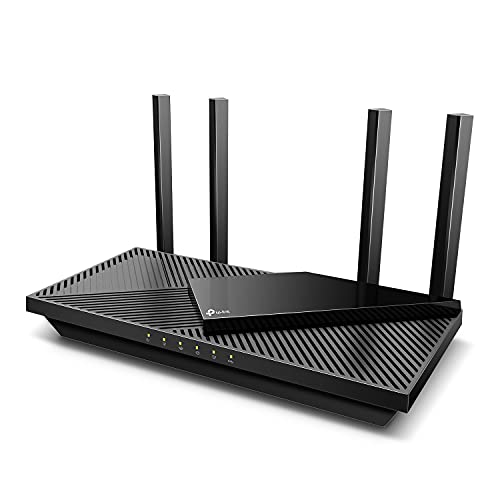
Pros
- Dual-band Wi-Fi 6 speeds up to 2402 Mbps
- OFDMA reduces multi-device latency and jitter
- Built-in VPN client and server support
- Four external antennas with Beamforming technology
- Compatible with Amazon Alexa voice commands
Cons
- Requires a standalone modem for most internet setups
- Advanced HomeShield protection features require additional upgrades

Pros
- Dedicated 6 GHz band for Wi-Fi 6E devices
- Fast 2.5G multi-gigabit WAN port
- Integrated network-level game acceleration features
- EasyMesh support for seamless whole-home expansion
- Simple setup and management via Tether app
Cons
- LAN ports are limited to 1 Gbps
- Requires Wi-Fi 6E hardware to use 6 GHz

Pros
- Tri-band support including the 6GHz band
- 1.8GHz quad-core processor for multi-device management
- AI QoS automatic traffic prioritization
- Eight concurrent data streams
- Integrated Mystic Light RGB synchronization
Cons
- Requires WiFi 6E devices for 6GHz access
- Large chassis requires significant setup space

Pros
- Dedicated 6 GHz band reduces wireless interference
- Built-in VPN server and client functionality
- EasyMesh compatibility for scalable network coverage
- Multi-device capacity supported by 512 MB RAM
Cons
- Advanced HomeShield network features require a paid subscription
- Requires a standalone modem for most ISP connections

Pros
- Dual-band WiFi 6 with OFDMA and MU-MIMO support
- Four dedicated Gigabit LAN ports for wired setups
- Subscription-free Trend Micro network protection included
- AiMesh support for expanding coverage with compatible routers
- Built-in Instant Guard mobile VPN encryption
Detailed Product Breakdowns
NETGEAR Nighthawk WiFi 6 Router (RAX36)
The NETGEAR Nighthawk WiFi 6 Router (RAX36) delivers dual-band AX3000 throughput designed for small to medium living spaces up to 2,000 square feet. It features four gigabit LAN ports for hardwired consoles and gaming PCs, alongside integrated VPN client support and a USB 3.0 port for basic network storage.
This unit serves competitive gamers seeking a reliable gigabit connection without unnecessary enterprise extras. Because it lacks multi-gigabit WAN support and a 6 GHz channel, users with fiber internet tiers above 1 Gbps will not fully utilize their provider’s peak speeds.
TP-Link Tri-Band AXE5400 Wi-Fi 6E Gaming Router (Archer GXE75)
The TP-Link Tri-Band AXE5400 Wi-Fi 6E Gaming Router expands wireless bandwidth by incorporating the 6 GHz spectrum. It includes a dedicated 2.5 Gbps multi-gigabit WAN port, game traffic acceleration modes, and EasyMesh capability for whole-home expansion.
Players running high-spec machines alongside fast peripherals like an MMO gaming mouse benefit from the dedicated game panel and server optimization. Keep in mind that unlocking the 6 GHz band requires compatible client devices with Wi-Fi 6E network cards.
TP-Link Dual-Band AX3000 Wi-Fi 6 Wireless Gigabit Router
The TP-Link Dual-Band AX3000 Wi-Fi 6 Wireless Gigabit operates with dual bands rated for 2402 Mbps on 5 GHz and 574 Mbps on 2.4 GHz. Four external beamforming antennas and an upgraded internal heat sink maintain signal stability and prevent thermal throttling during long gaming marathons.
Its target wake time (TWT) mechanism improves the battery life of connected portable devices, making it practical for mixed-use households. However, it relies entirely on gigabit Ethernet ports, meaning it cannot route local network transfers faster than 1 Gbps.
MSI Radix AXE6600 WiFi 6E Tri-Band Gaming Router
The MSI Radix AXE6600 WiFi 6E Tri-Band Gaming Router provides eight simultaneous data streams powered by a 1.8 GHz quad-core processor. MSI equips this unit with AI-driven Quality of Service (QoS) to prioritize gaming packets automatically above background tasks.
High computational throughput suits dense households where multiple users stream 4K video while competitive multiplayer matches run concurrently. Its aggressive external styling and Mystic Light RGB integration might not appeal to users looking for subtle office networking equipment.
TP-Link AXE5400 Tri-Band WiFi 6E Router (Archer AXE75)
The TP-Link AXE5400 Tri-Band WiFi 6E Router pairs tri-band functionality with 512 MB of system memory and a 1.0 GHz dual-core CPU. It acts as both a VPN server and client using protocols such as OpenVPN and L2TP while managing home device traffic via HomeShield.
This model is ideal for households managing numerous smart home devices alongside gaming consoles, distributing clients across 2.4 GHz, 5 GHz, and 6 GHz. Unlike the GXE75 variant, it relies on a standard 1 Gbps WAN port rather than multi-gigabit copper.
ASUS RT-AX1800S Dual Band WiFi 6 Extendable Router
The ASUS RT-AX1800S Dual Band WiFi 6 Extendable provides an entry point into modern wireless standards using 1024-QAM modulation across dual bands. It integrates commercial-grade AiProtection Classic powered by Trend Micro without requiring ongoing subscription fees.
The router supports ASUS AiMesh technology, allowing it to act as either an inexpensive main router or a node in a broader mesh setup. Its AX1800 bandwidth ceiling offers less headroom for simultaneous gigabit downloads compared to higher-tier AX3000 or AXE5400 alternatives.
Key Specifications Compared
| Router Model | Wi-Fi Standard | Total Wireless Bandwidth | Processor | Multi-Gig Support |
|---|---|---|---|---|
| NETGEAR Nighthawk RAX36 | WiFi 6 (Dual-Band) | Up to 3.0 Gbps | Not specified | No (1G WAN) |
| TP-Link Archer GXE75 | WiFi 6E (Tri-Band) | Up to 5.4 Gbps | Not specified | Yes (2.5G WAN) |
| TP-Link Archer AX55 AX3000 | WiFi 6 (Dual-Band) | Up to 3.0 Gbps | Not specified | No (1G WAN) |
| MSI Radix AXE6600 | WiFi 6E (Tri-Band) | Up to 6.6 Gbps | 1.8 GHz Quad-Core | Not specified |
| TP-Link Archer AXE75 | WiFi 6E (Tri-Band) | Up to 5.4 Gbps | 1.0 GHz Dual-Core | No (1G WAN) |
| ASUS RT-AX1800S | WiFi 6 (Dual-Band) | Up to 1.8 Gbps | Dual-Core | No (1G WAN) |
How to Choose the Best WiFi 6 Gaming Router
Selecting networking hardware requires balancing your incoming internet plan against your local device density. Investing in advanced wireless features yields minimal benefit if your gaming platform cannot connect to those bands or if your internet subscription creates a bottleneck.
WiFi 6 vs. WiFi 6E
Standard WiFi 6 operates strictly on the traditional 2.4 GHz and 5 GHz frequency bands. It increases network capacity via OFDMA and MU-MIMO, allowing the router to communicate with multiple client devices concurrently rather than queuing transmissions sequentially.
WiFi 6E routers unlock the 6 GHz wireless band, adding massive spectrum capacity free from legacy device traffic. If you game in an apartment building saturated with neighboring networks, a 6E router provides a clean channel with zero interference, provided your PC or console supports it.
Wired Ports and Multi-Gig WAN
Ethernet remains the most reliable connection method for competitive multiplayer games. When pairing your router with hardware such as prebuilt gaming PCs, hardwiring directly into a LAN port eliminates wireless fluctuations entirely.
If your internet service provider offers speeds beyond 1 Gbps, prioritize routers equipped with a 2.5 Gbps WAN port, like the TP-Link Archer GXE75. Standard gigabit ports throttle high-speed fiber packages right at the router entrance.
Quality of Service (QoS) and Processing Power
A router’s internal CPU handles packet inspection, firewall operations, and traffic prioritization. Routers equipped with quad-core chips, like the MSI Radix AXE6600, manage heavy concurrent throughput without dropping gaming packets.
Quality of Service features allow you to prioritize data sent to specific ports or applications. Setting your desktop or console as a high-priority device prevents your latency from spiking whenever another user initiates a large file download on the local network.
Frequently Asked Questions
Does a WiFi 6 router reduce ping in online games?
A WiFi 6 router cannot alter the physical distance between your home and a game server, which dictates your baseline ping. However, technologies like OFDMA reduce local latency spikes caused by other devices transmitting data simultaneously.
Can I use my existing modem with these routers?
Yes, all the routers in this guide are standalone routing devices and do not include integrated cable modems. You must connect your incoming modem or fiber optical network terminal (ONT) to the router’s WAN port using an Ethernet cable.
Is a wired connection still better than WiFi 6?
Yes, a physical Ethernet connection remains superior for competitive multiplayer gaming. While WiFi 6 significantly closes the gap in throughput and latency, radio signals remain vulnerable to physical barriers, radio noise, and distance degradation.




Write Your Review
No reviews yet. Be the first to share your experience!