

Choosing the best prebuilt gaming pc means finding a balanced system where the processor, graphics card, memory, and thermal design work together without bottlenecks. A properly configured desktop saves you the effort of sourcing individual parts while offering warranty protection and plug-and-play setup.
Modern gaming desktops now span several component generations, ranging from entry-level 1080p systems to high-end 4K rigs equipped with hardware like the RTX 5080 and Ryzen 3D V-Cache processors. To get the most frame rate per dollar, focus on matching the graphics card and processor tier to your preferred monitor resolution and target refresh rate.
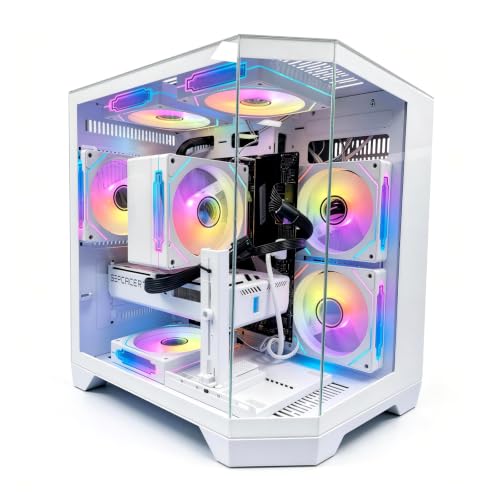
Pros
- AMD Ryzen 7 8700F and RTX 5060 hardware
- Six pre-installed RGB chassis fans
- Tool-free tempered glass side panel
- Supports up to four external displays
- Memory expandable up to 256GB
Cons
- Storage drive uses older PCIe 3.0 interface
- Majority of external connectivity relies on USB 2.0

Pros
- NVIDIA GeForce RTX 5070 Blackwell graphics
- 8-core AMD Ryzen 7 8700F processor
- Generous 32GB DDR5 memory and 2TB SSD
- Four pre-installed fans for active chassis airflow
- Convenient dedicated physical LED control button
Cons
- Equipped with CPU air cooling instead of liquid cooling
- Ships with Windows 11 Home rather than Pro
- Substantial 21.3-pound weight requires sturdy desk support

Pros
- GeForce RTX 5070 12GB and Ryzen 7 9700X hardware
- Fast 32GB DDR5 6000MHz memory
- Integrated 11.3-inch hardware monitoring smart screen
- Robust 360mm AIO liquid cooler included
- Modern WiFi 7 wireless connectivity
Cons
- 1TB SSD capacity may fill quickly with modern games
- VGA and DVI monitors require separate adapters

Pros
- High-performance AMD Ryzen 7 9850X3D processor
- Capable 16GB AMD Radeon RX 9070 XT GPU
- Pre-installed 360mm AIO liquid cooling solution
- Spacious and fast 2TB Gen4 NVMe SSD
- Generous 32GB of DDR5 memory pre-installed
Cons
- Specific graphics card manufacturer brand may vary
- Substantial chassis dimensions require significant desk space

Pros
- NVIDIA GeForce RTX 5080 graphics hardware
- Multi-core Intel Core Ultra 9 285 processor
- 240mm heat exchanger thermal management support
- Customizable multi-zone AlienFX lighting
- One year of included onsite hardware support
Cons
- Heavy 33.89-pound chassis restricts easy movement
- Large physical footprint requires significant desktop clearance

Pros
- NVIDIA GeForce RTX 5080 16GB GDDR7 graphics
- AMD Ryzen 7 9800X3D with 3D V-Cache
- 360mm AIO liquid cooling with three fans
- Fast 5-Gigabit LAN and WiFi 6E support
- Spacious 2TB NVMe M.2 solid-state storage
Cons
- Warranty return shipping limited to U.S. addresses
- Complete system warranty covers only one year

Pros
- High-performance Ryzen 7 9700X and RX 9070 XT hardware
- Integrated 11.3-inch real-time system monitoring screen
- 360mm liquid cooler with pump-head digital temperature display
- WiFi 7 and Bluetooth wireless connectivity built in
- 850W 80 PLUS Gold certified power supply
Cons
- 1TB storage capacity fills quickly with modern games
- Requires separate adapters for legacy VGA or DVI monitors

Pros
- Capable 8-core AMD Ryzen 7 5700X processor
- Generous 32GB DDR4 memory configuration
- Fast 1TB M.2 NVMe storage
- Integrated Wi-Fi and Bluetooth wireless support
- 80 Plus Bronze certified power supply
Cons
- Built on older AM4 and DDR4 platform
- Specific graphics card brand varies by unit
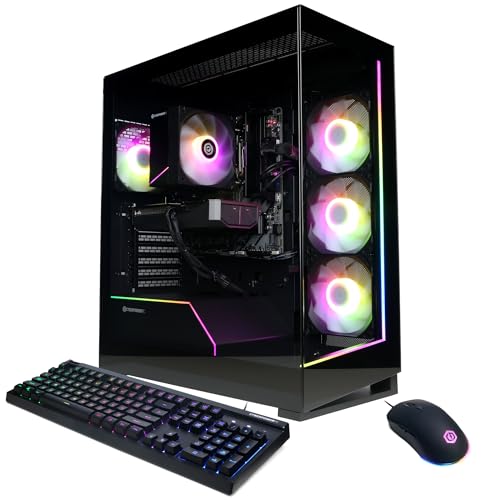
Pros
- Eight-core AMD Ryzen 7 8700F processor
- Dedicated GeForce RTX 5060 Ti graphics
- Fast 1TB PCIe 4.0 NVMe storage
- Integrated WiFi 6 and Bluetooth 5.3
- Keyboard and mouse included in the box
Cons
- 8GB VRAM limits headroom for high-resolution textures
- 16GB system RAM may require future expansion

Pros
- AMD Ryzen 9 7900X processor
- NVIDIA GeForce RTX 5070 12GB graphics
- 32GB DDR5 dual-channel memory
- Fast 1TB NVMe solid-state storage
- Includes gaming keyboard and mouse
Cons
- Uses older 802.11ac Wi-Fi standard
- Memory speed is limited to 4800MHz
- Heavy 36-pound desktop chassis
Quick Comparison of Featured Desktops
The table below provides a specification comparison across key hardware areas, including processor models, discrete graphics, memory capacity, and primary storage.
| Desktop Model | Processor | Graphics Card | RAM | Storage |
|---|---|---|---|---|
| LXZ Prebuilt Gaming PC Ryzen 7 8700F RTX 5060 16GB | Ryzen 7 8700F | GeForce RTX 5060 8GB | 16GB DDR5 | 1TB NVMe |
| YAWYORE Gaming PC, AMD Ryzen 7 5700X | Ryzen 7 5700X | GeForce RTX 5060 8GB | 32GB DDR4 | 1TB NVMe |
| CyberPowerPC Gaming PC, AMD Ryzen 7 8700F | Ryzen 7 8700F | GeForce RTX 5060 Ti 8GB | 16GB DDR5 | 1TB NVMe |
| msi Codex Z2 Gaming Desktop, AMD R7-8700F | Ryzen 7 8700F | GeForce RTX 5070 12GB | 32GB DDR5 | 2TB SSD |
| KOTIN Prebuilt Gaming PC RTX 5070 12GB | Ryzen 7 9700X | GeForce RTX 5070 12GB | 32GB DDR5 | 1TB NVMe |
| iBUYPOWER Element Gaming PC Desktop Computer AMD | Ryzen 9 7900X | GeForce RTX 5070 12GB | 32GB DDR5 | 1TB NVMe |
| KOTIN Gaming PC, Ryzen 7 9700X, RX 9070 XT 16GB | Ryzen 7 9700X | Radeon RX 9070 XT 16GB | 32GB DDR5 | 1TB NVMe |
| Skytech Gaming PC Desktop, Ryzen 7 9850X3D | Ryzen 7 9850X3D | Radeon RX 9070 XT 16GB | 32GB DDR5 | 2TB NVMe |
| Alienware Aurora Gaming Desktop, RTX 5080 | Core Ultra 9 285 | GeForce RTX 5080 16GB | Not specified | Not specified |
| ZOTAC MEK Gaming PC Desktop, Ryzen 7 9800X3D | Ryzen 7 9800X3D | GeForce RTX 5080 16GB | 32GB DDR5 | 2TB NVMe |
Detailed Reviews: Top Prebuilt Gaming Desktops
1. LXZ Prebuilt Gaming PC Ryzen 7 8700F RTX 5060 16GB
The LXZ prebuilt targets budget-conscious players looking for modern platform features without an excessive price tag. It pairs AMD’s 8-core Ryzen 7 8700F processor with NVIDIA’s GeForce RTX 5060 8GB graphics card, making it a capable option for 1080p and light 1440p workloads. Six ARGB case fans provide active airflow through the tempered glass chassis.
While 16GB of DDR5 memory handles contemporary gaming, heavy multitaskers might want to expand capacity down the road. The 650W power supply handles the current components easily, but it leaves limited headroom for higher-tier GPU upgrades later.
2. YAWYORE Gaming PC, AMD Ryzen 7 5700X
The YAWYORE configuration combines the previous-generation AM4 platform with modern graphics processing. Driven by an AMD Ryzen 7 5700X processor and an RTX 5060 8GB graphics card, it offers 32GB of DDR4 memory for smooth multitasking and streaming. The included MSI B550M-A PRO motherboard ensures solid board-level stability.
The primary trade-off is the older AM4 architecture. While capable of solid frame rates, upgrading the processor in the future will require replacing both the motherboard and memory with DDR5-compatible hardware.
3. CyberPowerPC Gaming PC, AMD Ryzen 7 8700F
CyberPowerPC integrates the newer AMD B850 chipset alongside an 8-core Ryzen 7 8700F processor and an RTX 5060 Ti 8GB graphics card. This pairing delivers a modest graphical step up from standard RTX 5060 systems, improving frame pacing in esports and visual-heavy titles. Comprehensive wireless connectivity includes Wi-Fi 6 and Bluetooth 5.3.
The unit ships with 16GB of DDR5 RAM, which satisfies base requirements for modern gaming but leaves less breathing room for heavy modding or content creation. An included basic keyboard and mouse set helps newcomers get up and running quickly.
4. msi Codex Z2 Gaming Desktop, AMD R7-8700F
The MSI Codex Z2 steps into enthusiast territory with the GeForce RTX 5070 12GB graphics card based on NVIDIA Blackwell architecture. Backed by the Ryzen 7 8700F processor, 32GB of DDR5 memory, and a spacious 2TB solid-state drive, this desktop is well equipped for running current games at high settings on modern 1440p gaming monitors.
Cooling is managed by an air cooler and four system fans integrated into the chassis. While air cooling simplifies long-term maintenance, buyers seeking liquid cooling or maximum processor boost clocks may look toward higher-tier AIO configurations.
5. KOTIN Prebuilt Gaming PC RTX 5070 12GB
KOTIN outfits this system with the Zen 5 architecture AMD Ryzen 7 9700X alongside an RTX 5070 12GB GPU. It features high-speed 32GB DDR5 6000MHz memory, a 360mm all-in-one liquid cooler, and modern Wi-Fi 7 networking. A distinctive 11.3-inch internal smart display shows live CPU and GPU temperatures alongside usage statistics.
Power delivery is handled by an 850W 80 Plus Gold power supply, offering genuine headroom for future hardware upgrades. The primary constraint is the 1TB NVMe drive, which fills up quickly if you maintain a large library of modern AAA titles.
6. iBUYPOWER Element Gaming PC Desktop Computer AMD
The iBUYPOWER Element targets mixed gaming and workstation tasks by combining a 12-core AMD Ryzen 9 7900X with an RTX 5070 12GB graphics card. The extra CPU cores provide strong compute power for video editing, rendering, and background applications while gaming. It comes equipped with 32GB of DDR5 RAM and 1TB of NVMe storage.
One trade-off is the baseline DDR5 memory speed of 4800MHz, which runs slightly slower than competitive 5600MHz or 6000MHz kits. The wireless networking configuration also relies on 802.11ac Wi-Fi rather than newer Wi-Fi 6 or Wi-Fi 7 standards.
7. KOTIN Gaming PC, Ryzen 7 9700X, RX 9070 XT 16GB
This variant from KOTIN shifts to AMD’s graphics platform by featuring the Radeon RX 9070 XT with 16GB of video memory. Paired with an AMD Ryzen 7 9700X and 32GB of DDR5 memory, the 16GB VRAM buffer provides substantial bandwidth for native 1440p and entry 4K texture packs. Thermal regulation is maintained with a 360mm ARGB liquid cooler.
Like its sibling, this build includes an 11.3-inch integrated smart monitor and an 850W 80 Plus Gold PSU. Players who depend heavily on NVIDIA-specific productivity suites or specialized DLSS workflows may prefer an RTX alternative instead.
8. Skytech Gaming PC Desktop, Ryzen 7 9850X3D
Skytech combines AMD’s dedicated 3D V-Cache architecture via the Ryzen 7 9850X3D with the Radeon RX 9070 XT 16GB graphics card. Processors with 3D V-Cache are recognized for excellent frame pacing in simulation titles and competitive shooters. The system includes 32GB of DDR5 5600MHz memory, a 2TB Gen4 NVMe drive, and a 360mm AIO cooler.
This build easily supports expansive setups, including ultrawide gaming monitors that require high rasterization throughput. However, its overall power draw and high-performance hardware require adequate desk ventilation to prevent ambient heat accumulation.
9. Alienware Aurora Gaming Desktop, RTX 5080
The Alienware Aurora takes aim at 4K gaming by incorporating NVIDIA’s GeForce RTX 5080 16GB graphics card and an Intel Core Ultra 9 285 processor. The chassis features customizable AlienFX lighting zones, a basalt black finish, and an integrated 240mm liquid cooling radiator. Dell backs the configuration with one year of onsite hardware service.
Alienware desktops traditionally employ proprietary motherboard and chassis layouts, which can restrict standard aftermarket part replacements over time. The 240mm cooling assembly is also slightly smaller than the 360mm units found on competitor chassis.
10. ZOTAC MEK Gaming PC Desktop, Ryzen 7 9800X3D
The ZOTAC MEK represents an elite pairing for pure gaming workloads, featuring AMD’s Ryzen 7 9800X3D CPU and ZOTAC’s GeForce RTX 5080 16GB GDDR7 graphics card. Supported by 32GB of fast DDR5 6000MHz RAM, a 2TB NVMe SSD, and an 850W Gold power supply, it easily handles high-refresh 4K gaming with ray tracing enabled.
The system is cooled by a 360mm AIO cooler paired with Infinity case fans. Advanced connectivity includes 5-Gigabit LAN and DisplayPort 2.1b, though buyers should note that warranty return shipping coverage applies strictly to domestic addresses.
How to Choose the Best Prebuilt Gaming PC
Evaluating prebuilt computers requires looking past exterior RGB lighting to examine core hardware specifications. Balancing components prevents purchasing a machine with an overpowered processor and an inadequate graphics card, or vice versa.
Matching Graphics Cards to Resolution
The graphics processing unit dictates your achievable gaming resolution and visual fidelity. For 1080p gaming, options like the RTX 5060 8GB provide reliable frame rates without overspending on unused graphical power. Stepping up to 1440p gaming requires broader memory bandwidth and larger VRAM pools, making the RTX 5070 12GB or Radeon RX 9070 XT 16GB ideal options.
If your goal is native 4K gaming or high frame rates with heavy ray tracing, GPUs such as the RTX 5080 16GB become necessary. Pair these cards with an appropriately matched display, and balance out your desk setup with reliable peripherals like those in our guide to mechanical gaming keyboards.
Processor Platforms and Upgradability
The choice between processor platforms directly impacts system longevity. Newer sockets like AMD AM5 provide an upgrade path to future CPU generations using modern DDR5 memory. While previous-generation platforms such as AM4 keep initial costs down, they eliminate CPU upgrade paths without replacing the motherboard and RAM.
CPUs featuring dedicated cache solutions, such as AMD’s 3D V-Cache found in the Ryzen 7 9800X3D and 9850X3D, reduce frame rate drops in cache-sensitive game engines. For hybrid workloads involving rendering or streaming, higher core-count chips like the Ryzen 9 7900X or Intel Core Ultra 9 offer practical benefits.
Cooling, Power Supplies, and Chassis Standards
Thermal management plays a crucial role in preventing hardware throttling under extended loads. While air coolers work well for lower-power 65W processors, higher-wattage chips benefit significantly from 240mm or 360mm all-in-one liquid coolers. Mesh front panels further assist by allowing unobstructed intake airflow.
Power supplies should feature an 80 Plus Bronze or Gold certification with adequate wattage headroom. An 850W power supply gives you freedom to swap graphics cards later, whereas 650W units generally constrain future component upgrades. If you are completing a dedicated gaming setup, you can read our guide on building an organized battlestation setup.
Frequently Asked Questions
Is 16GB of RAM enough for modern PC gaming?
16GB of DDR5 memory remains sufficient for running current mainstream titles at standard settings. However, 32GB is rapidly becoming the preferred baseline for running modern games alongside Discord, web browsers, and background recording software without encountering memory caching bottlenecks.
Where should I plug in my monitor on a prebuilt PC?
Always connect your display cable directly to the horizontal ports located on the dedicated graphics card near the middle or lower section of the case back. Connecting to the vertical display outputs on the upper motherboard I/O panel bypasses the dedicated GPU, resulting in a blank screen or inferior integrated graphics performance.



Write Your Review
No reviews yet. Be the first to share your experience!