

The best gaming monitor deals here range from compact 1080p screens to sharper QHD displays. For competitive play, prioritize refresh rate and your PC’s ability to deliver high frame rates; for finer detail, consider QHD.
The Samsung 27” Odyssey G5 (G50F) combines QHD resolution, an IPS panel, and 180Hz refresh, while the Samsung 32” Odyssey (G55C) offers a larger curved QHD screen at 165Hz. For budget-conscious 1080p gaming, the Sceptre 24.5-inch Prime advertises up to 240Hz. These are specification-based comparisons, not results from hands-on testing.

Pros
- Sharp QHD resolution across a spacious 32-inch display
- Fluid 165Hz refresh rate reduces visual lag
- Immersive 1000R curvature fills peripheral vision
- AMD Radeon FreeSync eliminates screen tearing
- Built-in Eye Saver and flicker-reduction modes

Pros
- Fast refresh rate reaching up to 144Hz
- Includes DisplayPort and HDMI connection options
- Thin bezels ideal for dual-display setups
- Built-in speakers preserve physical desk space
- Blue-Light Shift feature for eye comfort
Cons
- Compact 22-inch screen limits total viewing real estate

Pros
- Smooth 240Hz refresh rate via DisplayPort and HDMI
- Immersive 1500R curved 32-inch screen
- High 3500:1 contrast ratio
- Built-in FreeSync support
- DisplayPort cable included in the box
Cons
- Low pixel density with 1080p at 32 inches
- No integrated speakers
- Stand adjustment limited strictly to tilt

Pros
- Fast 240Hz refresh rate for fluid gameplay
- High 4000:1 static contrast ratio
- Immersive 1500R curved display
- FreeSync adaptive sync support
- Wide 130% sRGB color gamut
Cons
- 1080p resolution yields lower pixel density at 27 inches
- Stand provides tilt adjustment only
- No built-in audio speakers

Pros
- High 240Hz refresh rate for fluid gameplay
- Deep 4000:1 static contrast ratio
- Adaptive-Sync eliminates screen tearing
- Wide 130% sRGB color gamut coverage
- Standard 100x100mm VESA mount support
Cons
- 1080p resolution offers modest pixel density at 27 inches
- 300-nit peak brightness limits true HDR impact
- Basic 2W built-in speakers offer limited audio depth

Pros
- Fast 240Hz refresh rate for competitive play
- AMD FreeSync Premium support
- Responsive 1ms transition speed
- Four total video inputs across HDMI and DisplayPort
- Built-in stereo speakers
Cons
- Resolution limited to standard 1080p Full HD

Pros
- High 200Hz refresh rate for fluid competitive gameplay
- Deep 3000:1 static contrast ratio
- Adaptive-Sync minimizes visual tearing and stutter
- Wide 130% sRGB color volume coverage
- Standard 100x100mm VESA mounting support
Cons
- 1080p resolution yields modest pixel density at 27 inches
- Peak 300-nit brightness limits high-impact HDR performance
- Dual 2W integrated speakers offer basic audio output

Pros
- Immersive 1800R curved 27-inch panel
- 100Hz refresh rate delivers smoother visuals
- TÜV-certified blue light and flicker reduction
- Optimized Game Mode enhances dark scene visibility
Cons
- 1080p resolution yields modest pixel density at 27 inches
- 100Hz refresh rate is lower than dedicated gaming monitors

Pros
- Crisp 2560 x 1440 QHD resolution
- Fast 180Hz refresh rate and 1ms GtG response
- IPS panel with wide 178-degree viewing angles
- G-Sync compatibility eliminates screen tearing
- Full ergonomic stand with pivot, tilt, and swivel
How These Gaming Monitors Differ
QHD options for more screen detail
The Samsung 27” Odyssey G5 (G50F) is the clearest fit for shoppers who want 2560 × 1440 resolution without moving to a 32-inch screen. Its IPS panel, 180Hz refresh rate, 1ms GtG response specification, and G-Sync compatibility suit PC players seeking a balance of detail and motion. Its listed features also include an adjustable stand, HDR10, Black Equalizer, and Virtual Aim Point.
The Samsung 32” Odyssey (G55C) also provides QHD resolution, paired with a larger 1000R curved screen and a 165Hz refresh rate. AMD FreeSync is specified, as are HDR10 and a 1ms MPRT response time. Choose it if the larger curved display appeals; the listing does not specify an adjustable stand or panel type, so check those details before buying.
1080p choices for fast refresh rates
The SANSUI 27 Inch Curved 240Hz Gaming Monitor FHD pairs 1920 × 1080 resolution with a 240Hz maximum refresh rate, FreeSync, and a 1500R curve. It is a sensible match for competitive PC gaming when the system and connection can output the desired refresh rate. The listing specifies HDMI and DisplayPort 1.4, but no built-in speakers.
The SANSUI 32 Inch Curved 240Hz Gaming Monitor offers the same stated Full HD resolution and 240Hz refresh rate on a larger 32-inch, 1500R display. Its size may suit players who prefer a broad, curved view, but 1080p across a 32-inch screen is less pixel-dense than QHD at a similar size. It supports HDMI and DisplayPort 1.4 up to 240Hz, and has no built-in speakers.
The Amzfast 27 inch 240Hz Curved Monitor is another 1080p, 1500R option, with Adaptive-Sync, built-in speakers, HDMI 2.0, and DisplayPort 1.4. Its 240Hz specification targets high-refresh gaming, while the speakers can reduce the need for separate desktop audio. The Amzfast 27 inch 200Hz Curved Gaming Monitor uses the same listed resolution and curve, but tops out at 200Hz; it may be enough if that refresh ceiling better fits your needs.
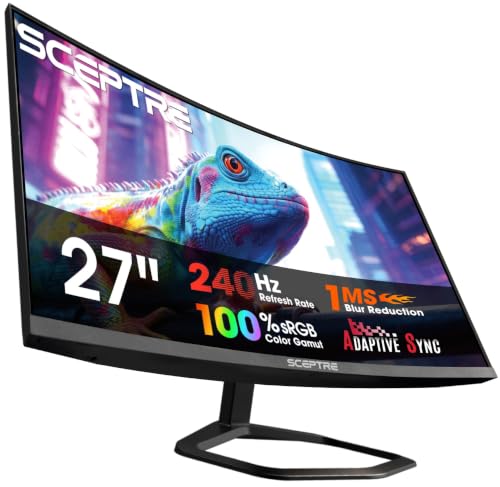
The Sceptre Curved 24.5-inch Prime Gaming Monitor is a smaller 1080p alternative with up to 240Hz, AMD FreeSync Premium, and built-in speakers. Its compact size is useful where desk space is limited. The Sceptre New 22-Inch Gaming Monitor, FHD 1080p is the simplest small-screen choice here, with up to 144Hz and integrated speakers; the supplied listing does not state its panel type or adaptive-sync support.
Entry-level curved displays
The Samsung 27” Essential S3 (S36GD) has a 27-inch curved Full HD screen and 100Hz refresh rate. It suits general PC use and more casual gaming better than players specifically seeking 165Hz or higher. Its eye-comfort features and game settings are listed, but the supplied information does not identify the ports or confirm adaptive sync.
What to Check Before Choosing
Resolution, size, and graphics capability
QHD provides more pixels than Full HD and can show finer detail, as reflected in the two Samsung Odyssey models. A 1080p monitor can be a practical choice for a high-refresh setup, especially if your PC is better suited to that resolution. Monitor refresh rate is not a promise of matching game frame rates: your graphics hardware and the game determine actual performance.
Refresh rate, response claims, and sync
Refresh rates listed here range from 100Hz to 240Hz. Higher maximum refresh rates can display more frequent updates when the computer supplies enough frames, but supported rates may depend on the input, cable, resolution, and settings. Check the monitor and graphics-card documentation for the connection and mode you plan to use.
Response-time figures use different measures in these listings, including MPRT and GtG, so they should not be treated as directly comparable independent test results. FreeSync, Adaptive-Sync, and G-Sync compatibility can help coordinate display refresh with graphics output, but confirm support for your particular GPU and connection before purchase.
Curve, stand, sound, and mounting
A curved screen is a preference, not a performance guarantee. These models specify curves from 1000R to 1800R; consider your viewing distance and desk layout, and note the SANSUI 32-inch listing recommends about 1.2 meters. Stand adjustability differs: the Samsung G50F lists height, pivot, tilt, and swivel adjustments, while several curved models list tilt only.
Built-in speakers are specified on the two Amzfast monitors and the Sceptre models, but the SANSUI 27-inch and 32-inch screens explicitly lack them. VESA mounting is specified for the SANSUI and Amzfast gaming models; verify the mount’s 100 × 100 mm pattern where stated and confirm the monitor’s weight and arm capacity separately.
More Monitor Buying Guidance
For a deeper look at high-refresh alternatives, see our 240Hz gaming monitor guide and 165Hz monitor comparisons. If you are choosing a console display, our guides to curved monitors for PS5 and 4K gaming monitors for PS5 cover different priorities.
Which Monitor Should You Choose?
Choose the Samsung 27” Odyssey G5 (G50F) for QHD detail, an IPS panel, and a height-adjustable stand; consider the Samsung 32” Odyssey (G55C) for a larger curved QHD screen. For 1080p high-refresh play, compare the SANSUI 27-inch, Amzfast 240Hz, and Sceptre 24.5-inch options by ports, speakers, and screen size. The 22-inch Sceptre and 100Hz Samsung Essential S3 fit simpler setups, while the Amzfast 200Hz model offers a middle ground. The best gaming monitor deals are the ones whose resolution, inputs, and refresh capabilities fit your computer and desk.





Write Your Review
No reviews yet. Be the first to share your experience!