

Pairing the PlayStation 5 with the best 4k gaming monitors for ps5 unlocks high-frame-rate console graphics. The console targets up to 4K resolution at 120Hz with variable refresh rate support. Choosing the right monitor requires verifying genuine HDMI 2.1 input bandwidth and panel response timing.
Monitors with standard HDMI 2.0 inputs restrict 4K output to 60Hz. To take full advantage of performance modes in supported titles, displays must feature high-bandwidth HDMI 2.1 connectivity. Panel type, aspect ratio, and local dimming performance also dictate image clarity during intense gaming sessions.

Pros
- Dual-mode 4K 160Hz and 1080p 320Hz functionality
- Two HDMI 2.1 and two DisplayPort 1.4 inputs
- FreeSync and G-Sync compatibility over DisplayPort
- Picture-in-Picture and Picture-by-Picture multitasking support
- IPS panel with 1.07 billion colors
Cons
- Stand limited to basic tilt adjustment
- Modest 300 cd/m brightness rating
- Uses smaller 75x75mm rather than standard 100x100mm VESA pattern

Pros
- Sharp 4K resolution paired with 160Hz refresh rate
- Fast IPS panel offers a 1ms response time
- HDMI 2.1 enables 4K 120Hz console gaming
- NVIDIA G-SYNC Compatible and AMD FreeSync Premium support
- Wide 95% DCI-P3 color gamut coverage

Pros
- Sharp QHD resolution across a spacious 32-inch display
- Fluid 165Hz refresh rate reduces visual lag
- Immersive 1000R curvature fills peripheral vision
- AMD Radeon FreeSync eliminates screen tearing
- Built-in Eye Saver and flicker-reduction modes

Pros
- Dual-mode support for 4K 72Hz or 1080p 144Hz
- Wide 95% DCI-P3 color gamut coverage
- AMD FreeSync tear-free gaming support
- VESA 100x100mm mounting compatibility
- Slim ZeroFrame bezels for multi-monitor setups
Cons
- 4K resolution capped at 72Hz refresh rate
- Stand only supports tilt adjustments
- HDMI inputs limited to version 2.0

Pros
- Large 40-inch ultrawide 4K curved panel
- Fast 180Hz refresh rate for fluid gameplay
- 1ms GtG response time reduces motion blur
- VESA DisplayHDR 600 certification
- Immersive 1000R wrap-around curve
Cons
- Wide 36.56-inch footprint requires extensive desk space
- Heavy 24.9-pound weight demands sturdy mounting or support

Pros
- High 180Hz refresh rate across all inputs
- Extensive connectivity with four total display ports
- Immersive 1500R curved screen design
- Full 100% sRGB color gamut coverage
- Built-in stereo speakers save desk space
Cons
- Advertised 1ms response relies on blur reduction
- Peak 180Hz refresh rate requires an overclocked setting

Pros
- Sharp 4K resolution with 160Hz refresh rate
- HDMI 2.1 ports support modern gaming consoles
- Wide 99% DCI-P3 color gamut coverage
- G-Sync and FreeSync adaptive sync support
- Fully adjustable ergonomic stand included
Cons
- HDR400 delivers only baseline dynamic range performance
Pros
- Dual display modes supporting up to 324Hz at FHD
- Fast IPS panel with wide 95% DCI-P3 coverage
- ELMB Sync eliminates motion blur alongside variable refresh rates
- USB-C input with DisplayPort Alt Mode support
- Three-year manufacturer warranty with advance replacement
Pros
- Sharp 4K UHD resolution across a large 37-inch screen
- Fluid 165Hz refresh rate for fast-paced gaming
- Rapid 1ms GtG response time reduces motion blur
- Immersive 1000R curved profile
- VESA DisplayHDR 600 delivers enhanced dynamic range
Cons
- Deep 12-inch footprint requires considerable desk space
- Substantial 24.7-pound weight requires a sturdy mounting surface

Pros
- Crisp 4K UHD resolution on an IPS panel
- Smooth 120Hz refresh rate with AMD FreeSync Premium
- Solid 1500:1 contrast ratio with 99% sRGB coverage
- Hardware-level ComfortView Plus low blue light technology
- Integrated upgraded stereo sound
Key Hardware Features for PS5 Gaming Displays
The primary technical specification for PS5 displays is interface standard support. Full-specification HDMI 2.1 ports allow uncompressed 4K signals up to 120Hz while keeping HDR active. Displays limited to older ports force users to downscale resolution or settle for lower refresh thresholds.
Aspect ratio compatibility remains another critical purchasing factor for console owners. The PlayStation 5 renders standard 16:9 widescreen formats natively across all video output modes. Connecting an ultrawide 21:9 monitor introduces pillarboxing with black side bars or stretched visuals.
Response time ratings directly influence motion clarity during high-speed camera movement. Fast IPS and high-grade VA panels reduce trailing behind moving objects without severe ghosting artifacts. Ergonomic stands and audio pass-through also help maintain clean console desk arrangements, especially if you pair displays with compact desktop audio solutions.
Individual Monitor Specifications and Trade-Offs
ASUS TUF Gaming VG27UQ1A
The ASUS TUF Gaming VG27UQ1A 27 Inch 4K 160Hz G-SYNC is built for competitive console and PC setups. It features a 27-inch 3840 x 2160 Fast IPS panel operating natively at 160Hz on PC. For console users, it explicitly supports 4K at 120Hz over HDMI 2.1 without chroma subsampling compromises.
The panel covers 95% of the DCI-P3 color spectrum and includes variable overdrive tuning. ASUS ELMB Sync technology allows backlight strobing to operate simultaneously with variable refresh rate protocols. The 27-inch screen size yields a sharp pixel density that makes text and environmental textures look crisp.
Gawfolk 27 Inch Dual-Mode UHD/FHD Monitor
The Gawfolk 27 Inch 4K Gaming Monitor UHD 160Hz/ FHD targets flexible multi-system arrangements. It provides dual-mode operation, switching between native 4K at 160Hz and 1080p at 320Hz. Equipped with two HDMI 2.1 ports, it handles 4K 120Hz console video feeds alongside secondary PC inputs.
The IPS panel offers 300 nits of peak brightness and 85% NTSC color gamut coverage. While its dual-mode utility caters to esports PC titles, console users will primarily operate in standard 4K. The stand includes tilt adjustment, though it lacks height or swivel articulation found on higher-tier designs.
CUNPU 27″ 4K 160Hz Ultimate Gaming Monitor
The CUNPU 27″ 4K 160Hz Ultimate Gaming Monitor delivers 48Gbps full-bandwidth HDMI 2.1 connectivity. This dedicated bandwidth allows 4K at 120Hz console gaming with active VRR support. Its Fast IPS panel achieves a pixel density of 163 pixels per inch for fine texture rendering.
Color reproduction spans 99% of the DCI-P3 space with factory calibration documentation. A fully ergonomic stand provides height, tilt, and pivot adjustments for tailored desk placement. Contrast remains bounded by typical IPS black levels, meaning dark game scenes will look slightly grey in dim rooms.
ASUS ROG XG27UCSR 27 Inch Gaming Monitor
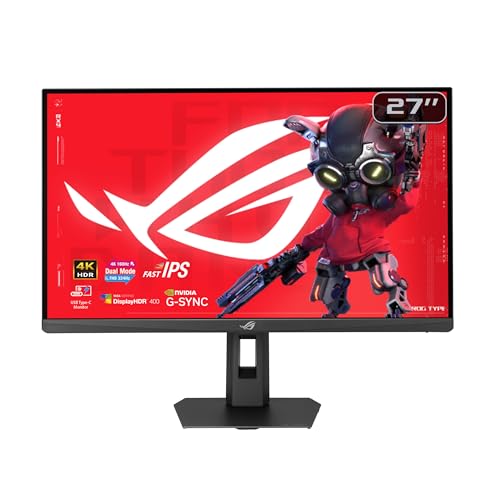
The ASUS ROG XG27UCSR 27 Inch 4K 162Hz USB-C G-SYNC integrates premium processing and connectivity. It utilizes a Fast IPS panel rated for minimum 0.3ms response times to prevent smearing. Dual-mode support enables native 4K at 160Hz or Full HD up to 324Hz for dual-purpose battlestations.
USB Type-C connectivity with DisplayPort Alternate Mode simplifies multi-device cable management. ELMB Sync and 95% DCI-P3 coverage supply consistent color gradations across diverse genres. Users should ensure their desks provide ample depth, as robust ROG stands require moderate clearance on dual-monitor desks.
Samsung 37” Odyssey G7 (G75F) 4K UHD Curved Monitor
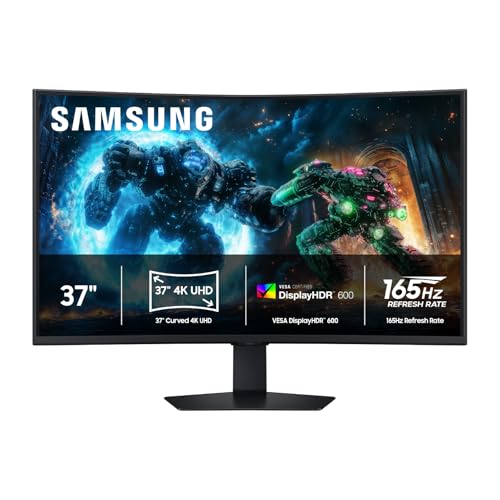
The Samsung 37” Odyssey G7 (G75F) delivers an expansive 16:9 view with an aggressive 1000R curve. The 37-inch panel retains native 3840 x 2160 resolution without introducing aspect ratio distortion on console signals. A 165Hz maximum refresh rate easily accommodates the PS5 120Hz performance ceiling.
DisplayHDR 600 certification brings elevated peak brightness and improved dynamic range over base HDR400 options. The deep 1000R curvature fills peripheral vision effectively during cinematic single-player campaigns. Viewers who sit further away or share their screen with friends might find the tight curve distracting from off-axis angles.
Dell 27 Monitor S2725QS
The Dell 27 Monitor S2725QS, 4K UHD IPS, 120Hz, 5ms provides a refined aesthetic suited for hybrid office and gaming spaces. The 4K IPS panel runs natively up to 120Hz with AMD FreeSync Premium support. It matches the top refresh rate supported by the PlayStation 5 without surplus bandwidth overhead.
Dell equips this unit with a 1500:1 static contrast ratio, which slightly outperforms standard IPS panels in black level retention. Integrated speakers provide baseline audio output without requiring external sound hardware immediately. Its 5ms response time profile is modestly slower than dedicated 1ms Fast IPS competition.
Acer Nitro VG270K L1 4K Gaming Monitor
The Acer Nitro 27in 4K 3840×2160 IPS 72Hz DFR 144Hz offers a budget-conscious entry into high-resolution visuals. In native 4K mode, refresh rates top out at 72Hz, making it ideal for 60Hz fidelity modes on console. Dynamic Frequency and Resolution technology allows 1080p output at 144Hz when prioritize frame rates.
The display covers 95% DCI-P3 color and features a slim ZeroFrame chassis. Gamers seeking native 4K at 120Hz simultaneously will need to step up to HDMI 2.1 displays. For role-playing adventures capped at 30 or 60 frames per second, its resolution clarity remains effective.
Specialty Form Factor Displays: Samsung Odyssey G55C and Ultrawide G7
Alternative monitors like the Samsung 32″ Odyssey (G55C) feature QHD 2560 x 1440 panels rather than true 4K. While the PS5 can output 1440p natively, it lacks the fine pixel density of true Ultra HD. The 1000R curve and 165Hz VA panel provide high contrast at a lower cost threshold.
Similarly, the Samsung 40” Odyssey G7 (G75F) uses a 21:9 ultrawide panel. Because the PS5 does not support ultrawide aspect ratios, images will either show black side bars or appear horizontally stretched. These ultrawide and lower-resolution units serve multi-platform users better than dedicated console players, who can also consider displays compared for budget gaming.
Entry-level high-refresh units like the New! Sceptre Curved 27-inch Prime Gaming Monitor feature 1080p resolution rather than 4K. They prioritize 180Hz refresh speeds for basic desktop tasks over detailed resolution. For genuine PlayStation 5 fidelity, full 3840 x 2160 panels remain the recommended target.
Console Compatibility Comparison Table
| Model | Native Resolution | Max Refresh Rate | Panel Architecture | HDMI 2.1 Console Support |
|---|---|---|---|---|
| ASUS TUF VG27UQ1A | 3840 x 2160 | 160Hz | Fast IPS | Yes (4K 120Hz) |
| Gawfolk 27″ Dual-Mode | 3840 x 2160 | 160Hz | IPS | Yes (4K 120Hz) |
| CUNPU 27″ 4K | 3840 x 2160 | 160Hz | Fast IPS | Yes (4K 120Hz) |
| ASUS ROG XG27UCSR | 3840 x 2160 | 162Hz | Fast IPS | Yes (4K 120Hz) |
| Samsung 37″ Odyssey G7 | 3840 x 2160 | 165Hz | Curved VA | Yes (4K 120Hz) |
| Dell S2725QS | 3840 x 2160 | 120Hz | IPS | Yes (4K 120Hz) |
| Acer Nitro VG270K | 3840 x 2160 | 72Hz (144Hz FHD) | IPS | No (Limited to 60Hz at 4K) |
Frequently Asked Questions
Does the PS5 require HDMI 2.1 for 4K gaming?
The console can display 4K at 60Hz over standard HDMI 2.0 connections. However, playing at 4K 120Hz with variable refresh rate active requires an HDMI 2.1 port. Monitors without HDMI 2.1 will cap frame rates or require dropping the output resolution to 1440p or 1080p.
Can I use an ultrawide gaming monitor with a PlayStation 5?
The PlayStation 5 does not natively support 21:9 ultrawide aspect ratios. When connected to an ultrawide display, the console outputs a standard 16:9 image. The screen will either display black borders on the left and right or stretch the picture horizontally.
Is a 27-inch or 32-inch screen better for 4K console gaming?
A 27-inch 4K monitor provides exceptionally high pixel density around 163 pixels per inch, resulting in very sharp text and edge detail. A 32-inch or 37-inch display offers more visual immersion when sitting further back from a desk. The ideal choice depends on your viewing distance and desk surface area.
Final Recommendation
For dedicated console performance, the ASUS TUF VG27UQ1A and CUNPU 27″ 4K monitors provide the best balance of Fast IPS response times and uncompressed 4K 120Hz HDMI 2.1 bandwidth. Buyers seeking larger curved immersion should evaluate the 16:9 Samsung 37″ Odyssey G7. If you only play story games capped at 60 frames per second, the Acer Nitro VG270K delivers native 4K clarity at a lower barrier to entry.


Write Your Review
No reviews yet. Be the first to share your experience!