

Choosing between compact keyboard layouts often comes down to how much you rely on dedicated arrow keys and navigation clusters. While a standard 65 percent layout retains arrow keys, many players also consider highly programmable 60 percent alternatives that offer custom firmware remapping.
Compact Keyboard Selection for Gaming and Productivity
Downsizing your keyboard frees up valuable desk space for sweeping mouse movements during fast-paced competitive shooters. If you are comparing form factors, you can explore broader models in our guide to the best gaming keyboards.
For users who want maximum desk clearance without sacrificing navigation shortcuts, programmable firmware like QMK or VIA bridges the gap. Layer programming allows you to place navigation keys directly under your home row, providing quick access without expanding the physical footprint.
Featured Compact Option: Womier

Pros
- QMK and VIA programmability across major operating systems
- Versatile tri-mode wireless and wired connectivity
- Hot-swappable sockets support 3-pin and 5-pin switches
- Vibration-dampening gasket mount design
- Dedicated rotary knob on a compact 60% layout
Cons
- Key remapping requires an initial wired connection
- Compact 60% layout lacks dedicated navigation keys
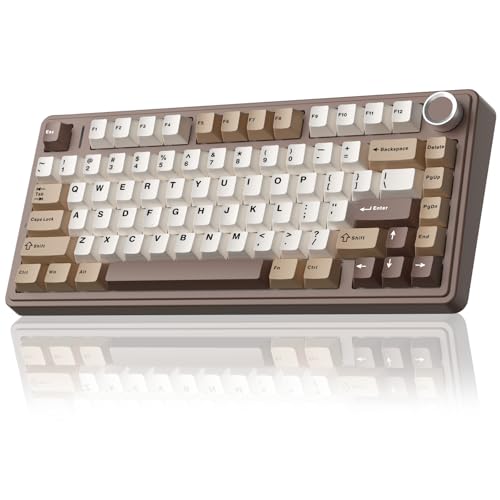
Womier Wireless Gaming Keyboard 60 Percent
The Womier Q61 V2 is built around a compact 60 percent layout featuring a dedicated multi-function rotary knob and open-source QMK and VIA programming support. This open firmware support means you can easily program dedicated arrows and macro layers across macOS, Windows, or Linux systems.
Underneath the dye-sublimation PBT keycaps, the board features pre-installed Womier full POM linear switches paired with a gasket mount dampening structure. If you want to understand how linear actuation compares to other tactile profiles, see our breakdown on mechanical keyboard switches.
Connectivity is handled via tri-mode options including 2.4GHz wireless, Bluetooth multi-device pairing, and USB-C wired connections powered by an integrated 3000mAh battery. The primary limitation to keep in mind is that VIA layer remapping requires an initial wired connection before profiles function wirelessly.
65 Percent vs 60 Percent Layout Considerations
A true 65 percent layout typically includes dedicated physical arrow keys and a vertical column for keys like Delete and Page Up. In contrast, 60 percent keyboards remove these dedicated physical keys to minimize desk width as much as possible for mouse movement.
When using a 60 percent unit with VIA firmware, you can replicate full 65 percent functionality through momentary layer triggers. Users who frequently write code or edit documents often prefer dedicated physical switches, while competitive gamers usually prioritize minimal chassis width.
Pairing a compact board with high-precision peripherals creates a clean aesthetic that pairs seamlessly with the best gaming mice on wide desks. Evaluating your daily typing habits ensures you select a form factor that fits your everyday workflow.
Frequently Asked Questions
Can a 60 percent keyboard replace a 65 percent keyboard?
Yes, provided the keyboard features customizable firmware like QMK or VIA to assign arrow functions to accessible secondary layers. However, users who require physical arrow keys without pressing a modifier key will still be better served by a native 65 percent board.
What are the benefits of hot-swappable switch sockets?
Hot-swappable sockets support both 3-pin and 5-pin mechanical switches without requiring any soldering tools. This design allows you to experiment with different switch weights, acoustics, and tactile responses whenever you want to upgrade your hardware.




Write Your Review
No reviews yet. Be the first to share your experience!