

Connecting a PlayStation 5 or Xbox Series X to a desktop display requires careful attention to video interfaces and refresh rates. While high-resolution gaming was once reserved for televisions, current desktop screens deliver native 3840×2160 panels paired with refresh rates of 120Hz or higher. Choosing among the best 4k monitors for console gaming comes down to verifying HDMI 2.1 support, panel technology, and refresh rate headroom.

Pros
- Sharp 4K resolution paired with 160Hz refresh rate
- Fast IPS panel offers a 1ms response time
- HDMI 2.1 enables 4K 120Hz console gaming
- NVIDIA G-SYNC Compatible and AMD FreeSync Premium support
- Wide 95% DCI-P3 color gamut coverage

Pros
- Sharp QHD resolution across a spacious 32-inch display
- Fluid 165Hz refresh rate reduces visual lag
- Immersive 1000R curvature fills peripheral vision
- AMD Radeon FreeSync eliminates screen tearing
- Built-in Eye Saver and flicker-reduction modes

Pros
- Dual-mode support for 4K 72Hz or 1080p 144Hz
- Wide 95% DCI-P3 color gamut coverage
- AMD FreeSync tear-free gaming support
- VESA 100x100mm mounting compatibility
- Slim ZeroFrame bezels for multi-monitor setups
Cons
- 4K resolution capped at 72Hz refresh rate
- Stand only supports tilt adjustments
- HDMI inputs limited to version 2.0

Pros
- High 180Hz refresh rate across all inputs
- Extensive connectivity with four total display ports
- Immersive 1500R curved screen design
- Full 100% sRGB color gamut coverage
- Built-in stereo speakers save desk space
Cons
- Advertised 1ms response relies on blur reduction
- Peak 180Hz refresh rate requires an overclocked setting

Pros
- Sharp 4K UHD resolution on a large 32-inch canvas
- Smooth 120Hz refresh rate with AMD FreeSync Premium
- Wide 95% DCI-P3 and 99% sRGB color coverage
- Built-in ComfortView Plus low blue light filtering
- Upgraded integrated speakers with expanded audio range
Cons
- Modest 1500:1 contrast ratio for a VA panel
- Basic HDR ready support without high peak brightness ratings
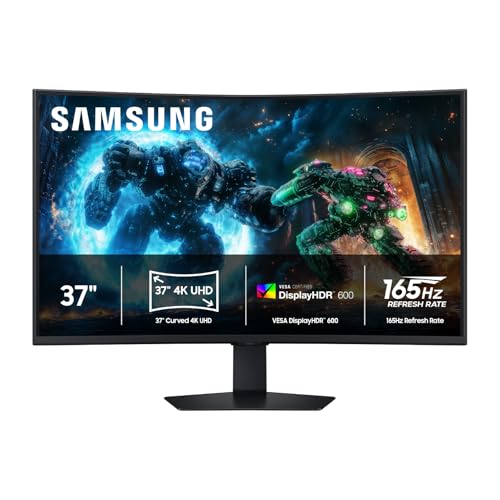
Pros
- Sharp 4K UHD resolution across a large 37-inch screen
- Fluid 165Hz refresh rate for fast-paced gaming
- Rapid 1ms GtG response time reduces motion blur
- Immersive 1000R curved profile
- VESA DisplayHDR 600 delivers enhanced dynamic range
Cons
- Deep 12-inch footprint requires considerable desk space
- Substantial 24.7-pound weight requires a sturdy mounting surface

Pros
- Crisp 4K UHD resolution on an IPS panel
- Smooth 120Hz refresh rate with AMD FreeSync Premium
- Solid 1500:1 contrast ratio with 99% sRGB coverage
- Hardware-level ComfortView Plus low blue light technology
- Integrated upgraded stereo sound

Pros
- Dual-mode refresh rates up to 320Hz at 1080p
- Sharp 4K UHD IPS panel
- AMD FreeSync Premium adaptive sync support
- Modern dual HDMI 2.1 and DisplayPort 1.4 connectivity
- VESA 100 x 100mm wall mount compatibility
Cons
- Stand adjustment is limited to tilt only
- Basic HDR10 support without local dimming specifications

Pros
- Sharp 4K UHD resolution with smooth 160Hz refresh rate
- Deep 3000:1 static contrast ratio
- AMD FreeSync reduces visual stutter and tearing
- Modern HDMI 2.1 and DisplayPort 1.4 connectivity
- Immersive 1500R curvature
Cons
- Modest 320 cd/m² peak brightness rating
- Uses smaller 75x75mm VESA mount instead of standard 100x100mm
- Stand ergonomic adjustments are not documented

Pros
- Fast refresh rate reaching up to 144Hz
- Includes DisplayPort and HDMI connection options
- Thin bezels ideal for dual-display setups
- Built-in speakers preserve physical desk space
- Blue-Light Shift feature for eye comfort
Cons
- Compact 22-inch screen limits total viewing real estate
Console Gaming Specification Comparison
| Monitor Model | Screen Size | Native Resolution | Max Refresh Rate | Panel Type |
|---|---|---|---|---|
| ASUS TUF Gaming VG27UQ1A | 27 inches | 3840 x 2160 | 160Hz (120Hz Console) | Fast IPS |
| Samsung Odyssey G7 (G75F) | 37 inches | 3840 x 2160 | 165Hz | Curved VA |
| Dell S3225QS | 32 inches | 3840 x 2160 | 120Hz | VA |
| Dell S2725QS | 27 inches | 3840 x 2160 | 120Hz | IPS |
| Acer Nitro VG270K V4 | 27 inches | 3840 x 2160 | 160Hz | IPS |
| CRUA 32″ Curved | 32 inches | 3840 x 2160 | 160Hz | Curved (1500R) |
| Acer Nitro VG270K L1 | 27 inches | 3840 x 2160 | 72Hz (144Hz at 1080p) | IPS |
| Samsung Odyssey G55C | 32 inches | 2560 x 1440 (QHD) | 165Hz | Curved VA |
| Sceptre C275B-FW180T | 27 inches | 1920 x 1080 (FHD) | 180Hz | Curved |
| Sceptre E225W-FW144 | 22 inches | 1920 x 1080 (FHD) | 144Hz | Flat |
Key Hardware Evaluations
1. ASUS TUF Gaming VG27UQ1A
The ASUS TUF Gaming VG27UQ1A 27 Inch 4K 160Hz G-SYNC is engineered specifically to address modern console specifications. Its HDMI 2.1 inputs support uncompressed 4K visuals at 120Hz without subsampling, delivering the exact signal target required by modern consoles. The Fast IPS panel produces a 1ms response time alongside 95 percent DCI-P3 color gamut coverage, making it suitable for competitive multiplayer titles where motion clarity is critical.
2. Samsung 37” Odyssey G7 (G75F)
Offering an expansive 37-inch display footprint, the Samsung 37” Odyssey G7 (G75F) delivers an immersive 1000R curvature matched with native 4K resolution. It features VESA DisplayHDR 600 certification, which ensures higher peak brightness and better specular highlights than basic entry-level HDR monitors. The 165Hz ceiling provides plenty of room for variable refresh rate smoothing, though its aggressive curve requires a deeper desktop surface.
3. Dell 32 Monitor S3225QS
The Dell 32 Monitor S3225QS, 4K UHD VA, 120Hz combines a generous 32-inch screen with a VA panel boasting a 1500:1 static contrast ratio. Because consoles top out at 120Hz output, this monitor matches console hardware limitations without charging a premium for unused 240Hz capabilities. The deep black levels of the VA panel work well for dimly lit gaming rooms, though viewing angles are narrower than IPS alternatives.
4. Dell 27 Monitor S2725QS
For players working with standard desk dimensions, the Dell 27 Monitor S2725QS, 4K UHD IPS, 120Hz, 5ms provides sharp pixel density across a 27-inch IPS panel. It runs smoothly at up to 120Hz with AMD FreeSync Premium synchronization to prevent screen tearing during fluctuating frame rates. While the IPS structure provides consistent viewing angles, its modest 5ms baseline response time is geared more toward general gaming than tournament shooters.
5. Acer Nitro 27in VG270K V4
The Acer Nitro 27in 4K 3840×2160 IPS 160Hz DFR 320Hz introduces dual-frame rate technology alongside native 4K 160Hz playback. Console players gain native 3840×2160 image fidelity for cinematic games, while hybrid players connected to a PC can switch to lower resolutions for higher frame rates. Its IPS panel covers 90 percent of the DCI-P3 color space, providing dependable color accuracy straight out of the box.
6. CRUA 32″ 4K UHD Curved Gaming Monitor
The CRUA 32″ 4K UHD 160Hz Curved Gaming Monitor provides a 1500R curved profile alongside native HDMI 2.1 connectivity. Its high static contrast ratio of 3000:1 generates strong contrast in shadow regions, which helps open-world adventure titles look striking. Integrated speakers allow direct audio without external hardware, though dedicated audio gear remains recommended for competitive sound positioning.
7. Acer Nitro 27in VG270K L1
Budget-minded players who primarily play story-driven games locked at 30 or 60 frames per second can evaluate the Acer Nitro 27in 4K 3840×2160 IPS 72Hz DFR 144Hz. It renders native 4K resolution up to 72Hz, meaning it can handle standard 60Hz console modes comfortably. However, it cannot display 120Hz performance modes at 4K resolution, making it unsuitable for competitive console titles targeting triple-digit frame rates.
Important Clarifications on Resolution Mismatches
When searching for the best 4k monitors for console gaming, retail listings occasionally group lower-resolution models alongside true 4K panels. The Samsung 32″ Odyssey (G55C) features a 2560×1440 QHD panel rather than 4K, which scales cleanly on current consoles but lacks full UHD resolution. Similarly, the New! Sceptre Curved 27-inch Prime Gaming Monitor and Sceptre New 22-Inch Gaming Monitor, FHD 1080p are strictly 1080p displays. Buyers seeking native 3840×2160 rendering should exclude 1080p models entirely.
Essential Buying Criteria for Console Monitors
Achieving optimal visual results from modern consoles requires matching three hardware specifications between your display and console port.
- HDMI 2.1 Bandwidth: To deliver 4K resolution at 120Hz with uncompressed color, an HDMI 2.1 port is mandatory. HDMI 2.0 ports top out at 4K at 60Hz or require color subsampling.
- Variable Refresh Rate (VRR): Both Xbox Series X and PlayStation 5 support VRR over HDMI to eliminate screen tearing during intensive sequences. Displays with AMD FreeSync Premium or documented HDMI VRR support maintain smoother output when frame rates fluctuate.
- Panel Selection (IPS vs. VA): IPS panels provide wider viewing angles and rapid response times that reduce ghosting. VA panels provide superior static contrast ratios, which create deeper blacks in dark rooms.
Audio is another frequent limitation of desktop screens. Built-in monitor speakers tend to sound thin, so pairing your station with one of the best gaming headsets provides far better spatial immersion and chat communication. If you are also assembling a complete gaming corner from scratch, our guide on how to build a battlestation on a budget covers desk ergonomics and cable organization.
Frequently Asked Questions
Do I need HDMI 2.1 for 4K console gaming?
HDMI 2.1 is strictly required if you wish to run supported games at 4K resolution with a 120Hz refresh rate. An HDMI 2.0 connection is sufficient if you only play cinematic titles locked at 60Hz or 30Hz.
Can I use an ultrawide monitor with a game console?
Consoles only output in standard 16:9 aspect ratios like 1920×1080, 2560×1440, and 3840×2160. Connecting a console to an ultrawide screen will result in black bars on the sides or a stretched image, making standard 16:9 displays the correct choice.
Is a 27-inch or 32-inch screen better for 4K gaming?
A 27-inch 4K screen offers remarkably sharp pixel density at normal desktop viewing distances. A 32-inch or 37-inch screen provides greater visual scale and immersion if you sit slightly farther back or recline while holding a controller.
Final Recommendation
For dedicated console players wanting seamless 4K 120Hz functionality, the ASUS TUF Gaming VG27UQ1A 27 Inch 4K 160Hz G-SYNC represents the most complete technical package among the 27-inch models. If you prefer larger screen real estate and high contrast for single-player gaming, the Samsung 37” Odyssey G7 (G75F) and Dell 32 Monitor S3225QS, 4K UHD VA, 120Hz deliver expansive 4K presentation matched to console hardware output.


Write Your Review
No reviews yet. Be the first to share your experience!