

Choosing the best computer speakers for gaming depends on desktop clearance, audio interface preferences, and whether you need dedicated stereo separation or a compact soundbar. While gaming headsets offer direct isolation, desktop audio systems deliver a comfortable listening environment for long campaigns and casual play.
The 6 models highlighted below cover standard 2.0 bookshelf arrangements, unified soundbars, and hybrid designs. Readers building out a clean desk layout can pair these audio choices with our guide on how to build the ultimate battlestation on a budget to organize wiring and monitor clearance.
Quick Comparison: Top Gaming Speakers

Pros
- Convertible design switches between satellite and soundbar setups
- Simple plug-and-play installation with no drivers required
- Touch control makes switching lighting modes effortless
- Dedicated knob provides smooth volume and power control
- Generous cable lengths accommodate wider desk layouts
Cons
- Requires both USB power and 3.5mm audio cables
- Lacks Bluetooth or other wireless connectivity options
- Modest 10W total output limits volume in larger spaces

Pros
- Compact form factor fits under computer monitors
- Dedicated top volume knob for easy control
- One-touch ambient lighting toggle
- Driver-free plug-and-play operation
- Includes USB-C adapter for broader connectivity
Cons
- Lacks Bluetooth wireless audio support
- No built-in microphone or headphone port
- Not compatible with televisions
Pros
- Compact footprint fits underneath most desktop displays
- Convenient physical volume knob with integrated power switch
- Audio-synced RGB lighting with multiple display modes
- Simple plug-and-play setup requires no dedicated software
Cons
- Requires both USB power and 3.5mm audio connections
- No documented Bluetooth or wireless audio support
Pros
- Touch-controlled RGB lighting with an off setting
- Dedicated physical volume adjustment buttons
- Universal 3.5mm audio and USB power connection
- Compact footprint fits smaller workspaces
Cons
- 31-inch inter-speaker cable restricts wide desk separation
- Requires both USB and 3.5mm ports for operation

Pros
- Single USB-C cable handles audio and power
- Compact design fits easily under monitors
- Dual full-range drivers with passive radiators
- Bluetooth 5.0 for low-latency wireless pairing
- Customizable 14-zone Razer Chroma RGB lighting
Cons
- Not water-resistant
- Requires a USB Type-C port for PC connectivity
Pros
- Versatile USB, Bluetooth, and 3.5mm AUX connectivity
- Dedicated subwoofer output port for audio expansion
- Compact angled design directs audio toward the listener
- Built-in EQ presets for gaming, music, and movies
Cons
- External subwoofer required for full low-frequency extension
- Modest 16W RMS output limits peak volume
Detailed Product Breakdown
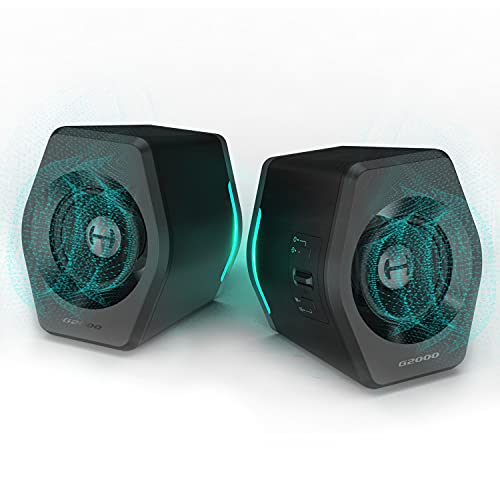
Edifier G2000 32W PC Gaming Computer Speakers
The Edifier G2000 32W PC Gaming Computer Speakers deliver 16W RMS output with 32W peak power using 2.75-inch full-range drivers. They feature an isometric cavity with a backward bass port and a built-in 10-degree upward tilt, aiming sound directly toward ear level from a standard desk surface.
Connectivity options are versatile, offering USB sound card input, 3.5mm auxiliary, and Bluetooth pairing. Edifier also includes a dedicated subwoofer output interface, giving users a direct hardware upgrade path for low-end bass extension. The primary trade-off is the relatively deep desktop footprint compared to slim under-monitor bars.
Razer Leviathan V2 X, PC Soundbar with Full-Range
The Razer Leviathan V2 X, PC Soundbar with Full-Range is designed specifically to tuck beneath low-clearance displays, pairing well with setups running modern ultrawide monitors where side desk space is restricted. It houses two full-range drivers and two passive radiators to generate balanced audio without an external sub enclosure.
A single USB Type-C cable handles both audio delivery and system power, cutting down on peripheral cable mess. Wireless switching is available through Bluetooth 5.0 for mobile devices. Users should note that this unit relies purely on USB-C or Bluetooth, omitting legacy 3.5mm analog inputs entirely.
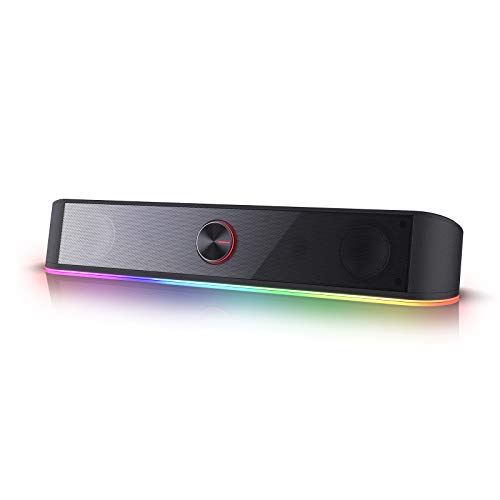
Redragon GS560 RGB Desktop Soundbar
The Redragon GS560 RGB Desktop Soundbar features a 16-inch wide chassis that fits neatly beneath flat panels, including standard displays seen in our roundup of 1440p gaming monitors. It combines a clean front profile with audio-syncing RGB illumination and a combined power and volume dial.
It utilizes standard USB for power and a 3.5mm auxiliary jack for analog signals, making it plug-and-play across PCs, consoles, and laptops. While the unified housing keeps desk corners clear, it does not provide the broad left-to-right stereo staging achievable with separated stereo units.
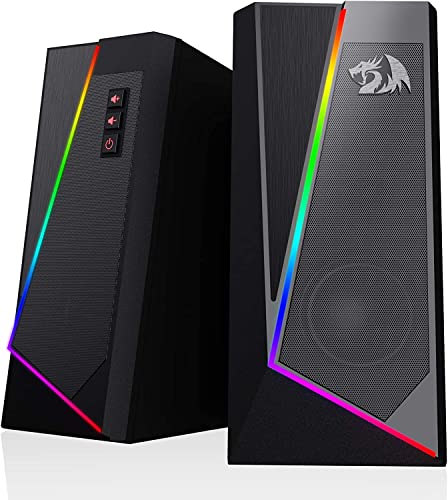
Redragon GS520 Wired 2.0 Channel Stereo Sound
The Redragon GS520 Wired 2.0 Channel Stereo Sound speakers feature a conventional two-piece satellite format. With up to 31 inches of inter-speaker cable, you can space them across monitor flanks to improve directional audio separation in competitive titles.
Touch-controlled lighting modes along the bottom rim offer customizable visual effects, while independent front-facing volume buttons allow fast adjustments. However, the fixed tether length between the two satellites limits ultra-wide desk deployments.
Computer Speakers, 2 in 1 PC Speaker
The Computer Speakers, 2 in 1 PC Speaker from OFFSIR features a convertible interlocking mechanism. It functions either as two separated 2.0 stereo towers or splices together directly into a unified horizontal soundbar configuration.
Dual 5W drivers provide basic desktop audio output, powered through standard USB with 3.5mm analog input. It includes a 52-inch connecting cable between units and an analog rotary knob. The structural splice point provides flexibility, though the lightweight plastic casing offers modest acoustic damping.
LENRUE G11 Computer Speakers for Desktop
The LENRUE G11 Computer Speakers for Desktop presents a low-profile single-chassis layout powered via USB or an included USB-C adapter. It employs four internal horn amplifiers to project sound forward without occupying dedicated floor or shelf space.
A top-mounted rotary knob controls volume, while a capacitive sensor toggles decorative lighting effects. Connectivity is strictly limited to 3.5mm auxiliary input, lacking Bluetooth wireless capabilities and dedicated headphone passthrough ports.
Key Factors When Choosing Gaming Speakers
Selecting between desktop audio formats requires matching physical dimensions and acoustic properties to your playstyle. Consider these fundamental hardware factors before deciding:
- Form Factor and Soundstage: Separated 2.0 speakers offer superior positional accuracy by letting you establish an equilateral triangle with your seating position. Soundbars conserve footprint by resting directly beneath the screen, which benefits compact surfaces at the expense of wider channel width.
- Power Delivery and Connectivity: USB-powered units simplify cable routing by drawing electricity straight from motherboard ports. Higher-output models with dedicated DSP or multi-input options like the Edifier G2000 require sufficient port bandwidth or independent power circuits.
- Driver Layout and Low-End Response: Compact drivers struggle to reproduce frequencies below 80 Hz without passive radiators or external subwoofers. If cinematic rumble is essential, look for soundbars with passive diaphragms or speakers equipped with dedicated sub-out terminals.
Frequently Asked Questions
Are desktop soundbars better than 2.0 stereo speaker pairs for gaming?
Soundbars excel at minimizing desk clutter and fitting beneath monitor panels. However, two separate desktop speakers allow wider physical separation, which creates superior left-and-right positional cues for competitive shooters.
Can USB-powered speakers draw adequate volume from a PC?
Standard USB ports supply enough wattage for nearfield listening at a standard computer desk. For higher dynamic peaks without audio distortion, speakers utilizing dedicated high-power Type-C feeds or external power bricks are recommended.
Do I need an external subwoofer for PC gaming?
An external subwoofer is not required for distinct gaming audio or clear team chat. It becomes advantageous if you want deep, physical low-end rumble during explosions and cinematic action scenes.



Write Your Review
No reviews yet. Be the first to share your experience!