

Reaching a 240Hz refresh rate gives competitive PC players noticeably fluid tracking and reduced display latency. To get the actual benefit of that speed, the monitor must feature fast pixel response times and an appropriate resolution for your graphics hardware. A display cannot deliver true motion clarity if its panel suffers from heavy ghosting or smears dark pixels.
Choosing between 1080p, 1440p, Fast IPS, VA, and OLED represents the core decision when browsing high-refresh panels. Competitive esports titles often pair well with compact 1080p screens, while general gaming setups gain visual sharpness from a 1440p panel. You can learn more about balancing resolution and hardware loads in our guide to the best 1440p gaming monitors.
Quick Recommendation Summary
Competitive esports players who prioritize frame rates and low input lag should focus on Fast IPS options like the ASUS TUF VG279QM5A or the compact Dell SE2426HG. If you want crisp Quad HD detail alongside esports motion clarity, the AOC Q27G41ZE and Acer Nitro XV272U offer excellent 1440p performance without sacrificing panel speed.
For enthusiasts seeking near-instantaneous response times and deep contrast, the Samsung Odyssey OLED G6 provides true per-pixel dimming and pristine motion handling. Gamers on tighter budgets who prefer curved immersive screens can consider high-contrast VA alternatives from Sceptre and SANSUI, keeping in mind that VA panels generally exhibit more dark-level motion trailing than Fast IPS or OLED displays.
Top 240Hz Monitors for Gaming
Pros
- High 240Hz refresh rate for fluid gameplay
- Immersive 1500R curved VA panel design
- Versatile connectivity with two HDMI and two DisplayPort connections
- Built-in speakers save desktop space
Cons
- 1080p resolution provides lower pixel density at 27 inches
- Integrated speakers offer modest audio output

Pros
- Fast 240Hz refresh rate for fluid gameplay
- High 4000:1 static contrast ratio
- Immersive 1500R curved display
- FreeSync adaptive sync support
- Wide 130% sRGB color gamut
Cons
- 1080p resolution yields lower pixel density at 27 inches
- Stand provides tilt adjustment only
- No built-in audio speakers
Pros
- Fluid 240Hz refresh rate
- G-Sync and FreeSync Premium adaptive sync support
- ELMB Sync combines blur reduction with variable refresh rates
- Fast IPS panel with 99% sRGB color coverage
- Comprehensive 3-year manufacturer warranty
Cons
- 1080p resolution yields lower pixel density at 27 inches

Pros
- Smooth 240Hz refresh rate via DisplayPort and HDMI
- Immersive 1500R curved 32-inch screen
- High 3500:1 contrast ratio
- Built-in FreeSync support
- DisplayPort cable included in the box
Cons
- Low pixel density with 1080p at 32 inches
- No integrated speakers
- Stand adjustment limited strictly to tilt

Pros
- Sharp 1440p QHD IPS panel
- High 240Hz refresh rate over DisplayPort
- Adaptive-Sync support for tear-free visuals
- Low 0.3ms MPRT response time
- Sleek three-sided frameless bezels
Cons
- Stand only supports tilt adjustments
- HDMI connectivity limited to version 2.0
- Modest 300-nit peak brightness rating

Pros
- Fluid 240Hz refresh rate for competitive play
- Fast IPS panel with 99% sRGB coverage
- AMD FreeSync Premium and HDMI VRR support
- DisplayPort 1.4 and dual HDMI connectivity
- TÜV Rheinland 3-star eye comfort certification
Cons
- Stand adjustment is limited to tilt only
- Limited to 1080p Full HD resolution

Pros
- Fast 240Hz refresh rate via DisplayPort
- Sharp 1440p resolution on an IPS panel
- Versatile stand with full ergonomic adjustments
- AMD FreeSync Premium support reduces tearing
- Includes both DisplayPort and HDMI cables
Cons
- Refresh rate capped at 144Hz over HDMI
- Integrated two-watt speakers provide basic audio output
Pros
- High 240Hz refresh rate for fluid motion
- Fast IPS panel with wide viewing angles
- AMD FreeSync Premium and HDMI VRR support
- Dual HDMI and DisplayPort connectivity options
Cons
- 1080p resolution provides lower pixel density at 27 inches
- Stand adjustment is limited to tilt only

Pros
- High 240Hz refresh rate for fluid motion
- Fast IPS panel provides wide viewing angles
- Adaptive Sync prevents visual screen tearing
- DisplayPort 1.4 and HDMI 2.0 inputs
- Standard 100x100 mm VESA mounting support
Cons
- Stand lacks height, swivel, and pivot adjustments
- Standard 1000:1 contrast limits true HDR dynamic range

Pros
- Rapid 240Hz refresh rate with 0.03ms response time
- Vibrant QD-OLED panel with Pantone Validated color accuracy
- Glare Free surface treatment minimizes ambient reflections
- OLED Safeguard thermal modulation helps mitigate burn-in risk
- Fully adjustable stand with height, swivel, tilt, and pivot
Detailed Product Breakdown
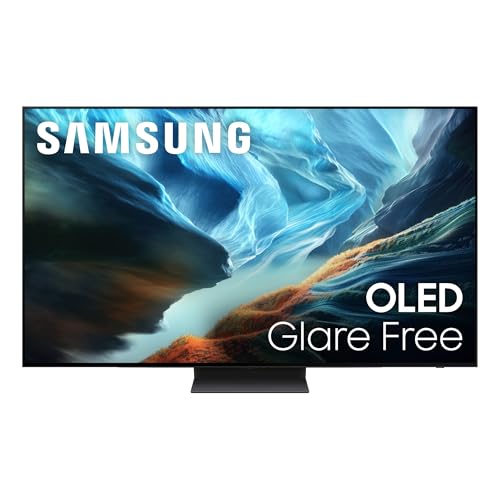
Samsung 27″ Odyssey OLED G6 (G61SH) QD-OLED
The Samsung 27″ Odyssey OLED G6 (G61SH) QD-OLED is designed for players who want top-tier motion performance combined with deep contrast. Its 2560×1440 QD-OLED panel features an advertised 0.03ms response time, essentially removing the motion smear common on LCD screens. The stand also includes comprehensive ergonomic adjustments, featuring height, swivel, pivot, and tilt.
Because it uses self-lit pixels, black levels remain pure with zero backlight bleed. However, OLED panels carry a static image burn-in risk over extended periods of non-gaming desktop usage. Samsung includes its OLED Safeguard thermal management to mitigate this, but prospective buyers should still avoid static desktop elements running continuously.
AOC 27″ Gaming Monitor QHD (Q27G41ZE)
The AOC 27″ Gaming Monitor QHD 260Hz Overclocked IPS combines a 2560×1440 resolution with a base 240Hz refresh rate over DisplayPort 1.4, which can be overclocked to 260Hz. Its IPS panel maintains 300 nits of brightness and wide viewing angles, making it a well-rounded pick for mixed use. The unit supports Adaptive-Sync across both AMD and NVIDIA graphics cards.
Running 1440p at 240Hz requires a capable GPU to reach matching frame rates in modern titles. Make sure your desktop rig, such as one of the options highlighted in our best prebuilt gaming PCs, possesses adequate graphic bandwidth. Note that the included stand supports tilt only, so you will need a separate VESA arm for height adjustment.
Acer Nitro 27in QHD IPS 240Hz (XV272U W2bmiiprx)
The MONITOR Acer Nitro 27in QHD 2560×1440 IPS 240Hz provides a balanced combination of 1440p clarity and an adaptable Ergostand. The display delivers its full 240Hz refresh rate via DisplayPort 1.4, with a stated 0.5ms to 1ms gray-to-gray response time. Its stand allows full height adjustment, 360-degree swivel, pivot, and tilt out of the box.
Connectivity is versatile with one DisplayPort and two HDMI 2.0 inputs, along with integrated two-watt basic speakers. Keep in mind that HDMI 2.0 limits maximum output to 144Hz at 1440p on this model. PC players looking for the full 240Hz signal must connect through the DisplayPort output.
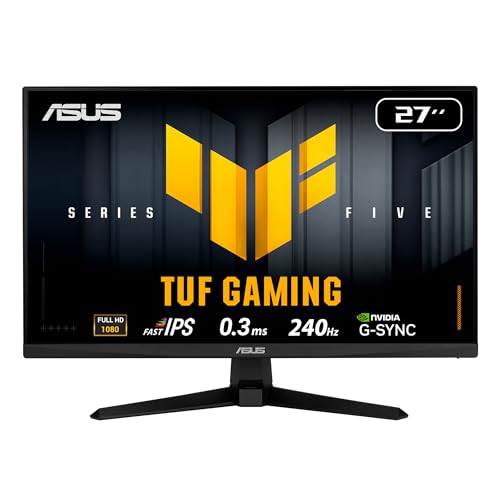
ASUS TUF VG279QM5A 27 Inch Fast IPS
The ASUS TUF VG279QM5A 27 Inch 1080p 240Hz Fast IPS is aimed squarely at competitive first-person shooters. It features a Full HD Fast IPS panel with an advertised minimum response time of 0.3ms. ASUS integrates ELMB SYNC technology, allowing backlight strobing to operate simultaneously with variable refresh rate for reduced motion blur.
The monitor is certified for both FreeSync Premium and G-Sync compatibility, preventing tearing during frame dips. While 1080p resolution keeps frame rates high, stretching that pixel count over a 27-inch diagonal results in lower pixel density. Users who sit close to their desk will notice individual pixels more readily than on a 24-inch panel.
Dell 24 240Hz Gaming Monitor (SE2426HG)
The Dell 24 240Hz Gaming Monitor – SE2426HG provides a compact 23.8-inch footprint favored by dedicated esports competitors. At 1920×1080, this smaller screen size yields crisp pixel density and makes tracking entire scenes effortless without excess head movement. It uses a Fast IPS panel with 99% sRGB coverage and an advertised 0.5ms response time.
It supports AMD FreeSync Premium alongside HDMI VRR across its two HDMI ports and single DisplayPort 1.4 connection. The stand features basic tilt adjustment without height or swivel options. Buyers building a cleaner desk arrangement can review our budget battlestation guide to plan an aftermarket VESA mount setup.
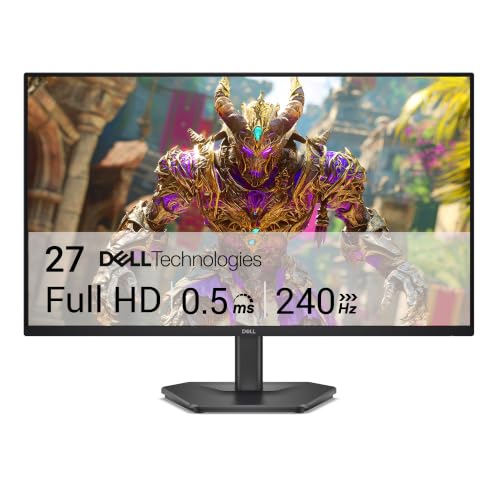
Dell 27 240Hz Gaming Monitor (SE2726HG)
The Dell 27 240Hz Gaming Monitor – SE2726HG shares the internal hardware profile of the smaller 24-inch variant on an enlarged 27-inch canvas. It features Fast IPS panel technology, a 0.5ms response rating, and AMD FreeSync Premium. The display also carries a TÜV Rheinland 3-star eye comfort rating to help reduce blue light emissions during long play sessions.
This display suits players who sit farther back from their desk and want larger in-game target models. However, retaining a 1080p resolution across 27 inches means fine text and desktop icons appear less sharp. Like its sibling, the factory stand only offers tilt adjustments from front to back.
KTC 24.5 Inch 240Hz Gaming Monitor (H25T7-A)
The KTC 24.5 Inch 240Hz Gaming Monitor is built on the classic competitive 24.5-inch Fast IPS form factor. It delivers a 1080p resolution, 1ms MPRT, and 114% sRGB color gamut coverage. Adaptive Sync support ensures stable frame pacing across both modern consoles and PC setups via DisplayPort 1.4 and HDMI 2.0.
The monitor includes flicker-free backlighting and low blue light presets for reduced eye fatigue during marathon sessions. Contrast is typical for an IPS panel at 1000:1, meaning black tones will look dark gray in a fully dim room. It supports tilt adjustments and standard 100x100mm VESA mounting.
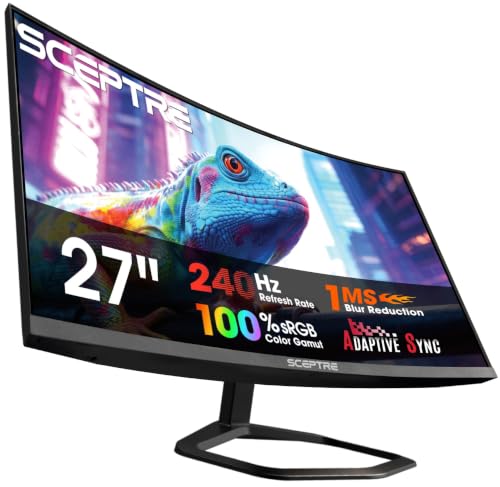
Sceptre 27-Inch Curved Gaming Monitor (C275B-FWT240)
The Sceptre 27-Inch Curved Gaming Monitor, FHD 1080p utilizes a 1500R curved VA panel with a 1080p native resolution. VA technology inherently delivers deeper blacks than standard IPS screens, making it comfortable for cinematic gaming in dark rooms. The monitor features two DisplayPort and two HDMI connections, all capable of 240Hz input.
Sceptre also integrates built-in desktop speakers, providing convenience for general audio alerts without separate desk peripherals. While rated at 1ms response time, VA panels are inherently susceptible to dark smearing during high-speed transitions. Players dedicated purely to twitch shooters may prefer a Fast IPS equivalent.
SANSUI 27 Inch Curved 240Hz Gaming Monitor FHD
The SANSUI 27 Inch Curved 240Hz Gaming Monitor FHD features a 1500R curved VA screen delivering a high 4000:1 static contrast ratio. It covers 130% of the sRGB color space and 95% DCI-P3 for saturated, punchy visuals. Gaming utilities include built-in FreeSync support, shadow boost adjustments, and hardware crosshair overlays.
The unit features a durable metal stand with tilt range between -5 and 15 degrees, alongside 100x100mm VESA compatibility. There are no integrated speakers, though an audio jack is provided for external headphones or desktop audio systems. The 1080p resolution on a 27-inch surface remains best viewed from at least an arm’s length away.
SANSUI 32 Inch Curved 240Hz Gaming Monitor
The SANSUI 32 Inch Curved 240Hz Gaming Monitor expands the 240Hz refresh rate onto a massive 32-inch 1500R curved display. Its VA panel produces a 3500:1 contrast ratio with 300 nits of brightness and 125% sRGB coverage. FreeSync support, anti-flicker circuitry, and low blue light modes are built directly into the firmware.
Because the panel uses a 1920×1080 resolution on a large 32-inch screen, pixel pitch is visibly coarse. SANSUI explicitly recommends a viewing distance of roughly 1.2 meters to minimize visible pixelation. This model is best suited for flight simulators or casual controller gaming where users sit well back from the desk.
Key Factors When Choosing a 240Hz Monitor
Selecting the best 240hz monitors for gaming requires balancing panel chemistry, screen size, resolution, and video port specifications. Each factor directly impacts in-game motion clarity and system compatibility.
Panel Types: Fast IPS vs. VA vs. OLED
Fast IPS panels remain the standard recommendation for esports. They offer consistent color accuracy, wide 178-degree viewing angles, and swift pixel transitions that keep motion clean. In contrast, VA panels offer superior static contrast ratios (often 3000:1 to 4000:1), creating deeper blacks, but they usually exhibit dark-level trailing in fast motion.
OLED displays eliminate liquid crystals entirely, allowing each individual pixel to switch states nearly instantly. This provides unmatched motion clarity and infinite contrast. However, OLED monitors carry higher price points and demand mindful usage to avoid potential image retention.
Resolution and GPU Overhead
A 240Hz refresh rate only yields fluid motion if your graphics card can render frames near that ceiling. At 1080p, midrange GPUs can easily reach 200+ FPS in competitive titles like Valorant, Overwatch, and CS2. Running a 1440p panel at 240Hz demands significantly more graphical processing power, especially in heavier modern games.
Port Standards and Bandwidth
Not all video inputs support maximum refresh rates. Many monitors include DisplayPort 1.4 alongside HDMI 2.0 ports. In several 1440p displays, the HDMI 2.0 connection is bandwidth-capped at 144Hz, requiring the DisplayPort connection to unlock the full 240Hz signal. Always verify which port standard provides the top refresh rate before connecting your PC.
Frequently Asked Questions
Is 240Hz noticeably better than 144Hz?
Moving from 144Hz to 240Hz reduces frame time intervals from 6.94ms down to 4.16ms. While the jump is less dramatic than moving from 60Hz to 144Hz, competitive gamers will notice smoother camera tracking and a more connected feel during fast mouse movements.
Does a 240Hz monitor improve aiming accuracy?
Higher refresh rates lower total system latency and reduce visual tearing, making moving targets easier to track visually. However, monitor refresh rate alone will not replace mechanical aiming skill or stable network latency.
Can I run 240Hz on HDMI cables?
At 1080p, HDMI 2.0 generally supports 240Hz if the monitor manufacturer enables it in the firmware. For 1440p resolutions, HDMI 2.0 is restricted to 144Hz, requiring either HDMI 2.1 or DisplayPort 1.4 to transmit a 240Hz signal.




Write Your Review
No reviews yet. Be the first to share your experience!