

Connecting a PlayStation 5 to a modern display requires specific hardware specifications to unlock high frame rates and HDR. A compatible television must support HDMI 2.1 bandwidth, Auto Low Latency Mode, and Variable Refresh Rate. Without these features, the console defaults to standard 60Hz output.
Essential Display and Hardware for PS5 Gaming

Pros
- Official HDMI 2.1 certified with scannable QR verification
- Supports 48Gbps bandwidth for 4K 144Hz gaming
- Reinforced double-layer braided jacket for durability
- Includes eARC support for Dolby Atmos audio
- Backward compatible with older HDMI display standards
Cons
- Fixed 6.6-foot length restricts longer entertainment center setups
- Requires source hardware and software support for high refresh rates

Pros
- Official 48Gbps Ultra High Speed HDMI certification
- Supports up to 4K at 240Hz and 8K at 60Hz
- Enables key console gaming features like VRR and ALLM
- Full eARC support for high-bitrate surround sound audio
Cons
- Fixed 6.6-foot length limits placement options in larger rooms
- Higher resolutions such as 10K require DSC 1.2a compression

Pros
- Dual 2.4 GHz and Bluetooth 5.4 wireless connections
- Lightweight 239-gram ergonomic construction
- Long battery life rated up to 45 hours
- USB-C fast charging supports play while charging
- Versatile 4-in-1 connection options
Cons
- Bluetooth mode is incompatible with PS4 and PS5
- Xbox Series X/S functionality requires wired 3.5 mm connection
- Older Xbox console models are not supported

Pros
- Native 144Hz MiniLED panel with local dimming
- FreeSync Premium Pro and Dolby Vision Gaming support
- Integrated 50W 2.1-channel audio system
- Built-in Google TV with hands-free voice control
- Dedicated hotel mode and IP control capabilities
Cons
- Only two HDMI ports support 4K at 144Hz
- Remaining two HDMI ports capped at 60Hz
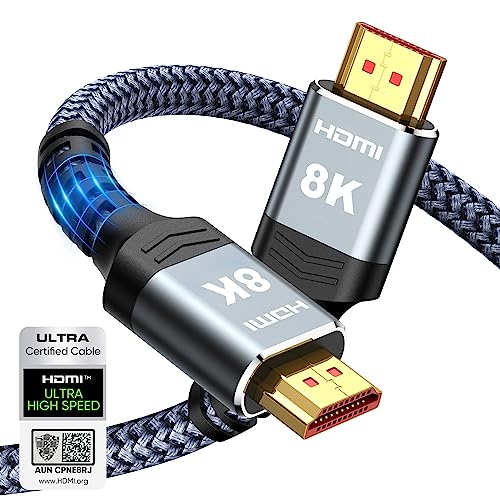
Pros
- Up to 48Gbps high-speed bandwidth
- Supports 4K 120Hz and 8K 60Hz displays
- Variable Refresh Rate support for gaming
- Durable braided nylon exterior
- Backward compatible with legacy HDMI versions
Cons
- Fixed 6.6-foot length restricts distant component placement
Display Capabilities: iFFALCON 55-Inch 4K MiniLED TV
The iFFALCON 55″ 4K MiniLED Smart TV delivers native 144Hz panel refresh rates with dedicated support for 4K at 120Hz console gaming. Its MiniLED backlight structure produces up to 1000 nits of HDR luminance alongside a 6000 to 1 contrast ratio. This level of peak brightness helps highlight fine environmental details in demanding HDR scenes.
Connectivity is handled through four HDMI ports, with two ports dedicated to full 4K 144Hz transmission. Integrated Auto Low Latency Mode automatically switches the display into game mode upon detecting console signals. However, players must note that only two ports support top refresh rates, while the remaining ports cap at standard 4K 60Hz.
Bandwidth Integrity: Certified HDMI 2.1 Cables
High-bandwidth 4K 120Hz signals demand cables capable of sustaining genuine 48Gbps throughput without signal degradation. The Silkland Certified HDMI 2.1 Cable Ultra High Speed features verified certification, dual-layer nylon shielding, and ferrite beads to block electromagnetic interference. This ensures uncompressed transmission for games running at peak frame rates with HDR enabled.
For setups needing certified signal parity across different input channels, the Ubluker 10K 8K 4K HDMI Cable 6.6FT Certified provides standard-compliant VRR and ALLM passthrough. Similarly, the Highwings 8K 10K 4K HDMI Cable 48Gbps 6.6FT/2M utilizes reinforced tail ends and braided nylon to resist tight bends behind wall-mounted displays. Both options prevent black screen drops caused by insufficient bandwidth.
Dedicated Audio Integration for Console Gaming
While the integrated 50W speaker setup on the display handles general playback, competitive multiplayer titles benefit from isolated directional cues. The AOC Wireless Gaming Headset for PS5, PS4 pairs via a 2.4GHz wireless dongle to maintain low latency during critical moments. Its 50mm graphene diaphragms output clean stereo imaging without introducing room reverberation.
Weighing 239 grams, this headset remains comfortable during lengthy sessions, though Bluetooth functionality is not compatible with console audio systems. Players looking to refine desk-based arrangements can read our guide on how to build the ultimate battlestation on a budget. Users who prefer desktop displays instead can also examine our overview of the best 1440p gaming monitors.
Key Technical Factors for PS5 Displays
Selecting best gaming tvs for ps5 involves matching console firmware capabilities with physical panel hardware. First, ensure the panel provides full 48Gbps HDMI 2.1 ports to deliver uncompressed 4K resolution at 120 frames per second. Displays limited to HDMI 2.0 cannot exceed 60Hz at full 4K output.
Second, look for certified Variable Refresh Rate and Auto Low Latency Mode compatibility. VRR syncs the screen refresh rate directly to the GPU frame output, eliminating stutter in performance modes. MiniLED backlights or full-array local dimming are equally critical to maintain balanced contrast without washouts.
Frequently Asked Questions
Does the PS5 require HDMI 2.1 to work?
The console operates on older HDMI ports, but output will be restricted to 60Hz at 4K. HDMI 2.1 is strictly required for 4K 120Hz output and VRR.
Can any high-speed cable carry 4K 120Hz gaming?
No, cables must hold official Ultra High Speed certification confirming 48Gbps throughput. Standard high-speed cables lack the bandwidth to transmit high frame rates with HDR simultaneously.





Write Your Review
No reviews yet. Be the first to share your experience!