

Finding a fast display no longer requires spending hundreds over standard component budgets. Modern sub-$200 displays now feature fluid motion rates along with crisp Quad HD resolutions that previously belonged to premium hardware categories.
Choosing among these options comes down to panel compromises, stand mechanics, and interface limits. Understanding whether your graphics card favors higher pixel counts or maximum frames will dictate the right screen choice.

Pros
- Smooth 240Hz refresh rate via DisplayPort and HDMI
- Immersive 1500R curved 32-inch screen
- High 3500:1 contrast ratio
- Built-in FreeSync support
- DisplayPort cable included in the box
Cons
- Low pixel density with 1080p at 32 inches
- No integrated speakers
- Stand adjustment limited strictly to tilt

Pros
- Sharp QHD resolution across a spacious 32-inch display
- Fluid 165Hz refresh rate reduces visual lag
- Immersive 1000R curvature fills peripheral vision
- AMD Radeon FreeSync eliminates screen tearing
- Built-in Eye Saver and flicker-reduction modes

Pros
- Fluid 180Hz refresh rate with 1ms response time
- Sharp 27-inch QHD Fast IPS display
- Simultaneous ELMB and variable refresh rate technology
- G-Sync compatible and FreeSync Premium support
- Wide 130% sRGB color gamut coverage

Pros
- Smooth 180Hz refresh rate via DisplayPort
- Immersive 1500R curved 1440p panel
- AMD FreeSync reduces visual tearing
- VESA 100 x 100mm mounting support
- Multiple video inputs including dual HDMI
Cons
- HDMI ports are capped at 144Hz
- Stand adjustment is limited to tilt only
- Integrated 2W speakers offer basic audio output

Pros
- Sharp 2560x1440 QHD resolution at 144Hz
- Full height, tilt, swivel, and pivot adjustability
- AMD FreeSync tear-free motion support
- 1500:1 contrast ratio for deeper dark tones
- Integrated dual 3W desktop speakers

Pros
- Detailed 3440 x 1440 WQHD ultrawide resolution
- High refresh rate reaching up to 180Hz
- Immersive 1500R curved screen design
- 99 percent sRGB color gamut coverage
- Two DisplayPort inputs for multiple video sources

Pros
- Smooth 144Hz refresh rate with AMD FreeSync
- Full ergonomic stand with height, tilt, swivel, and pivot
- Higher 1500:1 contrast ratio than standard office panels
- Integrated dual 3W speakers save desk space
- TÜV-certified hardware reduces blue light without color degradation
Cons
- 1080p resolution yields modest pixel density at 27 inches
- Documented video input options are limited to HDMI

Pros
- Sharp 4K UHD resolution with high pixel density
- HDR10 support displaying over one billion colors
- DisplayPort and HDMI video inputs
- TÜV-certified flicker-free Eye Saver Mode
- Game Mode for enhanced scene contrast

Pros
- Fast 260Hz refresh rate via DisplayPort
- Crisp 1440p Fast IPS display
- Wide 98% DCI-P3 color gamut
- AMD FreeSync Premium support
- Four total video inputs
Cons
- HDMI 2.0 ports capped at 144Hz
- Stand provides only tilt adjustments
- Moderate 320-nit peak brightness
Top Monitors Under $200 for Gaming Compared
ASUS TUF Gaming VG27AQ3A 27 Inch 1440p 180Hz
The ASUS TUF Gaming VG27AQ3A 27 Inch 1440p 180Hz delivers a balanced set of competitive features on a 2560×1440 Fast IPS panel. Its 180Hz refresh rate pairs with both AMD FreeSync Premium and Nvidia G-Sync compatibility to eliminate frame tearing during volatile gameplay moments.
A notable feature is ELMB Sync, which allows strobing backlight reduction to operate simultaneously with variable refresh rate modes. The 27-inch screen size maintains roughly 109 pixels per inch, providing sharp clarity across titles without overburdening mid-range graphics hardware.
The included stand only allows basic tilt adjustments, meaning ergonomic positioning might require an aftermarket VESA mount. Gamers who play in bright environments will appreciate the wide viewing angles and consistent colors that IPS technology reliably produces.
Samsung 32″ Odyssey (G55C)
The Samsung 32″ Odyssey (G55C) is designed for gamers who want deep visual immersion on an expansive screen. Its sharp 1000R curvature closely matches natural human peripheral vision to keep edges aligned with your gaze.
Running at 2560×1440 resolution at 165Hz, this panel produces rich black levels typical of VA architecture, backed by baseline HDR10 processing. This visual depth makes single-player RPGs and dark simulation environments look far punchier than basic low-contrast screens allow.
The aggressive curve requires sitting directly centered, as off-angle viewing quickly leads to contrast degradation and color shifts. In fast-paced competitive esports titles, transitions between dark colors may occasionally display slight trailing when compared against fast IPS rivals.
SANSUI Gaming Monitor 27″ 1440p 260hz/240hz WQHD
The SANSUI Gaming Monitor 27″ 1440p 260hz/240hz WQHD targets players who want extreme frame pacing without giving up resolution. It achieves a 260Hz refresh rate over DisplayPort alongside full 2560×1440 pixel clarity on an IPS matrix.
Wide color coverage rated at 98% DCI-P3 produces vibrant saturation for games, media playback, and casual creative duties. Connecting via HDMI caps the refresh rate at 144Hz, making DisplayPort mandatory if you want to unlock maximum frame throughput.
The chassis and tilt stand use basic lightweight plastics to stay within accessible budget boundaries during manufacturing. Players focusing heavily on tactical shooters like Counter-Strike or Valorant will appreciate the exceptionally quick pixel transitions.
Sceptre 34-inch Curved Ultrawide WQHD Monitor
The Sceptre 34-inch Curved ultrawide WQHD Monitor brings an ultrawide 21:9 aspect ratio into standard entry-level pricing tiers. Delivering 3440×1440 pixels at up to 180Hz, it provides roughly 30 percent more horizontal field of view than regular displays.
Flight simulators, racing titles, and open-world adventures benefit significantly from the wide peripheral immersion provided by its 1500R arc. You can explore more expanded setups in our roundup of the best 34 inch gaming monitors.
Driving this native pixel count requires stronger graphics cards compared to traditional 1080p screens. The integrated speakers supply low audio output with minimal low-end frequencies, so using a headset or desktop speakers remains essential.
Acer Nitro 31.5in QHD 2560×1440 Curved 180Hz
The Acer Nitro 31.5in QHD 2560×1440 Curved 180Hz provides a generous 31.5-inch viewing area paired with a 1500R curve. It operates at 180Hz through DisplayPort, while HDMI users remain capped at a still-fluid 144Hz ceiling.
The thin ZeroFrame bezel reduces visual distraction, making it suitable for multi-monitor simulator cockpits or broad desk arrangements. FreeSync synchronization prevents tearing across fluctuating frame rates when pairing this screen with modern mid-range PC graphics cards.
A pixel pitch of 0.272mm means text sharpness sits lower than a 27-inch panel sharing the identical 1440p resolution. Keeping proper viewing distance from this larger curved surface ensures comfortable visual clarity across full play sessions.
Dell 27 Plus QHD Monitor – S2725DSM
The Dell 27 Plus QHD Monitor – S2725DSM strikes a practical balance between gaming agility and everyday workspace ergonomics. Its fully adjustable stand includes height, swivel, pivot, and tilt articulation to maintain proper posture during long gaming marathons.
A 144Hz refresh rate with 1ms MPRT delivers smooth tracking in action games while managing 2560×1440 resolution. Dual integrated 3-watt speakers outperform standard monitor speakers, delivering usable casual audio without forcing you to wear bulky headphones continuously.
Competitive shooter players targeting 240Hz or higher frame rates may prefer specialized tournament-focused alternatives instead. However, users seeking a hybrid monitor for remote work and evening entertainment will appreciate its clean aesthetic and versatile stand.
SANSUI 32 Inch Curved 240Hz Gaming Monitor
The SANSUI 32 Inch Curved 240Hz Gaming Monitor pairs a rapid 240Hz refresh rate with a 1500R curved frame. By keeping the native resolution at Full HD 1080p, it allows modest graphics hardware to sustain very high frame rates.
A stated 3500:1 contrast ratio helps produce deep black levels across darker scenes, supported by a 300-nit backlight array. Both the HDMI and DisplayPort inputs support the full 240Hz signal, providing helpful flexibility across different source devices.
Spreading 1920×1080 pixels across a 32-inch surface results in lower pixel density, which makes UI elements appear relatively soft up close. Sitting back at the manufacturer-recommended distance of 1.2 meters keeps visual edges comfortable and avoids noticeable pixelation.
Dell 27 Plus Monitor – S2725HSM
The Dell 27 Plus Monitor – S2725HSM provides a 1080p gaming alternative equipped with the same robust stand found on Dell higher-tier monitors. It features 144Hz motion clarity alongside a 1500:1 contrast ratio that assists visibility in dim in-game spaces.
Integrated dual 3W speakers supply clear system audio, and TÜV-certified eye comfort profiles help reduce eye fatigue. For similar budget-conscious 1080p options, take a look at our guide to the best gaming monitors 144hz under $200.
Connectivity relies on standard HDMI without dedicated DisplayPort jacks, which limits configuration choices on select multi-port desktop setups. The 1080p resolution on a 27-inch panel is best suited for players prioritizing smooth framerates over sharp text rendering.
Samsung 27″ ViewFinity S7 (S71H)
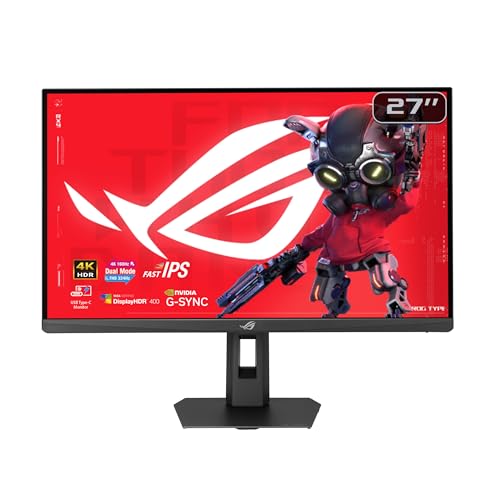
The Samsung 27″ ViewFinity S7 (S71H) approaches desktop gaming from a distinct visual angle by prioritizing 4K UHD resolution. Offering 3840×2160 pixels on an IPS panel, it delivers crisp line quality and detailed textures across slower-paced strategy titles.
While it lacks high-refresh capabilities and runs at standard 60Hz, an onboard Game Mode helps adjust contrast to illuminate hidden shadow details. Users splitting time between detailed 4K productivity tasks and casual simulation gaming will find its pixel density compelling.
Fast-action esports players will quickly feel the limitations of the 60Hz cap compared to 144Hz or 240Hz panels. Driving modern titles at native 4K also places significant rendering demands on entry-level graphics processing units.
Key Hardware Comparison
| Model | Screen Size | Resolution | Max Refresh Rate | Panel / Shape | Stand Adjustments |
|---|---|---|---|---|---|
| ASUS TUF VG27AQ3A | 27″ | 2560 x 1440 | 180Hz | Fast IPS / Flat | Tilt only |
| Samsung Odyssey G55C | 32″ | 2560 x 1440 | 165Hz | VA / 1000R Curved | Tilt only |
| SANSUI 27″ WQHD | 27″ | 2560 x 1440 | 260Hz | Fast IPS / Flat | Tilt only |
| Sceptre 34″ Ultrawide | 34″ | 3440 x 1440 | 180Hz | VA / 1500R Curved | Tilt only |
| Acer Nitro EDA323QU | 31.5″ | 2560 x 1440 | 180Hz | VA / 1500R Curved | Tilt only |
| Dell S2725DSM | 27″ | 2560 x 1440 | 144Hz | IPS / Flat | Height, Pivot, Swivel, Tilt |
| SANSUI 32″ Curved | 32″ | 1920 x 1080 | 240Hz | VA / 1500R Curved | Tilt only |
| Dell S2725HSM | 27″ | 1920 x 1080 | 144Hz | IPS / Flat | Height, Pivot, Swivel, Tilt |
| Samsung ViewFinity S7 | 27″ | 3840 x 2160 | 60Hz | IPS / Flat | Tilt only |
How to Choose the Best Monitors Under $200 for Gaming
Choosing a sub-$200 monitor requires understanding how resolution, panel architecture, and refresh rates interact with your gaming hardware. Prioritizing the proper feature mix prevents buying a panel that clashes with your favorite game genres.
Resolution and Pixel Density
Screen size dictates the visual sharpness you experience at standard desktop viewing distances. A 27-inch monitor with 2560×1440 resolution provides approximately 109 pixels per inch, which balances crisp visual fidelity with manageable graphics card workloads. You can explore higher-tier 1440p choices in our look at the best 27 gaming monitors under $300.
Conversely, stretching 1080p resolution over a 32-inch panel lowers pixel density down to roughly 69 pixels per inch. While fine lines and desktop text appear noticeably softer on such panels, the lighter rendering footprint lets modest graphics cards maintain steady, high framerates.
IPS Versus Curved VA Panels
IPS panels offer broad viewing angles and consistent color saturation across the entire surface. Fast IPS variations have largely eliminated traditional pixel response lag, making them standard recommendations for fast shooter environments.
Curved VA panels focus instead on deep black levels, regularly reaching static contrast ratios between 3000:1 and 3500:1. The curvature helps keep peripheral edges within view, though darker scene transitions can produce mild smearing in competitive titles.
Port Bandwidth and Variable Refresh Rates
Many affordable monitors restrict their maximum refresh rates based on which input cable you connect. Several models cap HDMI connections at 144Hz while requiring DisplayPort 1.4 to deliver advertised 180Hz or 260Hz output.
Variable refresh rate protocols like AMD FreeSync and G-Sync compatibility match monitor timing to your graphics card frame output. This synchronization removes distracting horizontal screen tearing without introducing the substantial input delay caused by traditional software V-Sync.
Frequently Asked Questions
Is 1440p viable for gaming on a budget under $200?
Yes, multiple reliable 1440p displays now fall within entry-level price brackets. Modern budget 1440p panels offer refresh rates between 144Hz and 260Hz, provided your graphics card has enough compute power to drive the higher pixel count.
Do budget gaming monitors offer true HDR performance?
Basic HDR10 support on sub-$200 monitors processes high dynamic range input signals but lacks local backlight dimming. While these panels accept HDR metadata, peak brightness typically tops out between 300 and 320 nits, which limits high dynamic range impact compared to premium displays.
Can I mount these monitors on an aftermarket monitor arm?
Most budget models incorporate standardized 100x100mm VESA mounting holes behind their detachable stands. Verifying the monitor weight without its stand ensures compatibility with standard third-party gas-spring desk clamps.
Which Monitor Should You Choose?
For an optimal mix of motion clarity, color fidelity, and resolution, the ASUS TUF Gaming VG27AQ3A 27 Inch 1440p 180Hz serves as the most versatile pick for mixed gaming libraries. Players who prefer maximum peripheral immersion for sim racing or grand strategy will gain more value from the ultrawide format on the Sceptre 34-inch Curved ultrawide WQHD Monitor. If ergonomic adjustability and dual-purpose office duty are critical, the fully adjustable Dell 27 Plus QHD Monitor – S2725DSM delivers daily comfort without giving up gaming speed.



Write Your Review
No reviews yet. Be the first to share your experience!