

Choosing among the best AMD graphics cards requires matching your target resolution with realistic hardware requirements. Modern Radeon cards offer distinct architectural generations, varying memory interfaces, and significant differences in physical dimensions and power needs.
For high-refresh competitive play and entry 1080p setups, cards like the RX 7600 provide dedicated ray tracing and AI hardware on an accessible power budget. Enthusiasts targeting 4K or ultra-wide displays need the higher compute unit counts and 16GB memory pools found on RX 9060 XT and RX 9070 XT models.

Pros
- Substantial 16GB GDDR6 video memory
- Hardware Dual BIOS toggle for sound and performance profiles
- 0dB mode stops fans under lighter workloads
- Compact eight-inch length fits many smaller cases
- Durable dual ball fan bearing design
Cons
- 2.5-slot profile requires multiple motherboard expansion slots
Pros
- Generous 16GB GDDR6 video memory
- Advertised boost clock up to 3320 MHz
- Dedicated SWFT dual-fan thermal design
- Built on AMD RDNA 4 architecture
- Multiple DisplayPort and HDMI video outputs
Cons
- Provides only three total video outputs
- Card length requires clearance over 10.6 inches

Pros
- High factory boost clock up to 2970 MHz
- 16GB GDDR6 memory on a 256-bit bus
- Modern DisplayPort 2.1a and HDMI 2.1b connectivity
- Sturdy design featuring a reinforced metal frame
- Triple-fan thermal design for heat dissipation
Cons
- Bulky 2.9-slot thickness limits compact case fitment
- Demands a substantial 800W recommended power supply
- Requires two standard 8-pin PCIe power connectors

Pros
- High 2695 MHz factory boost clock
- Triple-fan cooling with 0dB silent fan stop
- Supports up to four external displays
- Rigid metal backplate enhances structural durability
- Requires only a single 8-pin power connector
Cons
- Long 303 mm length restricts compact case compatibility
- Thick 2.5-slot profile occupies extra bracket space
- Limited to a PCIe 4.0 x8 bus interface

Pros
- Generous 16GB GDDR6 memory capacity
- High-speed PCIe 5.0 interface support
- WINDFORCE thermal solution with Hawk fans
- Server-grade thermal conductive gel integration
- Integrated customizable RGB lighting
Cons
- Requires substantial case clearance at 11.34 inches long
- Thick 2.2-inch profile occupies multiple expansion slots

Pros
- High factory boost clock up to 2970 MHz
- Generous 16GB GDDR6 memory capacity
- Modern DisplayPort 2.1a and HDMI 2.1b outputs
- Triple-fan cooling with 0dB silent mode
- PCIe 5.0 interface support
Cons
- Requires a high-capacity 800W power supply
- Long 11.4-inch card length requires spacious PC cases
Quick Comparison of Featured AMD GPUs
The table below summarizes key technical specifications based on documented manufacturer data. Review these figures to verify slot dimensions, power supply ratings, and memory bandwidth before planning your installation.
| Graphics Card | Memory & Bus | Boost Clock | Form Factor | Recommended PSU |
|---|---|---|---|---|
| ASUS Dual RX 9060 XT 16GB | 16GB GDDR6 | Up to 3250 MHz | 2.5-slot | Not specified |
| ASRock RX 9070 XT Steel Legend | 16GB GDDR6 (256-bit) | Up to 2970 MHz | 2.9-slot (298 mm) | 800W |
| XFX Swift RX 9060 XT OC | 16GB GDDR6 | Up to 3320 MHz | Dual-fan | Not specified |
| ASRock RX 7600 Challenger Pro | 8GB GDDR6 (128-bit) | Up to 2695 MHz | 2.5-slot (303 mm) | 550W |
| GIGABYTE RX 9070 XT Gaming OC | 16GB GDDR6 | Not specified | Triple-fan | Not specified |
| ASRock RX 9070 XT Challenger OC | 16GB GDDR6 (256-bit) | Up to 2970 MHz | Triple-fan | 800W |
Individual AMD Graphics Card Breakdown
ASUS Dual Radeon RX 9060 XT 16GB GDDR6
The ASUS Dual Radeon RX 9060 XT 16GB GDDR6 is designed around a practical 2.5-slot footprint that balances thermal dissipation with mid-tower compatibility. It features Axial-tech fans with dual ball bearings that extend mechanical longevity, paired with 0dB technology for silent operation during low loads.
With an OC mode boost clock reaching up to 3250 MHz and 16GB of GDDR6 memory, this model handles modern texture loads without running into the memory bottlenecks typical of 8GB alternatives. A dual BIOS switch allows hardware toggling between Quiet and Performance fan curves, though prospective buyers should note ASUS does not document an official minimum power supply rating on the basic spec sheet.
ASRock Radeon RX 9070 XT Steel Legend 16GB
Built on AMD RDNA 4 architecture, the ASRock Radeon RX 9070 XT Steel Legend 16GB features 64 Compute Units, 3rd Gen Ray Tracing, and 2nd Gen AI Accelerators. Its memory subsystem uses 16GB of GDDR6 across a 256-bit bus operating at 20 Gbps, providing ample memory bandwidth for high-resolution rendering and demanding creative applications.
This model features a factory overclocked boost clock of up to 2970 MHz alongside modern connectivity including DisplayPort 2.1a and HDMI 2.1b. However, installation requires careful planning: it measures 298 mm in length, takes up 2.9 slots, requires two 8-pin PCIe power connectors, and demands at least an 800W power supply.
XFX Swift AMD Radeon RX 9060 XT OC Gaming Edition
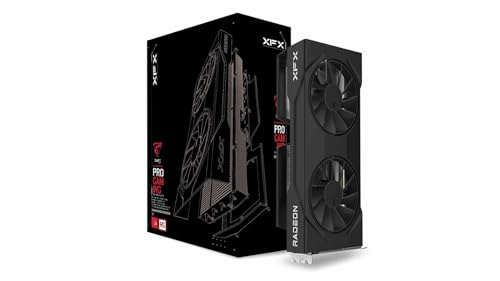
The XFX Swift AMD Radeon RX 9060 XT OC Gaming Edition leverages AMD’s RX 9060 XT silicon with an aggressive factory boost clock reaching up to 3320 MHz. Outfitted with 16GB of GDDR6 memory, it provides substantial headroom for modern titles that exceed typical VRAM allocations at 1440p resolution.
XFX uses its SWFT dual-fan cooling layout to keep card length manageable compared to long triple-fan alternatives. While the dual-fan arrangement fits standard cases more easily, user setups running inside compact enclosures must maintain steady case airflow to manage heat generated by the card’s aggressive boost clock.
ASRock Radeon RX 7600 Challenger Pro 8GB OC
The ASRock Radeon RX 7600 Challenger Pro 8GB OC targets standard 1080p gaming with 32 RDNA 3 compute units and 2048 stream processors. Equipped with 8GB of GDDR6 memory on a 128-bit bus and 32MB of AMD Infinity Cache, it delivers stable frame pacing on standard power delivery systems.
Thermal management is handled by a triple-fan Challenger Pro heatsink with 0dB silent cooling that stops fans during minor desktop workloads. The trade-off lies in the card’s 303 mm length, which is unusually long for an entry-level tier, alongside an 8GB memory ceiling that limits high-resolution texture packs in newer games.
GIGABYTE Radeon RX 9070 XT Gaming OC 16G Graphics
The GIGABYTE Radeon RX 9070 XT Gaming OC 16G Graphics brings 16GB of GDDR6 memory to AMD’s high-tier RDNA 4 platform. It relies on GIGABYTE’s proprietary WINDFORCE cooling system, which integrates specialized Hawk fans and server-grade thermal conductive gel to distribute heat effectively.
Supporting modern PCI Express 5.0 motherboard interfaces, this card is built for high-throughput bandwidth and contemporary multi-monitor setups. As with all high-tier 9070 XT boards, the heavy triple-fan heatsink necessitates structural support and generous clearance inside your chassis to avoid motherboard slot strain.
ASRock Radeon RX 9070 XT Challenger 16GB OC
For builders seeking performance without elaborate aesthetic shrouds, the ASRock Radeon RX 9070 XT Challenger 16GB OC pairs RDNA 4 architecture with a practical triple-fan thermal array. It features the same core 64 Compute Units, 2970 MHz boost clock, and 256-bit memory bus as its Steel Legend sibling.
It provides modern output flexibility via three DisplayPort 2.1a ports and one HDMI 2.1b connection, making it capable of driving ultra-high refresh gaming displays. Keep in mind that running this card requires a dedicated 800W power supply and adequate physical depth in your chassis.
Key Factors When Choosing an AMD Graphics Card
Evaluating an AMD graphics card requires looking beyond the model number to determine how memory architecture, physical dimensions, and power delivery interact with your existing PC build.
Memory Capacity and Bus Width
Video memory capacity directly dictates what level of texture quality and display resolution your system can sustain. Modern graphics cards with 16GB of VRAM and 256-bit bus widths handle ray tracing and high-resolution textures without hitching, while 8GB cards on 128-bit buses remain strictly aligned with 1080p rendering.
Display Pairing and Target Resolution
If you play on high-density displays, your graphics processor must push significantly more raw pixel data. Pair your selected card with appropriate monitor hardware, such as those covered in our guide to the best 1440p gaming monitors or the best ultrawide monitors, to avoid leaving performance unutilized.
Power Supply and Physical Clearance
Flagship boards like the RX 9070 XT series require substantial power delivery, often calling for at least an 800W PSU and dual 8-pin PCIe cables. Builders assembling components from scratch should consult our walkthrough on how to build a battlestation on a budget to ensure case length, power supply capacity, and motherboard spacing line up before purchasing.
Frequently Asked Questions
What power supply wattage is needed for AMD RX 9070 XT cards?
Board partners such as ASRock specify a recommended power supply rating of at least 800W for their RX 9070 XT models. You will also need two separate 8-pin PCIe power cables rather than split pigtail connectors to guarantee stable power delivery under sustained loads.
Is 8GB of VRAM sufficient for gaming in modern titles?
An 8GB buffer remains capable for standard 1080p gaming with balanced visual settings in current releases. However, at 1440p or 4K resolution, complex texture assets and ray tracing effects regularly demand more than 8GB, making 16GB cards a more resilient choice for future workloads.
Do AMD graphics cards support PCIe 5.0?
Recent RDNA 4 models like the RX 9070 XT series include support for PCI Express 5.0 interfaces. They are fully backwards compatible with PCIe 4.0 and PCIe 3.0 motherboard slots, though they will operate at the maximum bandwidth supported by the host motherboard.
Final Recommendation
If you are upgrading an existing mid-tier desktop and want generous 16GB memory without an excessive power footprint, the ASUS Dual Radeon RX 9060 XT 16GB GDDR6 offers a balanced 2.5-slot profile and dual BIOS flexibility. For builders equipped with an 800W power supply who demand 4K capabilities and 64 Compute Units, the ASRock Radeon RX 9070 XT Steel Legend 16GB delivers robust cooling, reinforced build materials, and next-generation DisplayPort 2.1a connectivity.




Write Your Review
No reviews yet. Be the first to share your experience!