
Choosing a 1440p monitor provides the sweet spot between crisp image clarity and approachable graphics card rendering loads. Modern displays in this category balance high refresh rates, reliable motion clarity, and adaptive sync support to prevent screen tearing during fast gameplay. Selecting the ideal display requires evaluating real panel capabilities rather than relying on promotional response time claims.
Quick Comparison of Top 1440p Displays
These verified models cover distinct technological categories ranging from vibrant Nano IPS panels to self-lit WOLED displays. Gamers pairing their screen with capable hardware from our guide to the best prebuilt gaming PCs can easily achieve fluid frame rates across all three options. Review the documented technical specifications below to narrow down your options quickly.

Pros
- Peak brightness up to 1500 nits
- High contrast with UL-certified black levels
- Four-sided borderless frame for clean setups
- AMD FreeSync Premium Pro synchronization
- Built-in AI-based OLED Care protection
Cons
- Requires active OLED maintenance routines to mitigate burn-in
- Glossy panel layer can reflect strong direct lighting

Pros
- Fast 165Hz refresh rate with 180Hz overclock support
- Sharp 2560 x 1440 QHD resolution
- Rapid 1ms GTG Nano IPS panel
- NVIDIA G-SYNC Compatible and AMD FreeSync Premium
- Versatile tilt, height, and pivot adjustable stand
Cons
- Basic DisplayHDR 400 offers limited dynamic range
- Peak 180Hz refresh rate requires manual overclocking
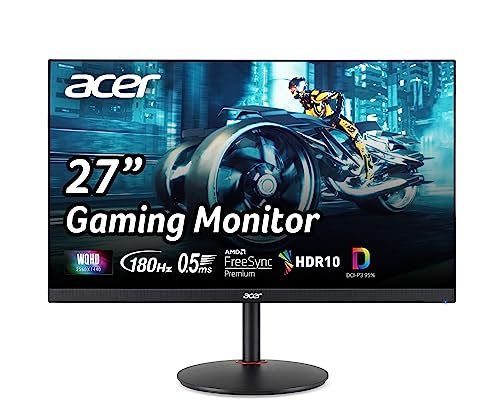
Pros
- Smooth 180Hz refresh rate over DisplayPort
- Sharp 1440p resolution on an IPS panel
- AMD FreeSync Premium variable refresh rate support
- Full ergonomic stand with height and pivot adjustments
- Includes both DisplayPort and HDMI cables
Cons
- Refresh rate capped at 144Hz over HDMI
- Older DisplayPort 1.2 and HDMI 2.0 port standards
- Basic 2W built-in speakers have limited output
| Model | Panel Type | Peak Refresh Rate | Advertised Response | Variable Sync | Stand Adjustments |
|---|---|---|---|---|---|
| GIGABYTE MO27Q28GR | WOLED (4th Gen) | Not specified | Not specified | FreeSync Premium Pro | Not specified |
| LG 27GP850-B | Nano IPS | 180Hz (Overclocked) | 1ms GtG | G-SYNC Compatible / FreeSync Premium | Height, Tilt, Pivot |
| Acer Nitro XV271U M3 | Fast IPS | 180Hz (DisplayPort) | 0.5ms to 1ms GtG | FreeSync Premium | Height, Tilt, Swivel, Pivot |
Detailed Reviews of the Best 1440p Displays
GIGABYTE MO27Q28GR 27″ W-OLED QHD AMD Freesync
The GIGABYTE MO27Q28GR incorporates a fourth-generation WOLED panel built with primary RGB tandem architecture. This display technology reaches up to 1500 nits of peak brightness while maintaining infinite contrast ratios with true black levels. A zero-haze optical surface and RealBlack glossy treatment reduce ambient reflections in illuminated rooms without compromising dark shadow gradients.
This monitor is certified by UL to sustain perfect black reproduction even in five hundred lux room environments. Competitive players benefit from borderless bezels across all four sides, creating seamless sightlines within complex multi-monitor flight or racing configurations. Integrated AI-driven OLED Care processes run unobtrusive mitigation routines in the background to lower permanent image retention risks over extended play sessions.
Prospective owners must note that WOLED panels demand proper desktop hygiene like taskbar auto-hiding to prevent burn-in over multi-year ownership periods. The premium panel construction carries a higher investment barrier compared to conventional liquid crystal technology. Enthusiasts demanding unmatched high dynamic range highlights and instant pixel transitions will find this display difficult to surpass.
LG 27GP850-B Ultragear Gaming Monitor 27-Inch QHD
The LG 27GP850-B utilizes an established Nano IPS panel delivering rich color saturation across wide viewing angles without distortion. Its baseline refresh rate reaches 165Hz out of the box, with built-in hardware overclocking pushing motion clarity to 180Hz. A certified 1ms gray-to-gray transition time curbs ghosting artifacts during erratic first-person camera movement.
Nvidia has officially verified this monitor for G-Sync compatibility, and it natively supports AMD FreeSync Premium to stop frame pacing stutters. The bundled desk stand includes generous height adjustment, tilt, and vertical pivot mechanisms to align with ergonomic seating requirements. Gamers prioritizing desk customization can also mount the display using standard VESA-compliant hardware arms.
Because IPS technology relies on a constant LED backlight, black levels appear dark gray when playing cinematic titles in dark rooms. The VESA DisplayHDR 400 tier provides standard brightness handling rather than genuine zone-controlled dynamic contrast. It remains an exceptionally versatile pick for users combining day-to-day office productivity with high-tempo competitive esports.
Acer Nitro 27in QHD 2560×1440 IPS 180Hz
The Acer Nitro XV271U M3 delivers dependable 2560×1440 gaming metrics on an accessible IPS architecture. Its DisplayPort interface supports refresh rates up to 180Hz, whereas the dual HDMI 2.0 ports cap output at 144Hz. Documented response measurements span from 1ms down to 0.5ms gray-to-gray under optimal overdrive parameters to minimize smearing.
An included ErgoStand provides comprehensive physical versatility with full 360-degree swivel, height movement spanning 4.7 inches, and bidirectional screen pivoting. Dual integrated two-watt speakers provide basic desktop audio output for casual content streaming and system notifications without extra peripheral clutter. AMD FreeSync Premium synchronization ensures stable performance when graphics card frame output fluctuates under demanding graphical loads.
Users connecting modern gaming consoles should remember that HDMI 2.0 ports cannot achieve the maximum 180Hz refresh ceiling of the panel. The integrated speaker setup also lacks low-frequency bass impact, making a dedicated headset necessary for discerning competitive spatial cues. For price-conscious builders assembling an accessible battlestation, this monitor offers outstanding functional value.
Key Factors When Choosing a 1440p Gaming Screen
Screen technology forms the primary compromise between speed, pricing, and visual fidelity when choosing a contemporary display. Modern IPS monitors remain the most reliable choice for bright spaces due to excellent viewing angles and realistic color calibration profiles. WOLED panels deliver genuine pixel-level illumination for immersive dark-room gaming, although they demand deliberate maintenance habits to protect panel longevity.
Refresh rates exceeding 144Hz guarantee smooth tracking across fast titles, provided your graphics processor maintains matching render speeds. Readers considering wider cinematic layouts might explore our guide to the best ultrawide monitors in 2026 for expanded desktop field view. Standard 27-inch 16:9 displays nevertheless offer superior frame rate stability on mainstream graphics cards without scaling penalties.
Ergonomics play a vital role during long competitive matches or remote workdays at your desk. Adjustable stands featuring height, tilt, and swivel mechanics prevent neck fatigue and make monitor placement effortless. Builders aiming to assemble balanced peripherals can review our practical tips on how to build the ultimate battlestation on a budget to manage desk real estate efficiently.
Frequently Asked Questions
Why is 27 inches considered the optimal screen size for 1440p?
A 27-inch diagonal screen with a 2560×1440 resolution provides approximately 108 pixels per inch density. This level of sharpness eliminates noticeable pixelation at normal viewing distances without requiring Windows desktop interface scaling. Stepping up to 32-inch 1440p panels reduces density, whereas smaller screens make fine text difficult to read comfortably.
Do I need DisplayPort to reach maximum refresh rates?
Most 1440p gaming screens reserve their highest refresh ceilings and variable refresh windows for DisplayPort connections. Monitors using older HDMI 2.0 connections often limit throughput to 144Hz at 1440p resolution due to internal bandwidth caps. Always connect your primary gaming PC with the included DisplayPort cable to unlock top refresh modes and adaptive sync.
Does VESA DisplayHDR 400 deliver real HDR gaming?
The DisplayHDR 400 certification simply indicates that an edge-lit LCD screen can accept an HDR signal and briefly hit 400 nits. Because these panels lack dedicated full-array local dimming zones, they cannot display bright highlights against deep shadows simultaneously. True high dynamic range performance requires per-pixel lighting technologies such as WOLED or advanced mini-LED backlights.
Final Recommendation
The LG 27GP850-B stands as the most balanced pick for players seeking dependable color performance, robust overdrive tuning, and certified variable refresh support. Those pursuing the highest visual fidelity and instantaneous response times should select the GIGABYTE MO27Q28GR for its peerless WOLED contrast. Budget-conscious PC builders will get exceptional refresh capability and a fully adjustable stand by choosing the Acer Nitro XV271U M3.