

Choosing the best dual monitor arm mounts for desks comes down to your screen weight, display width, and desktop construction. A sturdy arm setup prevents wobble while typing and clears valuable surface area for peripherals and work materials.
Before purchasing, check the thickness of your desktop, the underside clearance for clamp brackets, and whether your panels use standard 75x75mm or 100x100mm VESA patterns. If you are also planning a new workspace layout, reviewing dedicated gaming desks for dual monitors helps ensure your desktop material can safely handle clamp pressure.

Pros
- Full 360-degree rotation for portrait and landscape modes
- Dual C-clamp structure enhances overall desk stability
- Includes both C-clamp and grommet mounting hardware
- Supports heavy displays up to 19.8 pounds per arm
- Integrated cable management frees up desktop space
Cons
- Only compatible with wooden desktops
- Desk underside must be free of crossbeams
- Maximum screen size limited to 27 inches

Pros
- Supports two monitors up to 22 lbs each
- Full 360-degree rotation and wide tilt range
- Includes both C-clamp and grommet mounting options
- Integrated cable management keeps wiring organized
Cons
- Recommended only for wooden desktop surfaces
- Under-desk crossbeams can block clamp installation
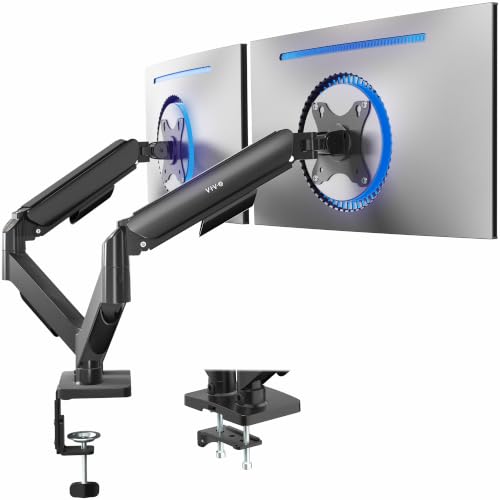
Pros
- Supports displays up to 32 inches and 19.8 lbs
- Full motion tilt, swivel, and screen rotation
- Open-top VESA plates for easier monitor installation
- Includes both C-clamp and grommet mounting options
- Mechanical counterbalance provides smooth toolless adjustment
Cons
- Arms extend behind the desk surface
- Minimum display weight requirement of 4.4 lbs per arm

Pros
- Supports screens up to 32 inches and 17.6 pounds
- Flexible tilt, swivel, and full 360-degree screen rotation
- Includes both C-clamp and grommet mounting hardware
- Compatible with 75x75 mm and 100x100 mm VESA plates
- Integrated clips assist with desk cable routing
Cons
- Requires desks free of interfering underside beams or panels
- Manufacturer recommends use primarily on wooden desktops
Dual Monitor Mount Comparison
| Model | Supported Screen Sizes | Weight Capacity (Per Arm) | Clamp Thickness Range | Articulation Highlights |
|---|---|---|---|---|
| HUANUO Dual Monitor Stand | 13 to 27 inches | 4.4 to 19.8 lbs | 0.59 to 3.54 inches | +85°/-50° tilt, ±90° swivel, 360° rotation |
| WALI Adjustable Dual Monitor Arm | 13 to 32 inches | Up to 22 lbs | 0.39 to 2.76 inches | +70°/-45° tilt, ±90° swivel, 19.3″ extension |
| VIVO Dual Monitor Stand | 17 to 32 inches | 4.4 to 19.8 lbs | Up to 3.1 inches (clamp) | +90°/-90° tilt, 180° swivel, mechanical springs |
| ErGear Dual Monitor Stand | 13 to 32 inches | Up to 17.6 lbs | 0.39 to 3.0 inches | ±45° tilt, ±90° swivel, 31.22″ total span |
Detailed Product Breakdown
1. HUANUO Dual Monitor Stand
The HUANUO Dual Monitor Stand is designed for compact to medium displays ranging from 13 to 27 inches. It features a reinforced dual C-clamp base that provides extra contact area against the desk underside, which helps prevent unwanted shift during typing.
Each arm supports between 4.4 and 19.8 lbs and can lift displays up to 16.2 inches above the desktop. This makes it an effective choice for lighter office displays or standard panels from our curated gaming monitors directory. However, it tops out at 27-inch screens, so users running dual 32-inch displays will need a wider arm configuration.
2. WALI Adjustable Dual Monitor Arm
The WALI Adjustable Dual Monitor Arm for 13-32 inch delivers higher payload tolerance, supporting up to 22 lbs per arm. It accommodates displays up to 32 inches, allowing broader flexibility for heavy ultrawide or curved productivity screens.
With an arm reach of 19.3 inches and a maximum elevation of 17.3 inches, you can easily pull screens forward or push them flush against the back edge. Its clamp mechanism fits desks up to 2.76 inches thick, which covers most solid wood and composite office surfaces with adequate clearance.
3. VIVO Dual Monitor Stand (STAND-V002O)
The VIVO Dual Monitor Stand, Fully Adjustable Arms utilizes mechanical spring counterbalances to allow smooth repositioning without requiring hex wrench adjustments for minor shifts. It handles panels between 17 and 32 inches weighing from 4.4 to 19.8 lbs per side.
Installation is simplified by open-top VESA brackets that let you drop monitors directly onto the arm mounts before securing screws. A key geometric constraint is that the elbow joints extend behind the desk edge, requiring several inches of rear wall clearance to position screens side-by-side.
4. ErGear Dual Monitor Stand
The ErGear Dual Monitor Stand provides a 31.22-inch arm span supported by a central 16-inch vertical pole. It accommodates two displays up to 32 inches, offering independent tilt of 45 degrees and full 360-degree rotation for portrait orientation.
Its maximum capacity of 17.6 lbs per screen is slightly lower than the WALI or VIVO mounts, making it best matched with standard modern LED panels rather than exceptionally heavy vintage monitors. The clamp bracket attaches to surfaces up to 3 inches thick, while the included grommet kit works on tops up to 2.36 inches thick.
How to Choose the Right Dual Monitor Mount
Desk construction is the first factor to inspect. Heavy-duty clamps exert concentrated downward and rotational force on a small area, meaning tempered glass or hollow honeycomb paperboard desks should never be clamped directly. For additional desk build ideas, explore our full library of setup guides.
Next, account for display weight without original factory stands attached. Most arm specifications list net monitor capacities, so look up the weight of your screen panel alone to avoid exceeding spring tensions. Also consider rear perimeter beams under your tabletop, as framing obstructions can block clamp brackets from sliding fully forward.
Frequently Asked Questions
Can I mount two different monitor sizes on one dual arm?
Yes, provided each screen falls within the weight limits and maximum diagonal dimensions of the mount. Independent articulated arms allow you to position mixed panels, like a 24-inch vertical display beside a 27-inch landscape screen, without alignment issues.
What is the difference between C-clamp and grommet mounting?
A C-clamp wraps around the back outer perimeter of your desk, requiring zero permanent modifications. A grommet mount runs a threaded bolt straight through a pre-drilled cable hole or custom hole in the desktop, which is ideal when desks sit directly against drywall.
Final Recommendation
If you run standard 24-inch to 27-inch screens and prioritize maximum base stability, the HUANUO Dual Monitor Stand provides a dependable dual-bracket clamp structure. For heavier or larger 32-inch displays, the WALI Adjustable Dual Monitor Arm for 13-32 inch offers higher load overhead and extended horizontal reach.




Write Your Review
No reviews yet. Be the first to share your experience!