

Choosing among the best g sync monitors comes down to matching your graphics card performance with the right display resolution and panel speed. Variable refresh rate technology synchronizes your monitor refresh cycle with frame delivery from your GPU, which completely removes screen tearing and prevents stuttering without adding the severe input delay of traditional V-Sync. NVIDIA users have multiple tiers of compatibility to evaluate, ranging from cost-effective 1080p esports panels to high-end QHD OLED displays.
If you play fast-paced multiplayer games, high refresh rates and low pixel response times are the primary specifications to prioritize. For narrative and visually heavy games, higher pixel densities and wider dynamic contrast deliver far greater immersion. Below are 5 well-specified options suited to different desktop setups, budgets, and competitive requirements.
Best G-Sync Compatible Monitors at a Glance
Pros
- Fluid 240Hz refresh rate
- G-Sync and FreeSync Premium adaptive sync support
- ELMB Sync combines blur reduction with variable refresh rates
- Fast IPS panel with 99% sRGB color coverage
- Comprehensive 3-year manufacturer warranty
Cons
- 1080p resolution yields lower pixel density at 27 inches

Pros
- 144Hz overclocked refresh rate
- NVIDIA G-SYNC and AMD FreeSync support
- IPS panel with 99% sRGB coverage
- 1ms Motion Blur Reduction mode
- DisplayPort and HDMI connectivity
Cons
- Stand provides tilt adjustment only
- 144Hz refresh rate requires overclocking

Pros
- Fluid 180Hz refresh rate with 1ms response time
- Sharp 27-inch QHD Fast IPS display
- Simultaneous ELMB and variable refresh rate technology
- G-Sync compatible and FreeSync Premium support
- Wide 130% sRGB color gamut coverage

Pros
- Smooth 144Hz IPS panel with vivid colors
- Supports both G-SYNC Compatible and FreeSync
- Height and tilt adjustable ergonomic stand
- Built-in stereo speakers and headphone port
- Dynamic Action Sync reduces input lag
Cons
- 1ms response rating requires Motion Blur Reduction
- 1080p resolution limits workspace compared to 1440p

Pros
- Fast 240Hz refresh rate and 0.03ms response time
- Dual HDMI 2.1 and DisplayPort 1.4 connections
- NVIDIA G-SYNC and AMD FreeSync Premium Pro support
- VESA DisplayHDR True Black 400 certification
- Fully adjustable stand with pivot capability
Cons
- Modest standard brightness rating of 275 nits
- Requires periodic maintenance cycles to mitigate image retention
Specification Comparison
Reviewing documented hardware specifications side by side clarifies how each display handles motion, connectivity, and color reproduction. The table below outlines core metrics for each evaluated display.
| Monitor | Panel Type | Resolution | Refresh Rate | Response Time |
|---|---|---|---|---|
| LG 27GX704A-B 27-inch Ultragear QHD (2650×1440) | OLED | 2560 x 1440 | 240Hz | 0.03ms |
| ASUS TUF Gaming VG27AQ3A 27 Inch 1440p 180Hz | Fast IPS | 2560 x 1440 | 180Hz | 1ms |
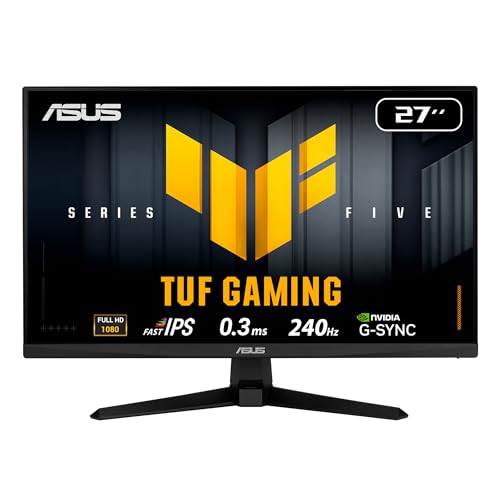
| ASUS TUF VG279QM5A 27 Inch 1080p 240Hz Fast IPS | Fast IPS | 1920 x 1080 | 240Hz | 0.3ms (min) |
| LG 24G414B-B 24-inch Ultragear IPS 1080p 144Hz 1ms | IPS | 1920 x 1080 | 144Hz | 1ms MBR |
| LG 24G411A-B 24-inch Ultragear Full HD | IPS | 1920 x 1080 | 120Hz (144Hz OC) | 1ms MBR |
Detailed Product Breakdown
1. LG 27GX704A-B 27-inch Ultragear QHD (2650×1440)
The LG 27GX704A-B sits at the performance peak of this group thanks to its 27-inch QHD OLED panel. Delivering a native 240Hz refresh rate alongside an ultra-low 0.03ms response time, it essentially eliminates motion ghosting during high-speed camera pans. It carries VESA DisplayHDR True Black 400 certification and covers 98.5% of the DCI-P3 color gamut, making it a standout option for dark-room gaming where deep contrast matters. For additional context on this display resolution, explore our guide to the best 1440p gaming monitors.
Connectivity is also robust, offering dual HDMI 2.1 ports, DisplayPort 1.4, and a built-in USB 3.2 hub for peripherals. The glossy screen finish accentuates sharpness and saturation, though users placed near bright, direct windows may notice ambient reflections. This display is best suited for enthusiasts with mid-to-high-end GPUs who want premium motion clarity and true HDR reproduction.
2. ASUS TUF Gaming VG27AQ3A 27 Inch 1440p 180Hz
The ASUS TUF Gaming VG27AQ3A strikes a practical balance between visual crispness and raw rendering demands. Its 2560 x 1440 resolution provides clean pixel density at 27 inches without punishing your graphics card as heavily as 4K. With a 180Hz refresh rate and Fast IPS panel, motion stays smooth while maintaining wide viewing angles and 130% sRGB color coverage.
A notable feature on this model is ASUS Extreme Low Motion Blur Sync (ELMB Sync), which allows backlight strobing to operate simultaneously with variable refresh rate. Integrated stereo speakers offer basic desktop audio when you do not want to wear a headset. Keep in mind that its HDR10 support is entry-level and will not deliver the striking specular highlights of localized dimming or OLED displays.
3. ASUS TUF VG279QM5A 27 Inch 1080p 240Hz Fast IPS
Designed primarily with competitive esports titles in mind, the ASUS TUF VG279QM5A focuses entirely on speed. The 240Hz refresh rate pairs with an advertised 0.3ms minimum response time to minimize tracking blur in fast first-person shooters. It supports both G-Sync compatibility and FreeSync Premium, ensuring tear-free operation across fluctuating frame rates.
The display relies on a 1920 x 1080 resolution stretched over a 27-inch diagonal. While this keeps frame rates high on entry-level graphics cards, it produces lower pixel density than a 24-inch 1080p or 27-inch 1440p panel, which can lead to softer text during productivity work. It is an ideal pick for players who prioritize frame delivery and competitive speed above pure fine-detail visual fidelity.
4. LG 24G414B-B 24-inch Ultragear IPS 1080p 144Hz 1ms
The LG 24G414B-B is a compact 24-inch IPS monitor tailored for mainstream setups and esports players who sit close to their screens. Its 1920 x 1080 resolution on a 24-inch canvas yields sharper pixel density than larger 1080p screens. Running natively at 144Hz with 1ms Motion Blur Reduction, it delivers responsive visual tracking in fast arena titles.
LG includes features like Dynamic Action Sync to trim processing latency and Black Stabilizer to reveal targets hiding in dark shadows. Built-in speakers provide casual audio output, while the LG Switch desktop app lets you organize split-screen window layouts easily. Its primary limitation is a modest static contrast ratio typical of standard IPS panels, which makes deep blacks appear slightly gray in a pitch-black room.
5. LG 24G411A-B 24-inch Ultragear Full HD
The LG 24G411A-B is an entry-level option that brings G-Sync compatible variable refresh rate to cost-conscious gamers. It features an IPS panel with 99% sRGB color gamut coverage and a native 120Hz refresh rate that can be overclocked to 144Hz through the display menu. If you are putting together your first gaming space, check out our guide on how to build a battlestation on a budget.
Gamers receive essential gaming software toggles like an on-screen crosshair overlay, Dynamic Action Sync, and Black Stabilizer. The monitor relies on a basic tilt-only stand, so users who need height adjustment or swivel will want to mount it to an aftermarket VESA arm. It represents a straightforward, dependable entry point for smooth 1080p PC gaming.
Key Factors When Choosing a G-Sync Monitor
Understanding monitor specifications prevents mismatched purchases that bottle up your PC performance. Keep these technical considerations in mind before selecting a screen.
G-Sync Compatible vs Hardware G-Sync
Most modern gaming monitors are classified as G-Sync Compatible. This means they utilize the open VESA Adaptive-Sync or DisplayPort variable refresh rate standard, validated by NVIDIA drivers to run without artifacts or flickering. They do not contain proprietary hardware modules, which keeps prices accessible while still providing seamless tear elimination over DisplayPort and modern HDMI connections.
Resolution and Screen Size Balance
Pixel density determines visual clarity. A 1080p resolution works best on a 24-inch diagonal, maintaining crisp text and sharp in-game edges. At 27 inches, 1440p (QHD) is generally the sweet spot, providing significantly sharper imagery without demanding the immense graphics horsepower required for 4K. If your desk setup accommodates wider screens, our roundup of the best ultrawide monitors covers expanded aspect ratios.
Panel Technology: IPS vs OLED
Fast IPS panels dominate mainstream gaming because they offer reliable color accuracy, wide viewing angles, and rapid transition times at reasonable manufacturing costs. OLED panels represent the premium tier, delivering per-pixel illumination with infinite contrast ratios and near-instantaneous pixel transitions. However, OLED monitors require higher investment and thoughtful desktop habits to avoid persistent image retention during prolonged static use.
Frequently Asked Questions
Do I need a DisplayPort cable to use G-Sync?
For most G-Sync Compatible monitors paired with desktop GeForce graphics cards, a DisplayPort connection is recommended to enable variable refresh rate in the NVIDIA Control Panel. Newer monitors equipped with HDMI 2.1 also support VRR over HDMI on GeForce RTX 30-series and newer graphics cards.
Does enabling G-Sync increase input lag?
G-Sync operates without the significant buffer-induced latency caused by traditional V-Sync. To maintain optimal responsiveness, gamers typically cap their frame rate two to three frames below the display maximum refresh rate and enable NVIDIA Reflex in supported games to stay inside the active VRR window.
Final Recommendation
For gamers wanting uncompromising visual fidelity, true HDR contrast, and exceptional motion clarity, the LG 27GX704A-B 27-inch Ultragear QHD (2650×1440) is the clear standout option. If your goal is a well-rounded 1440p gaming monitor with strong color coverage and a high refresh rate, the ASUS TUF Gaming VG27AQ3A 27 Inch 1440p 180Hz offers great all-around value. Those operating on a strict budget or building a competitive esports setup will find reliable responsiveness in the 24-inch LG 24G414B-B 24-inch Ultragear IPS 1080p 144Hz 1ms or the ultra-fast ASUS TUF VG279QM5A 27 Inch 1080p 240Hz Fast IPS.




Write Your Review
No reviews yet. Be the first to share your experience!