

Storage drive selection directly dictates how fast game levels load and how cleanly open worlds stream assets. Modern releases routinely require high throughput to prevent asset hitching during gameplay.
When selecting the best ssds for gaming inside complete desktop and laptop rigs, capacity matters just as much as protocol speed. A 1TB drive fills rapidly after installing three or four modern major releases, making secondary slots or 2TB configurations far more practical for long-term libraries.

Pros
- GeForce RTX 5060 Ti for 1080p and 1440p gaming
- Fast 1TB PCIe Gen4 NVMe SSD storage
- 650W 80 PLUS Gold certified power supply
- Four DIMM and two M.2 slots for expansion
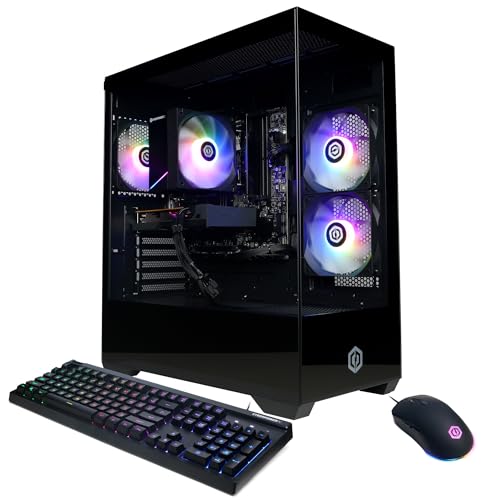
- Four ARGB fans provide ample airflow out of the box
Cons
- Uses previous-generation DDR4 memory rather than DDR5
- 8GB VRAM capacity may limit demanding future titles
- Legacy VGA and DVI monitors require separate adapters

Pros
- NVIDIA GeForce RTX 5070 Blackwell graphics
- 8-core AMD Ryzen 7 8700F processor
- Generous 32GB DDR5 memory and 2TB SSD
- Four pre-installed fans for active chassis airflow
- Convenient dedicated physical LED control button
Cons
- Equipped with CPU air cooling instead of liquid cooling
- Ships with Windows 11 Home rather than Pro
- Substantial 21.3-pound weight requires sturdy desk support

Pros
- NVIDIA GeForce RTX 5070 Laptop GPU
- Intel Core i7-13620H processor
- Slim 19.45mm chassis design
- Flexible 180-degree lay-flat hinge

Pros
- Capable 8-core AMD Ryzen 7 5700X processor
- Generous 32GB DDR4 memory configuration
- Fast 1TB M.2 NVMe storage
- Integrated Wi-Fi and Bluetooth wireless support
- 80 Plus Bronze certified power supply
Cons
- Built on older AM4 and DDR4 platform
- Specific graphics card brand varies by unit

Pros
- Powerful Core Ultra 9 and RTX 5070 Ti configuration
- Fluid 240Hz 2.5K ROG Nebula display
- Generous 32GB DDR5-5600MHz RAM included
- Comprehensive cooling with vapor chamber and tri-fan system
- Integrated Wi-Fi 7 for ultra-fast wireless networking
Cons
- Heavy 5.84-pound chassis limits portable use
- 1TB storage capacity fills rapidly with modern games
Quick Comparison of Storage Specifications
| System | Storage Capacity | Drive Interface | Expansion Potential |
|---|---|---|---|
| KOTIN Gaming PC Desktop, i5-14400F | 1TB | PCIe Gen4 NVMe M.2 | Two M.2 SSD slots documented |
| msi Codex Z2 Gaming Desktop, AMD R7-8700F | 2TB | PCIe Solid State Drive | Standard ATX desktop chassis |
| GIGABYTE Gaming A16 – Intel i7-13620H GeForce RTX | Not specified (PCIe) | PCIe M.2 NVMe | Laptop internal form factor |
| YAWYORE Gaming PC, AMD Ryzen 7 5700X | 1TB | PCIe M.2 NVMe | Micro-ATX B550 platform |
| ASUS ROG Strix G16 (2025) Gaming Laptop | 1TB | PCIe Gen4 NVMe M.2 | High-performance laptop chassis |
Individual Storage and Hardware Breakdown
KOTIN Gaming PC Desktop, i5-14400F
This mid-tower configuration pairs an Intel Core i5-14400F processor with a dedicated 1TB PCIe Gen4 NVMe drive. Gen4 transfer bandwidth ensures snappy operating system boot times alongside rapid map loading in demanding titles.
A notable benefit for storage-focused users is the documented inclusion of two M.2 SSD slots on the motherboard. This secondary slot allows you to drop in an additional high-capacity NVMe drive later without replacing the primary boot drive.
The primary restriction rests in its 16GB of DDR4 memory rather than DDR5, and an initial 1TB storage ceiling that will require expansion once your library expands across modern updates.
msi Codex Z2 Gaming Desktop, AMD R7-8700F
The MSI Codex Z2 provides a spacious 2TB solid state drive straight out of the box, paired with an AMD Ryzen 7 8700F processor. Having 2TB available from day one removes the immediate need to shuffle installs or purchase add-on storage.
The desktop platform runs 32GB of DDR5 memory and an RTX 5070 graphics card, providing balanced support for texture decompression pipelines in modern game engines. The roomy case layout also offers ample ventilation across four system cooling fans to maintain stable drive temperatures.
While the internal drive capacity is generous, MSI does not specify the exact read and write generation tiers of the pre-installed drive, making raw sequential transfer ceiling checks necessary upon delivery.
GIGABYTE Gaming A16 – Intel i7-13620H GeForce RTX
Built into a slim 19.45mm chassis, the Gigabyte A16 delivers portable performance powered by an Intel Core i7-13620H and an RTX 5070 mobile processor. Its onboard solid state drive provides quick resume functions and snappy access for gaming on the move.
The system is tailored for players who require mobile workstation capabilities alongside modern graphical fidelity. If you are pairing this setup with an external desktop display, check our guide to the best 1440p gaming monitors to maximize screen space.
Because this is a compact notebook chassis, internal storage expansion is restricted compared to a full-sized desktop tower. Thermal throttling during prolonged high-throughput file transfers can also occur under tight laptop constraints.
YAWYORE Gaming PC, AMD Ryzen 7 5700X
The YAWYORE desktop features a 1TB M.2 NVMe PCIe drive mounted to an MSI B550M-A PRO motherboard. Powered by an 8-core AMD Ryzen 7 5700X and 32GB of DDR4 memory, it handles asset loading without operational stutters.
The NVMe solid state drive connects directly via M.2 lanes to avoid the legacy bottlenecks of standard SATA storage drives. This ensures low system latency during background software installations and game patches.
Keep in mind that the compact micro-ATX B550 platform offers fewer expansion slots than standard ATX configurations. Users seeking multi-drive archival capacity will need to evaluate SATA expansion alternatives carefully.
ASUS ROG Strix G16 (2025) Gaming Laptop
The ASUS ROG Strix G16 carries a high-speed 1TB PCIe Gen4 SSD alongside an Intel Core Ultra 9 275HX processor and 32GB of DDR5-5600MHz memory. High bandwidth across both storage and system memory allows instantaneous level loading in modern esports titles.
Thermal management is backed by an end-to-end vapor chamber and tri-fan cooling array, keeping internal drives running beneath critical thermal throttling thresholds. The 240Hz ROG Nebula panel complements the system speed with fluid visuals.
For serious media editors and gamers with massive libraries, a 1TB drive can reach capacity quickly. Adding external fast storage or an additional internal M.2 module will eventually be required for multi-game collections.
How to Choose Fast Solid State Storage for Gaming
Selecting storage for a gaming rig involves balancing raw interface bandwidth against sustained drive thermal performance and total storage size. These baseline considerations outline what matters in practice.
PCIe Gen4 vs. Gen3 Protocol Speeds
PCIe Gen4 M.2 NVMe drives offer theoretical throughput limits reaching roughly 7,000 to 7,500 MB/s, doubling Gen3 ceilings. While baseline game launch times see diminishing returns past 3,500 MB/s, technologies like DirectStorage benefit substantially from Gen4 bandwidth.
Capacity Guidelines: 1TB vs. 2TB
Modern gaming installments frequently exceed 100GB individually once high-resolution texture packs and seasonal updates install. A 1TB drive holds the operating system and approximately four to six substantial titles before space becomes constrained.
Opting for a 2TB configuration, or selecting a system with secondary M.2 slots like the KOTIN desktop, offers breathing room. You can also review our advice on how to build the ultimate battlestation on a budget for component pairing insights.
Frequently Asked Questions
Does an SSD increase gaming frame rates?
An SSD does not directly raise peak frame rates, as graphics rendering remains bound to the GPU and CPU. However, an NVMe SSD eliminates loading pauses, reduces asset pop-in, and prevents micro-stutter when traversing open-world environments.
Is 1TB of SSD storage enough for a gaming setup?
A 1TB drive is sufficient for players who keep only a few active titles installed at any single time. Enthusiasts juggling multiple major titles will benefit from expanding to 2TB or installing a second dedicated game drive.



Write Your Review
No reviews yet. Be the first to share your experience!