

Finding the best pc speakers for gaming comes down to a balance between physical desk clearance, audio driver configuration, and connectivity. Many players rely on compact soundbars to fit beneath a monitor, while others prefer separated stereo speakers to track directional cues in competitive games.
Before purchasing audio hardware, verify whether your setup has available 3.5mm analog jacks, standard USB Type-A ports, or modern USB Type-C connectors. The guide below examines the physical footprints, connection methods, and acoustic hardware of 7 popular options to help match your battlestation layout.
Quick Comparison of Desktop Gaming Speakers
| Model | Form Factor | Drivers / Power | Connectivity | Key Advantage |
|---|---|---|---|---|
| OFFSIR 2 in 1 | Convertible 2.0 / Bar | Dual 5W drivers | 3.5mm AUX, USB Power | Splicing split or bar setup |
| Bluedee Sound Bar | Compact Soundbar | Dual drivers + dual diaphragms | Bluetooth 5.0, 3.5mm AUX | Wireless phone or PC streaming |
| LENRUE G11 | Compact Soundbar | 4 amplifier IC horns | 3.5mm AUX, USB-C / USB-A | Includes USB Type-C adapter |
| Redragon GS560 | Desktop Soundbar | Stereo drivers (16-inch bar) | 3.5mm AUX, USB Power | Music-reactive lighting display |
| Razer Leviathan V2 X | Gaming Soundbar | 2 full-range + 2 passive radiators | USB-C Audio/Power, Bluetooth 5.0 | Single-cable digital PC audio |
| Redragon GS520 | Traditional 2.0 Set | Enhanced 2.0 channel core | 3.5mm AUX + Mic, USB Power | Physical stereo width adjustment |
| Edifier G2000 | Angled 2.0 Satellites | 2.75-inch (16W RMS / 32W Peak) | USB Audio, Bluetooth, 3.5mm AUX | Dedicated sub-out and 10-degree tilt |

Pros
- Convertible design switches between satellite and soundbar setups
- Simple plug-and-play installation with no drivers required
- Touch control makes switching lighting modes effortless
- Dedicated knob provides smooth volume and power control
- Generous cable lengths accommodate wider desk layouts
Cons
- Requires both USB power and 3.5mm audio cables
- Lacks Bluetooth or other wireless connectivity options
- Modest 10W total output limits volume in larger spaces

Pros
- Compact form factor fits under computer monitors
- Dedicated top volume knob for easy control
- One-touch ambient lighting toggle
- Driver-free plug-and-play operation
- Includes USB-C adapter for broader connectivity
Cons
- Lacks Bluetooth wireless audio support
- No built-in microphone or headphone port
- Not compatible with televisions
Pros
- Versatile Bluetooth 5.0 and 3.5mm AUX inputs
- Compact low-profile design fits under monitors
- Driver-free plug-and-play USB power
- Braided Y-cable reduces desktop cord clutter
Cons
- Requires a continuous USB connection for power
- Lacks a dedicated AC wall power adapter
Pros
- Compact footprint fits underneath most desktop displays
- Convenient physical volume knob with integrated power switch
- Audio-synced RGB lighting with multiple display modes
- Simple plug-and-play setup requires no dedicated software
Cons
- Requires both USB power and 3.5mm audio connections
- No documented Bluetooth or wireless audio support
Pros
- Touch-controlled RGB lighting with an off setting
- Dedicated physical volume adjustment buttons
- Universal 3.5mm audio and USB power connection
- Compact footprint fits smaller workspaces
Cons
- 31-inch inter-speaker cable restricts wide desk separation
- Requires both USB and 3.5mm ports for operation

Pros
- Single USB-C cable handles audio and power
- Compact design fits easily under monitors
- Dual full-range drivers with passive radiators
- Bluetooth 5.0 for low-latency wireless pairing
- Customizable 14-zone Razer Chroma RGB lighting
Cons
- Not water-resistant
- Requires a USB Type-C port for PC connectivity
Pros
- Versatile USB, Bluetooth, and 3.5mm AUX connectivity
- Dedicated subwoofer output port for audio expansion
- Compact angled design directs audio toward the listener
- Built-in EQ presets for gaming, music, and movies
Cons
- External subwoofer required for full low-frequency extension
- Modest 16W RMS output limits peak volume
Top PC Speakers for Gaming Analyzed
Computer Speakers, 2 in 1 PC Speaker
The OFFSIR 2-in-1 system offers a versatile physical footprint by letting you snap the two stereo halves together into a central soundbar or position them apart as standalone towers. It uses dual 5W full-range acoustic drivers designed to run on standard USB bus power while receiving sound through a 3.5mm auxiliary cord.
With a 52-inch connecting cable between units and an overall cable reach of roughly 58 inches, this model easily accommodates wider desks or dual-screen workstations. The primary compromise is volume ceiling, as 5W stereo drivers powered strictly via 5V USB will naturally lack sub-bass punch during heavy explosions.
Bluedee Computer Speakers for Desktop PC
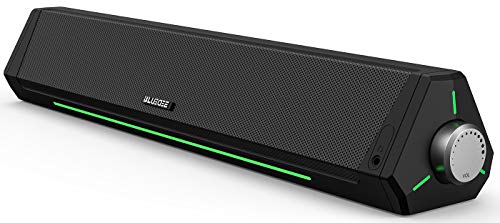
The Bluedee soundbar measures 16.4 inches wide by 2.6 inches tall, allowing it to slide cleanly under most raised displays without blocking your screen view. Internally, the speaker integrates dual acoustic drivers paired with dual passive diaphragms and anti-magnetic shielding to curb electromagnetic line buzz.
A notable benefit is dual-mode input switching between wired 3.5mm auxiliary audio and Bluetooth 5.0 wireless playback. Keep in mind that while the unified braided Y-cable reduces clutter, Bluetooth connectivity can present minor audio latency in fast-paced rhythm or first-person shooter titles.
LENRUE G11 Computer Speakers for Desktop
The LENRUE G11 focuses on high plug-and-play compatibility by packaging a native USB Type-C adapter alongside its standard USB power plug and 3.5mm line connector. Inside the low-profile enclosure, four amplifier IC horns drive midrange clarity suitable for team voice chat and streaming audio.
This design fits particularly well in modern gaming laptop setups where full-sized USB Type-A ports might be scarce. A clear operational limitation is that the unit lacks Bluetooth, auxiliary headphone passthrough ports, and an onboard microphone, meaning it functions solely as an external output speaker.
Redragon GS560 RGB Desktop Soundbar
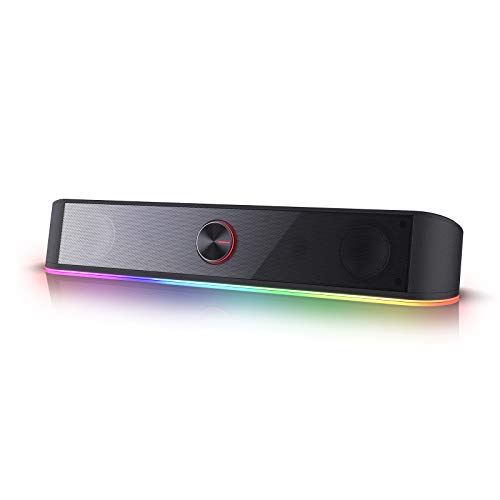
Redragon built the GS560 with an integrated audio-synced RGB light bar that reacts dynamically to active audio tracks, making it popular for themed battlestations. The compact 16-inch enclosure features a mechanical volume knob on the front face that doubles as the main power switch for fast adjustments mid-game.
The speaker runs on a basic dual-channel 2.0 configuration powered by a 5V USB source and 3.5mm sound jack. Because it relies entirely on a single horizontal housing, wide left-to-right stereo separation is naturally narrower compared to separate desktop satellite speakers.
Razer Leviathan V2 X, PC Soundbar with Full-Range
The Leviathan V2 X utilizes two full-range drivers supplemented by two passive radiators to deliver up to 90dB of sound output. Unlike standard analog options, it handles both system power and digital audio transmission through a single USB Type-C cable, eliminating analog ground loop interference.
Integration with Razer Synapse provides 14 customizable Chroma lighting zones and software-based equalizer management, alongside Bluetooth 5.0 pairing for mobile use. Note that this unit requires a high-power USB-C port on your motherboard or laptop to operate properly without power dropouts.
Redragon GS520 Wired 2.0 Channel Stereo Sound
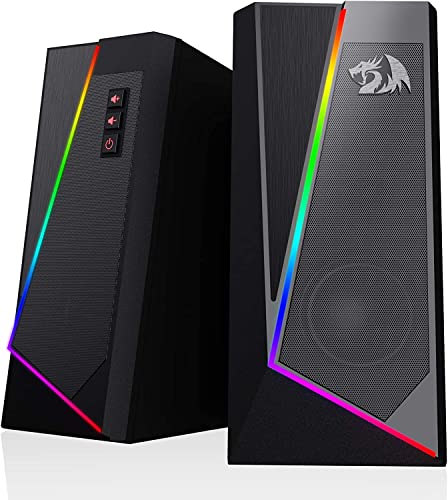
For players who prioritize directional spatial imaging, the Redragon GS520 provides two independent satellite speakers joined by an 80cm linking cable. Separating the speakers to either flank of your screen provides superior acoustic soundstaging for identifying enemy footstep positions in multiplayer matches.
Each tower features an urban brushed chassis with touch-activated RGB patterns on the base and physical volume up-and-down buttons. While directional separation is stronger than with an under-monitor soundbar, the extra cabling and dual desktop units require more open surface space on your desk.
Edifier G2000 32W PC Gaming Computer Speakers
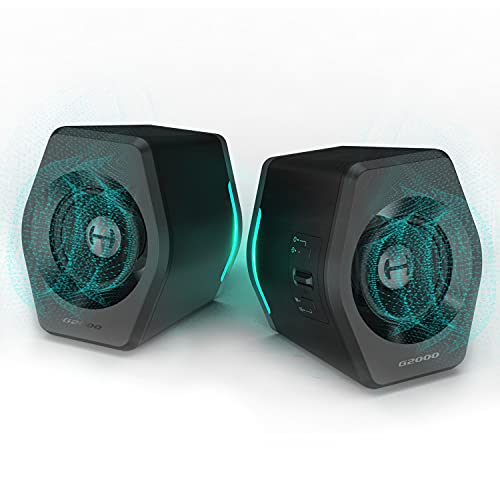
The Edifier G2000 stands out with 2.75-inch full-range drivers running at 16W RMS (32W peak) inside compact 10-degree elevated cabinets. That upward slant points sound directly toward the player’s ears, reducing desktop sound reflections and enhancing spatial dialogue clarity in movies and gaming.
Versatility is a core highlight here, featuring an internal USB sound card, Bluetooth playback, 3.5mm analog input, and a dedicated 3.5mm subwoofer output jack for future expansion. The primary trade-off is the bulkier hexagonal cabinet footprint and reliance on a dedicated external DC power supply rather than low-profile USB power.
How to Choose Gaming PC Speakers
Selecting the best pc speakers for gaming requires examining your physical desk layout and sound hardware interfaces. If you are refining a clean setup underneath one of the best 1440p gaming monitors, a single horizontal soundbar like the Bluedee or Razer Leviathan V2 X preserves open workspace.
Conversely, gamers working with a wide desk on an organized budget battlestation build often benefit from dedicated 2.0 satellite pairs like the Edifier G2000. Spreading speakers across the desk yields superior stereo staging, helping you pinpoint audio cues across competitive map environments.
Power delivery also alters your audio ceiling. USB-powered units are convenient because they turn on alongside your PC and require no wall outlet, but they generally feature 5W to 10W outputs. Independent wall-powered sets deliver significantly more dynamic headroom and higher maximum volume without distortion.
Frequently Asked Questions
Are soundbars or 2.0 speakers better for PC gaming?
Soundbars excel at conserving desk space and fitting cleanly beneath monitor stands. However, separate 2.0 channel speakers allow you to place left and right audio channels several feet apart, producing a wider soundstage that improves directional cue detection during competitive matches.
Can I run gaming speakers on USB power alone?
Yes, many compact models draw power through a 5V USB connection while receiving audio through a 3.5mm line. Modern soundbars like the Razer Leviathan V2 X go a step further by using a single USB-C cable to transmit both high-bandwidth digital audio and DC power simultaneously.
Does Bluetooth audio introduce lag in PC games?
Standard Bluetooth audio connections often introduce between 100ms and 200ms of latency, which can cause perceptible audio delays during fast-paced shooting or rhythm games. For competitive PC gaming, using a direct 3.5mm analog cable or low-latency USB connection is strongly recommended.




Write Your Review
No reviews yet. Be the first to share your experience!