

Finding the best PC for gaming comes down to matching graphics power, CPU architecture, and thermal capacity to your monitor resolution. Modern gaming PCs span from entry-level 1080p machines to high-end 4K rigs equipped with advanced ray tracing hardware.
If you prefer an assembled setup, our guide to the best prebuilt PC for gaming highlights how modern components interact straight out of the crate. Below, we compare 10 desktops evaluated across current hardware generations to help you choose the best system for your desk.
Top Desktops for Gaming Compared

Pros
- NVIDIA GeForce RTX 5070 Blackwell graphics
- 8-core AMD Ryzen 7 8700F processor
- Generous 32GB DDR5 memory and 2TB SSD
- Four pre-installed fans for active chassis airflow
- Convenient dedicated physical LED control button
Cons
- Equipped with CPU air cooling instead of liquid cooling
- Ships with Windows 11 Home rather than Pro
- Substantial 21.3-pound weight requires sturdy desk support

Pros
- GeForce RTX 5070 12GB and Ryzen 7 9700X hardware
- Fast 32GB DDR5 6000MHz memory
- Integrated 11.3-inch hardware monitoring smart screen
- Robust 360mm AIO liquid cooler included
- Modern WiFi 7 wireless connectivity
Cons
- 1TB SSD capacity may fill quickly with modern games
- VGA and DVI monitors require separate adapters

Pros
- High-performance AMD Ryzen 7 9850X3D processor
- Capable 16GB AMD Radeon RX 9070 XT GPU
- Pre-installed 360mm AIO liquid cooling solution
- Spacious and fast 2TB Gen4 NVMe SSD
- Generous 32GB of DDR5 memory pre-installed
Cons
- Specific graphics card manufacturer brand may vary
- Substantial chassis dimensions require significant desk space

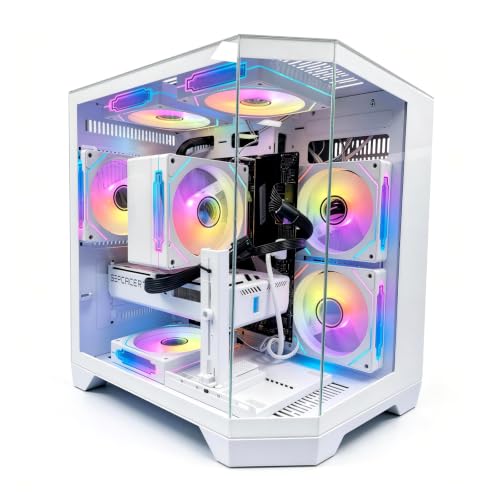
Pros
- Dedicated NVIDIA RTX 3060 Ti graphics
- Six-core AMD Ryzen 5 5500 processor
- Six pre-installed RGB case fans
- Dual-chamber panoramic glass design
Cons
- Limited 512GB internal storage capacity
- Uses previous-generation CPU architecture

Pros
- Capable 8-core AMD Ryzen 7 5700X processor
- Generous 32GB DDR4 memory configuration
- Fast 1TB M.2 NVMe storage
- Integrated Wi-Fi and Bluetooth wireless support
- 80 Plus Bronze certified power supply
Cons
- Built on older AM4 and DDR4 platform
- Specific graphics card brand varies by unit

Pros
- AMD Ryzen 9 7900X processor
- NVIDIA GeForce RTX 5070 12GB graphics
- 32GB DDR5 dual-channel memory
- Fast 1TB NVMe solid-state storage
- Includes gaming keyboard and mouse
Cons
- Uses older 802.11ac Wi-Fi standard
- Memory speed is limited to 4800MHz
- Heavy 36-pound desktop chassis

Pros
- AMD Ryzen 7 8700F and RTX 5060 Ti configuration
- High-speed 1TB PCIe Gen4 NVMe storage
- Latest-generation WiFi 7 wireless connectivity
- Expansion-ready motherboard with three M.2 slots
- Efficient 650W 80 PLUS Gold power supply
Cons
- Baseline 16GB RAM may require upgrading for heavy multitasking
- Requires separate adapters to support legacy VGA or DVI displays

Pros
- NVIDIA GeForce RTX 5070 graphics card
- Intel Core Ultra 7 265F processor
- Dell 1-year onsite hardware service included
- Customizable AlienFX chassis lighting zones
- Alienware Command Center performance monitoring
Cons
- Heavy chassis weighing nearly 34 pounds
- Modest 1 TB base storage capacity

Pros
- High-performance Ryzen 7 9800X3D and RTX 5070 Ti hardware
- Fast 2TB Gen4 NVMe solid-state storage
- Efficient 360mm liquid AIO CPU cooling solution
- High-speed 32GB DDR5 6000MHz system memory
- Clean operating system installation without bloatware
Cons
- Uses older 802.11ac Wi-Fi instead of newer standards
- Graphics card manufacturer and extra display ports vary
- Heavy chassis design weighing over 48 pounds

Key Hardware Breakdown for Gaming Desktops
Your graphics processing unit establishes your baseline visual settings and display frame rates. Modern NVIDIA RTX 50-series cards, such as the RTX 5070 and RTX 5080, introduce updated architectures alongside enhanced frame generation features. Meanwhile, high-capacity alternatives like the AMD Radeon RX 9070 XT offer 16GB of video memory to comfortably run heavy textures at high resolutions.
Processor choice dictates minimum frame rate consistency and background computing headroom. AMD X3D chips, including the Ryzen 7 9800X3D and Ryzen 7 9850X3D, employ expanded cache pools that minimize frame dips in competitive and simulation titles. For buyers targeting tighter price brackets, readers can reference our best prebuilt gaming PC under $1500 breakdown for balanced mid-tier configurations.
Cooling and System Enclosure Trade-Offs
Maintaining sustained clock speeds depends directly on your chassis airflow and CPU cooling hardware. Systems pairing high-draw chips with 360mm all-in-one liquid setups manage heat loads better during extended sessions than standard low-profile air towers. To explore thermal configurations in depth, take a look at our overview of the best liquid cooled gaming PC builds.
Prebuilts with proprietary cases, such as select compact OEM configurations, often trade component upgrade paths for a distinctive aesthetic. Standard ATX mid-towers allow easier motherboard, power supply, and graphics card replacements over several hardware generations.
Evaluating the Top Gaming PCs
The Skytech Gaming PC Desktop, Ryzen 7 9850X3D targets top-tier 4K performance by combining the AMD Ryzen 7 9850X3D with an NVIDIA GeForce RTX 5080 16GB card. Supported by 32GB of DDR5 memory and a 360mm liquid cooler inside a King 95 chassis, it serves demanding multi-taskers, though its footprint and hardware tier sit beyond entry-level needs.
For high-refresh 1440p and native 4K gaming, the Skytech Gaming PC Desktop, Ryzen 7 9850X3D pairs the same high-tier processor with the AMD Radeon RX 9070 XT 16GB card. This provides substantial VRAM headroom for modern asset streaming while maintaining 2TB of Gen4 storage.
Players focused on high-refresh esports and heavy simulations will appreciate the Skytech Gaming PC Desktop, Ryzen 7 9800X3D. It combines an AMD Ryzen 7 9800X3D with an RTX 5070 Ti 16GB card, striking an effective balance between specialized processor caching and mid-to-high graphical throughput.
If you are shopping near the two-thousand-dollar threshold, you can also review our roundup of the best gaming PC for under $2000. In that segment, the KOTIN Prebuilt Gaming PC RTX 5070 12GB delivers an AMD Ryzen 7 9700X, 32GB of DDR5 RAM, an 850W Gold power supply, and a built-in 11.3-inch monitoring display.
Similarly, the msi Codex Z2 Gaming Desktop, AMD R7-8700F pairs an 8-core AMD Ryzen 7 8700F with an RTX 5070 and a generous 2TB NVMe drive. Its four-fan cooling layout keeps components stable, providing a straightforward option from an established hardware manufacturer.
Those balancing streaming workloads alongside gaming might examine the iBUYPOWER Element Gaming PC Desktop Computer AMD. Its 12-core AMD Ryzen 9 7900X handles multi-threaded production tasks effectively, even though its 4800MHz DDR5 configuration clocks lower than enthusiast memory kits.
The Alienware Aurora Gaming Desktop, RTX 5070 integrates Intel’s Core Ultra 7 265F processor and an RTX 5070 GPU inside Dell’s proprietary chassis. It includes one-year onsite service coverage, which appeals to users who prioritize manufacturer support over standard ATX chassis upgrades.
For mid-range gaming on AM5 platforms, the KOTIN Gaming PC Desktop, Ryzen 7 8700F delivers an RTX 5060 Ti 8GB and WiFi 7 support. While its 16GB memory footprint is lighter than higher-end models, four DIMM slots provide an accessible upgrade route for the future.
Entry-level budgets are represented by the YAWYORE Gaming PC, AMD Ryzen 7 5700X, which matches an 8-core AM4 processor with an RTX 5060 8GB GPU and 32GB of DDR4 RAM. The older AM4 platform limits subsequent CPU upgrades, but it offers ample baseline memory out of the box.
Finally, the Olialia Gaming PC Prebuilt, RTX 3060 Ti pairs an AMD Ryzen 5 5500 with an RTX 3060 Ti graphics card. With a 512GB solid state drive and 16GB of system RAM, it stands as an economical pick for 1080p gaming with room for supplemental storage additions.
Prebuilt Gaming PC Buying Checklist
When selecting your desktop, confirm your monitor cable connects directly into the horizontal ports on the dedicated graphics card rather than the vertical motherboard outputs. Motherboard video ports will yield a blank display when connected to processors lacking integrated graphics.
Check the available expansion slots for solid state storage before making a purchase. Modern game installations frequently exceed one hundred gigabytes, making empty M.2 sockets or available SATA bays helpful for future game library growth.
Frequently Asked Questions
Is 16GB of system memory sufficient for modern gaming? Sixteen gigabytes remains standard for 1080p and mid-tier titles, but 32GB helps maintain smooth responsiveness when streaming software, voice applications, and browser windows run simultaneously alongside current AAA games.
What is the benefit of an AMD X3D processor? AMD X3D CPUs feature vertically stacked 3D V-Cache that keeps critical game instructions closer to the computing cores. This cache configuration reduces memory latency and delivers higher minimum frame rates in processor-bound titles.




Write Your Review
No reviews yet. Be the first to share your experience!