

Choosing the best gaming pc tower depends on whether you need a fully assembled prebuilt desktop or an empty chassis designed for a custom build. Modern desktop hardware demands dependable airflow, adequate power delivery, and physical clearance for expanding graphics cards. This specification-based breakdown evaluates complete desktop systems and standalone PC cases to match your target resolution and workload.
Top Recommended Gaming PC Towers for 2026

Pros
- GeForce RTX 5060 Ti for 1080p and 1440p gaming
- Fast 1TB PCIe Gen4 NVMe SSD storage
- 650W 80 PLUS Gold certified power supply
- Four DIMM and two M.2 slots for expansion
- Four ARGB fans provide ample airflow out of the box
Cons
- Uses previous-generation DDR4 memory rather than DDR5
- 8GB VRAM capacity may limit demanding future titles
- Legacy VGA and DVI monitors require separate adapters

Pros
- NVIDIA GeForce RTX 5070 Blackwell graphics
- 8-core AMD Ryzen 7 8700F processor
- Generous 32GB DDR5 memory and 2TB SSD
- Four pre-installed fans for active chassis airflow
- Convenient dedicated physical LED control button
Cons
- Equipped with CPU air cooling instead of liquid cooling
- Ships with Windows 11 Home rather than Pro
- Substantial 21.3-pound weight requires sturdy desk support

Pros
- Intel Core Ultra 7 265F multi-core processor
- NVIDIA GeForce RTX 5060 Ti dedicated graphics
- Alienware Command Center performance and lighting controls
- Customizable AlienFX chassis and stadium illumination
- Includes one year of Dell onsite service

Pros
- Four pre-installed PWM ARGB fans included
- Supports back-connect ATX and Micro-ATX motherboards
- Generous clearance for GPUs up to 420mm
- Tool-less side panels for fast interior access
- Accommodates up to 360mm top-mounted radiators
Cons
- Relatively heavy chassis weighing over 18 pounds unbuilt
- Fans reach up to 30.8 dBA at maximum speed

Pros
- Seven pre-installed PWM ARGB fans included
- 270-degree dual tempered glass panoramic layout
- Accommodates graphics cards up to 400 mm
- Top support for 360 mm liquid radiators
- Equipped with front-panel USB Type-C
Cons
- Tight 140 mm PSU clearance when using HDD cage
- Pre-installed fans offer modest 24.72 CFM airflow

Pros
- Capable 8-core AMD Ryzen 7 5700X processor
- Generous 32GB DDR4 memory configuration
- Fast 1TB M.2 NVMe storage
- Integrated Wi-Fi and Bluetooth wireless support
- 80 Plus Bronze certified power supply
Cons
- Built on older AM4 and DDR4 platform
- Specific graphics card brand varies by unit

Pros
- Generous 1TB solid-state storage capacity
- Integrated Wi-Fi 6 and Bluetooth 5.0 support
- Comes with six pre-installed RGB cooling fans
- Includes bundled RGB keyboard and mouse accessories
Cons
- Features an older AMD Radeon RX 580 graphics architecture
- Specific Intel Core i7 processor generation is not documented

Pros
- Generous 16GB RAM for smooth basic multitasking
- Modern Wi-Fi 6 and Bluetooth 5.0 connectivity
- Includes bundled RGB gaming keyboard and mouse
- Solid-state storage ensures fast operating system boot times
- Pre-installed Windows 11 Home operating system
Cons
- Entry-level RX 550 GPU struggles with modern AAA games
- Specific Intel Core i5 processor generation is not disclosed
- Modest 512GB SSD capacity fills quickly with large titles

Pros
- Dedicated 4GB GeForce GTX 1050 Ti graphics
- 512GB SSD for responsive system performance
- 16GB memory supports smooth multitasking
- Includes matching RGB keyboard, mouse, and speakers
- Integrated Wi-Fi connectivity and Windows 11 Pro
Cons
- Older 6th Gen Intel Core processor platform
- Relies on legacy DDR3L memory technology

Pros
- Dedicated 8GB Radeon RX 580 graphics card
- 16GB RAM supports reliable multitasking
- Modern Wi-Fi 6 and Bluetooth 5.0 wireless
- Includes bundled RGB keyboard and mouse
- Pre-installed Windows 11 Home operating system
Cons
- Specific Intel Core i7 generation is unspecified
- 512GB storage is limited for multiple modern games
- Older GPU architecture lacks advanced modern rendering features
Prebuilt Gaming PC Towers: High-End and Mid-Range Models
Complete systems eliminate the assembly process and provide out-of-the-box hardware integration. If you are comparing configurations around intermediate price brackets, our evaluation of the best gaming PC under $1500 provides helpful context for balancing graphics processing with system memory.
msi Codex Z2 Gaming Desktop
The msi Codex Z2 Gaming Desktop, AMD R7-8700F is designed around modern components suited for demanding AAA gaming and multitasking. It pairs an 8-core AMD Ryzen 7 8700F processor boosting up to 5.0 GHz with NVIDIA GeForce RTX 5070 graphics based on the Blackwell architecture. A generous 32GB of DDR5 system memory and a 2TB solid-state drive provide rapid load speeds and room for extensive game libraries.
Thermal management relies on an ARGB air cooler alongside four pre-installed case fans arranged with three front intakes and one rear exhaust. The chassis integrates an LED switch button on the front panel to toggle RGB lighting profiles without mandatory desktop utility adjustments. This configuration targets gamers playing modern releases at high resolutions who require contemporary platform architecture.
KOTIN Gaming PC Desktop
The KOTIN Gaming PC Desktop, i5-14400F targets fluid 1080p and 1440p gaming with an Intel Core i5-14400F processor and an NVIDIA GeForce RTX 5060 Ti 8GB graphics card. Storage is handled by a 1TB PCIe Gen4 NVMe drive, complemented by 16GB of DDR4 memory across two modules. A 6-heatpipe air cooler and four 120mm ARGB case fans maintain consistent thermal dissipation during demanding gameplay sessions.
System expansion is supported by four DDR4 DIMM slots, two M.2 storage slots, and a 650W 80 PLUS Gold power supply unit. Connectivity features include integrated Wi-Fi, Bluetooth, and standard display outputs on the lower graphics bracket. It serves buyers seeking a dependable 1440p platform with an efficient power unit and straightforward component upgrade paths.
Alienware Gaming Desktop
The Alienware Gaming Desktop, RTX 5060 Ti features an Intel Core Ultra 7 265F processor combined with an NVIDIA GeForce RTX 5060 Ti graphics card. Housed in Alienware’s Basalt Black chassis, the system integrates proprietary stadium lighting zones managed directly through the Alienware Command Center suite. The system architecture is built to support sustained power distribution across intensive gaming sessions and streaming workloads.
Dell includes a one-year onsite service warranty that covers hardware repairs at the user location when remote diagnosis cannot solve issues. While proprietary motherboard layouts inside brand-specific enclosures can limit standard aftermarket swaps, the system delivers structured performance control profiles and immediate factory support.
YAWYORE Gaming PC
The YAWYORE Gaming PC, AMD Ryzen 7 5700X combines an 8-core AMD Ryzen 7 5700X CPU with a GeForce RTX 5060 8GB GDDR7 graphics card. It is assembled around an MSI B550M-A PRO motherboard and features 32GB of DDR4 3200MHz memory along with a 1TB M.2 NVMe SSD. A 650W 80 PLUS Bronze certified power supply supplies reliable electrical overhead for internal components.
This desktop incorporates built-in Wi-Fi and Bluetooth to facilitate untethered peripheral pairing and network connectivity. The inclusion of an older AM4 socket means future processor upgrades are restricted compared to AM5 platforms, but the system provides ample RAM for heavy background applications.
Standalone Gaming PC Tower Cases for Custom Builds
Building your own computer allows complete control over component matching, power margins, and cooling configuration. A well-designed mid-tower case ensures adequate internal clearance for large modern graphics cards and oversized liquid cooling radiators.
Lian Li V100-ATX Mid-Tower PC Case
The Lian Li V100-ATX Mid-Tower PC Case-Black-V100RX is engineered to house expansive gaming hardware while maintaining clean cable management. It accommodates ATX, Micro-ATX, and Mini-ITX motherboards, including modern back-connect board layouts that conceal main wiring behind the tray. The internal layout supports graphics cards up to 420mm in length, CPU tower coolers up to 178mm, and liquid radiators up to 360mm on top.
Four pre-installed 120mm PWM ARGB fans provide adjustable airflow running up to 1800 RPM with hydraulic bearings for quieter continuous rotation. Tool-less side panels expedite hardware installation and maintenance routines. Builders seeking spacious GPU clearance and clean front-to-back airflow will find this chassis straightforward to assemble.
MUSETEX ATX PC Case K2
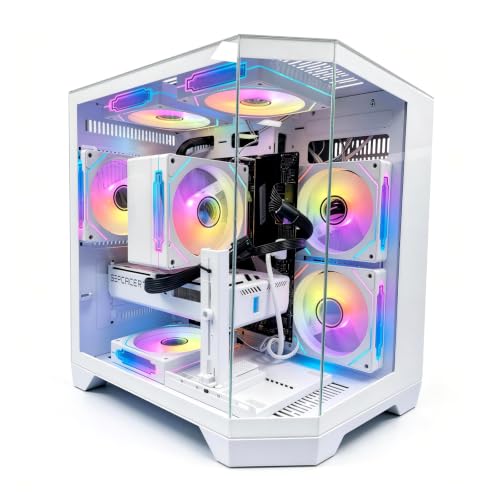
The MUSETEX ATX PC Case 7 PWM ARGB Fans Pre-Installed emphasizes panoramic component visibility using a 270-degree dual tempered glass enclosure. The chassis comes equipped with seven pre-installed PWM ARGB fans, structured with three reverse-blade intake fans on the side and four traditional exhaust fans. Fan speeds adjust between 600 and 1300 RPM through standard motherboard software headers.
Hardware clearance permits GPUs up to 400mm long, CPU air coolers up to 165mm tall, and top-mounted 360mm radiators. The front I/O panel includes a Type-C port alongside dual USB 3.0 ports for rapid data transfer. Builders must verify power supply length, as clearance is restricted to 140mm when retaining the internal hard drive cage.
Entry-Level and Legacy Desktop Towers
Budget-tier desktops often utilize older architectures to keep purchase prices low. Buyers should understand the hardware limitations of legacy platforms when playing newer gaming titles.
STGAubron Core i7 Desktop (1TB SSD)
The STGAubron Gaming PC Desktop,Core i7,RX 580 8G,16G pairs an older Intel Core i7 processor boosting to 3.9GHz with an AMD Radeon RX 580 8GB graphics card. It is outfitted with 16GB of system memory, a 1TB solid-state drive, and six internal RGB cooling fans. Connectivity features include Wi-Fi 6, Bluetooth 5.0, three DisplayPort outputs, and an HDMI connection.
The system is tailored for entry-level titles, general web use, and lighter esports games. However, because the RX 580 relies on older Polaris architecture, modern titles demanding current DirectX features or advanced driver suites will experience distinct performance ceilings.
STGAubron Core i7 Desktop (512GB SSD)
The STGAubron Gaming PC Desktop,Core I7,RX 580 8G,16G uses the same foundational Core i7 and Radeon RX 580 8GB combination as its sibling model, but ships with a 512GB SSD. The enclosure integrates four RGB cooling fans and arrives packaged with an RGB gaming mouse and keyboard bundle. It functions as an affordable secondary system for older game libraries, though storage space will fill rapidly with multiple modern installations.
STGAubron Core i5 Desktop
The STGAubron Gaming PC Desktop,Core I5,RX 550 4G,16G is an entry-tier configuration featuring a Core i5 processor boosting up to 3.6GHz and an AMD Radeon RX 550 4GB graphics card. With 16GB of RAM and a 512GB solid-state drive, it manages casual office tasks, basic computing, and older esports titles. Demanding modern graphics workloads exceed the processing capability of the low-profile RX 550 card.
Dell RGB Gaming Tower Computer
The Dell RGB Gaming Tower Computer is a renewed desktop system built inside a Dell OptiPlex chassis. It features a sixth-generation Intel Core i7-6700 processor running at 3.40GHz, 16GB of legacy DDR3L memory, and an NVIDIA GeForce GTX 1050 Ti 4GB graphics card. A 512GB SSD hosts Windows 11 Pro, accompanied by aftermarket RGB accessories.
While practical for retro PC gaming, schoolwork, and casual light titles, the platform relies on hardware nearly a decade old. Users cannot easily upgrade the proprietary motherboard and power supply, making it an option only for shoppers seeking basic everyday usability on a tight budget.
Key Hardware Specifications Compared
Evaluating hardware architecture across prebuilt models reveals critical differences in component generations, memory technologies, and storage capacity.
| Desktop Tower Model | Processor | Graphics Card | System RAM | Storage Capacity |
|---|---|---|---|---|
| MSI Codex Z2 | AMD Ryzen 7 8700F | NVIDIA RTX 5070 | 32GB DDR5 | 2TB SSD |
| KOTIN Desktop | Intel Core i5-14400F | NVIDIA RTX 5060 Ti 8GB | 16GB DDR4 | 1TB NVMe SSD |
| Alienware Desktop | Intel Core Ultra 7 265F | NVIDIA RTX 5060 Ti | Not specified | Not specified |
| YAWYORE Desktop | AMD Ryzen 7 5700X | GeForce RTX 5060 8GB | 32GB DDR4 | 1TB NVMe SSD |
| STGAubron i7 (1TB) | Intel Core i7 (up to 3.9GHz) | Radeon RX 580 8GB | 16GB | 1TB SSD |
| STGAubron i7 (512GB) | Intel Core i7 (up to 3.9GHz) | Radeon RX 580 8GB | 16GB | 512GB SSD |
| STGAubron i5 | Intel Core i5 (up to 3.6GHz) | Radeon RX 550 4GB | 16GB | 512GB SSD |
| Dell RGB Tower | Intel Core i7 6th Gen | GeForce GTX 1050 Ti 4GB | 16GB DDR3L | 512GB SSD |
How to Select the Best Gaming PC Tower
Finding a suitable computer tower involves balancing processing components, chassis airflow, and future upgrade capability. Consider these factors prior to finalizing a purchase.
1. Graphics Card Capability and Resolution Targets
Your graphics processing unit dictates game resolution and visual fidelity. Current cards like the RTX 5070 and RTX 5060 Ti handle high-frame-rate 1440p gaming and modern ray tracing routines easily. Older units such as the RX 580, RX 550, and GTX 1050 Ti lack modern architectural optimizations and are limited to lighter 1080p competitive settings.
2. Platform Generation and Memory Standards
Modern processors like the Ryzen 7 8700F and Intel Ultra 7 265F utilize DDR5 memory and contemporary motherboard sockets that offer long-term compatibility. Systems utilizing DDR4 or older DDR3L memory are fixed on end-of-life platforms that cannot receive newer CPU drop-in upgrades without a total motherboard overhaul.
3. Chassis Cooling and Airflow Dynamics
High-wattage components produce considerable thermal output. Desktops and cases with front mesh intakes, four or more pre-installed fans, and clearance for 360mm radiators maintain steady operational temperatures. Stabilizing thermal headroom also protects performance when connected to high-performance peripherals or low-latency network hardware such as the gear explored in our best gaming routers for low ping overview.
Frequently Asked Questions
Should I purchase a prebuilt gaming tower or build inside a standalone case?
Prebuilt towers provide immediate convenience, factory warranties, and pre-installed operating systems, making them ideal for buyers who want plug-and-play functionality. Building inside a standalone case such as the Lian Li V100 allows customized component quality, superior wire management, and simpler future repairs.
Why must monitors connect directly to the graphics card?
Connecting display cables to upper motherboard video ports routes video signals through the processor, which either yields a black screen on “F” series processors without integrated graphics or runs off underpowered integrated silicon. Always attach HDMI and DisplayPort cables to the horizontal graphics card ports located lower on the chassis back panel.


Write Your Review
No reviews yet. Be the first to share your experience!