

Selecting among the best rtx gaming laptops requires looking past the graphics model number alone. Display panel clarity, cooling headroom, and factory memory allocations significantly alter real-world gaming performance and sustained frame rates.
NVIDIA RTX 50-series mobile GPUs introduce architecture revisions alongside technologies like DLSS 4 neural rendering. Evaluating these machines based on documented hardware specifications ensures you invest in hardware tailored to your specific gaming and productivity needs.

Pros
- Fast 180Hz refresh rate with 100% sRGB coverage
- Equipped with latest generation NVIDIA GeForce RTX 5060 graphics
- Pre-installed with 32GB high-speed DDR5 RAM
- Includes an open M.2 slot for storage upgrades
Cons
- System memory is capped at the installed 32GB limit
- Display is limited to 1920 x 1200 resolution
Quick Comparison: RTX Gaming Laptop Specifications
| Model | GPU | Processor | Display | RAM / Storage |
|---|---|---|---|---|
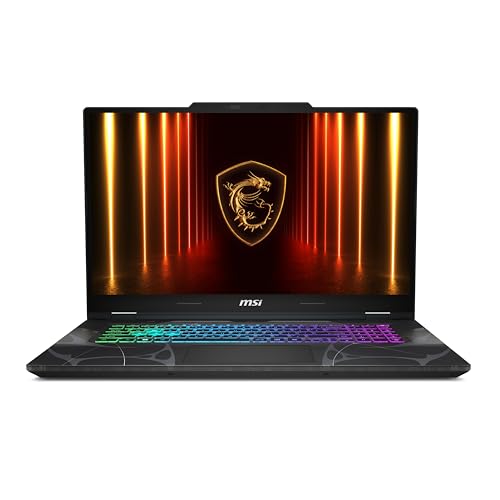
| msi Cyborg 17 17.3″ FHD 144Hz Gaming Laptop | RTX 5060 Laptop GPU | Intel Core 7-240H | 17.3-inch FHD (1920×1080) 144Hz | 16GB DDR5 / 1TB NVMe SSD |
| Acer Nitro V 16S AI Gaming Laptop | RTX 5060 Laptop GPU | AMD Ryzen 7 260 | 16-inch WUXGA (1920×1200) 180Hz 100% sRGB | 32GB DDR5 / 1TB Gen 4 SSD |
| ASUS ROG Strix G16 (2025) Gaming Laptop | RTX 5070 Ti Laptop GPU | Intel Core Ultra 9 275HX | 16-inch 2.5K (2560×1600) 240Hz 3ms | 32GB DDR5 / 1TB Gen 4 SSD |
The Best RTX Gaming Laptops Reviewed
1. msi Cyborg 17 17.3″ FHD 144Hz Gaming Laptop
The msi Cyborg 17 17.3″ FHD 144Hz Gaming Laptop provides desktop-style viewing space in a relatively slender profile. At 0.83 inches thick and 5.5 pounds, it pairs a large 17.3-inch 144Hz display with an Intel Core 7-240H processor and NVIDIA GeForce RTX 5060 graphics.
Targeting 1080p competitive esports and mid-tier modern titles, this laptop relies on MSI Cooler Boost shared-pipe cooling to maintain consistent operating speeds. Connectivity is well rounded with dedicated USB-C, USB-A, HDMI, an RJ45 Ethernet port, and modern Wi-Fi 6E networking.
A notable trade-off is the base configuration memory, which sits at 16GB DDR5. While sufficient for most standard gaming sessions, heavier multitaskers and video editors may eventually want to expand system memory for resource-heavy projects.
2. Acer Nitro V 16S AI Gaming Laptop
The Acer Nitro V 16S AI Gaming Laptop focuses on productivity balance and high frame rate visual clarity. Powered by an AMD Ryzen 7 260 processor and an RTX 5060 GPU, it features a 16-inch 16:10 WUXGA display that operates at a fluid 180Hz refresh rate.
A major advantage of this build is its inclusion of 32GB of DDR5 memory right out of the box, alongside a fast 1TB Gen 4 SSD. Content creators will appreciate the 100% sRGB color gamut coverage, which ensures dependable color accuracy during creative editing passes.
However, the 1920×1200 resolution targets smooth 1080p-class gaming rather than ultra-dense pixel fidelity. If your desk setup already includes one of the best 1440p gaming monitors, you may prefer driving external displays to maximize graphics sharpness.
3. ASUS ROG Strix G16 (2025) Gaming Laptop
For high-tier performance, the ASUS ROG Strix G16 (2025) Gaming Laptop delivers enthusiast specifications. It couples an Intel Core Ultra 9 275HX processor with an NVIDIA GeForce RTX 5070 Ti graphics card to push demanding workloads and intensive ray tracing.
The standout feature is its 16-inch ROG Nebula 2.5K display, running at 240Hz with a quick 3ms response time. Thermal management uses an end-to-end vapor chamber, tri-fan arrangement, and Conductonaut Extreme liquid metal on the processor for sustained high clock frequencies.
The trade-off is the substantial price jump compared to entry-tier rigs, alongside a gaming-focused aesthetic with wraparound RGB accents. Although Stealth Mode disables the lighting for office environments, the chassis remains built squarely around thermal bulk and raw power.
How to Choose the Best RTX Gaming Laptops
Selecting the right laptop requires balancing GPU tiering against resolution. An RTX 5060 laptop provides excellent native performance at 1080p and 1200p, whereas an RTX 5070 Ti holds the graphical bandwidth needed to render games natively on 1440p and 1600p panels.
System memory also dictates long-term reliability for upcoming games and creative tools. While 16GB handles straightforward gaming, 32GB setups eliminate stuttering during heavy multitasking, local game recording, and background asset streaming.
Finally, screen dimensions and chassis designs impact overall portability. Larger 17.3-inch panels offer immersive standalone views at the expense of footprint, whereas 16-inch 16:10 chassis provide a practical middle ground for transport and bag storage.
Which Laptop Fits Your Setup?
If you prioritize display real estate without adding extreme chassis thickness, the msi Cyborg 17 17.3″ FHD 144Hz Gaming Laptop is a sensible desktop alternative. For creators who want 32GB of system memory and full sRGB color accuracy, the Acer Nitro V 16S AI Gaming Laptop offers great baseline value.
Gamers demanding maximum frame rates, a 2.5K 240Hz panel, and advanced vapor chamber thermals should look toward the ASUS ROG Strix G16 (2025) Gaming Laptop. Matching your target resolution and memory requirements will ensure you choose the ideal mobile rig.




Write Your Review
No reviews yet. Be the first to share your experience!