

Choosing the best 144hz gaming monitors requires balancing panel technology, native resolution, and adaptive sync support. A 144Hz or higher refresh rate reduces input lag and eliminates perceived motion judder, provided your graphics card can deliver matching frame rates. In this guide, we analyze 10 displays based on documented specifications, port selection, and panel performance.

Pros
- 144Hz overclocked refresh rate
- NVIDIA G-SYNC and AMD FreeSync support
- IPS panel with 99% sRGB coverage
- 1ms Motion Blur Reduction mode
- DisplayPort and HDMI connectivity
Cons
- Stand provides tilt adjustment only
- 144Hz refresh rate requires overclocking

Pros
- Fluid 180Hz refresh rate with 1ms response time
- Sharp 27-inch QHD Fast IPS display
- Simultaneous ELMB and variable refresh rate technology
- G-Sync compatible and FreeSync Premium support
- Wide 130% sRGB color gamut coverage
Pros
- Smooth 144Hz refresh rate with AMD FreeSync
- Color-accurate IPS panel with wide viewing angles
- Dual HDMI ports for multi-device setups
- TÜV Rheinland certified blue light reduction
- Slim bezels suitable for multi-monitor arrangements
Cons
- Ergonomic adjustments limited to tilt only
Pros
- Smooth 144Hz refresh rate with FreeSync support
- IPS panel with wide 178-degree viewing angles
- TÜV Rheinland certified flicker-free and low blue light
- VESA 100x100mm mount compatibility
Cons
- Stand adjustment limited to tilt only
- Lacks DisplayPort connectivity
- 1080p resolution provides lower pixel density at 27 inches

Pros
- Overclockable 146Hz refresh rate with 1ms response time
- IPS panel ensures consistent colors and wide viewing angles
- ASUS ELMB Sync minimizes motion blur and tearing
- Integrated speakers save desk space
- Backed by a three-year manufacturer warranty
Cons
- Full HD resolution provides limited screen real estate
- Modest refresh rate headroom over standard 144Hz displays

Pros
- Smooth 144Hz refresh rate
- Sharp 1080p resolution on a 22-inch screen
- Standard 75x75mm VESA mount support
- Wide 178-degree horizontal and vertical viewing angles
Cons
- No built-in speakers
- Stand adjustment is limited to tilt
- Lacks DisplayPort connectivity

Pros
- Fast refresh rate reaching up to 144Hz
- Includes DisplayPort and HDMI connection options
- Thin bezels ideal for dual-display setups
- Built-in speakers preserve physical desk space
- Blue-Light Shift feature for eye comfort
Cons
- Compact 22-inch screen limits total viewing real estate

Pros
- Smooth 144Hz IPS panel with vivid colors
- Supports both G-SYNC Compatible and FreeSync
- Height and tilt adjustable ergonomic stand
- Built-in stereo speakers and headphone port
- Dynamic Action Sync reduces input lag
Cons
- 1ms response rating requires Motion Blur Reduction
- 1080p resolution limits workspace compared to 1440p
Pros
- Smooth 144Hz refresh rate with FreeSync support
- IPS panel with wide 178-degree viewing angles
- TÜV Rheinland certified eye protection features
- Standard VESA 100x100mm mount compatibility
- Supports both modern HDMI and legacy VGA connections
Cons
- Stand is limited to tilt adjustments only

Pros
- Expansive 49-inch 32:9 panoramic workspace
- Fluid 144Hz refresh rate with 1ms response
- AMD FreeSync Premium Pro tear-free gaming
- Hardware Picture-by-Picture and Picture-in-Picture support
- Immersive 1000R curved screen radius
Cons
- Large 45-inch width demands extensive desk space
- Heavy 34-pound total weight requires sturdy desk support
Individual Monitor Analyses and Specifications
LG 24G411A-B 24-inch Ultragear Full HD
The LG 24G411A-B 24-inch Ultragear Full HD utilizes an IPS panel with 1920×1080 resolution, a native 120Hz refresh rate, and an available 144Hz overclock. It includes AMD FreeSync and Nvidia G-Sync Compatible certification to prevent screen tearing during variable frame rate scenarios. The panel covers roughly 99 percent of the sRGB color space, making it visually dependable for both gaming and daily productivity.
For motion clarity, LG includes a 1ms Motion Blur Reduction (MBR) backlight strobing mode alongside Dynamic Action Sync to minimize processing latency. Note that achieving the full 144Hz output requires enabling panel overclocking within the monitor firmware settings. Furthermore, its HDR10 capability is entry-level metadata support rather than true high-dynamic-range hardware with local dimming.
ASUS TUF Gaming VG27AQ3A 27 Inch 1440p 180Hz
The ASUS TUF Gaming VG27AQ3A 27 Inch 1440p 180Hz steps beyond standard 1080p, delivering a 2560×1440 resolution across a 27-inch Fast IPS panel. This size and resolution combination is widely considered the sweet spot for pixel density in modern PC gaming. If you are comparing mid-range resolutions, explore our breakdown of the best 1440p gaming monitors to see how panel types stack up.
Equipped with FreeSync Premium, G-Sync compatibility, and ASUS ELMB Sync, this monitor allows backlight strobing and variable refresh rates to operate simultaneously. The panel achieves up to a 180Hz refresh rate, giving headroom above baseline 144Hz panels. Keep in mind that pushing modern games to 1440p at high frame rates requires a mid-range to high-end discrete GPU.
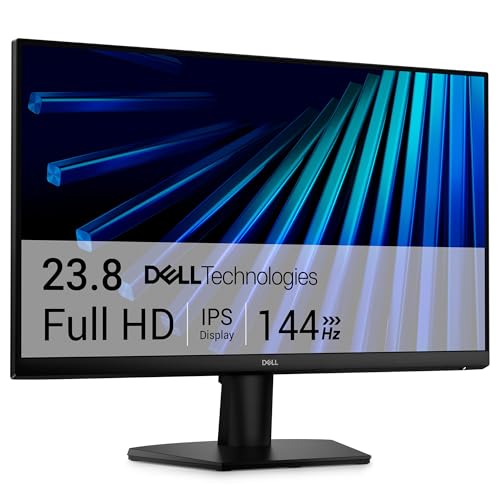
Dell 24 Monitor – SE2426H
The Dell 24 Monitor – SE2426H is a minimalist 23.8-inch 1080p display that supports a native 144Hz refresh rate over its dual HDMI inputs. It features an IPS panel with wide 178-degree viewing angles and a 1ms MPRT rating for reduced blur during transitions. Dell adds TÜV Rheinland 3-star eye comfort certification with integrated hardware low blue light filtering.
This monitor works well as a dual-purpose office and gaming display, particularly for compact desks. Because it only includes HDMI inputs, users with older DisplayPort-only graphics card setups may require an adapter or cable conversion. Ergonomic adjustments are limited strictly to panel tilt, meaning a third-party mount is needed for height customization.
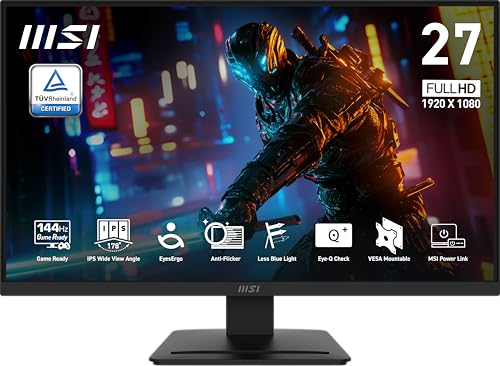
msi PRO MP273L E14 27-inch IPS 1920 x 1080 (FHD)
The msi PRO MP273L E14 27-inch IPS 1920 x 1080 (FHD) combines a larger 27-inch viewing area with a 144Hz refresh rate and FreeSync support. It delivers a static contrast ratio of 1500:1, which is moderately higher than standard 1000:1 IPS panels, improving dark scene clarity. Connectivity covers both HDMI 2.0 and a legacy VGA port for compatibility with older office systems.
Spreading a 1080p resolution across a 27-inch panel results in a lower pixel density of approximately 81 pixels per inch, meaning text looks softer compared to 24-inch models. However, this lower density reduces strain for users sitting further back. The monitor supports standard 100x100mm VESA mounting and includes built-in eye fatigue assessment software.
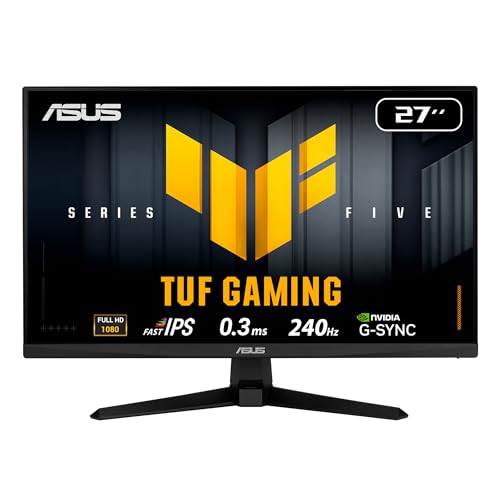
ASUS TUF Gaming 24” (23.8” viewable)
The ASUS TUF Gaming 24” (23.8” viewable) (VG249QE5A) offers a compact 1080p Fast IPS configuration with an overclockable refresh rate reaching 146Hz. It features ASUS ELMB Sync technology, variable overdrive adjustments, and Shadow Boost to improve shadow visibility in competitive games. It also integrates basic stereo speakers and DisplayWidget Center desktop control.
The 23.8-inch screen size keeps pixel density sharp at Full HD, making enemy tracking straightforward without demanding excessive GPU rendering power. It is ideal for esports titles such as Counter-Strike 2, Valorant, or Apex Legends. Note that the included stand offers basic tilt adjustment, so an aftermarket desk arm is recommended for vertical positioning.
ArcticPro 22 Inch Gaming Monitor 144Hz
The ArcticPro 22 Inch Gaming Monitor 144Hz is built around a compact 21.5-inch to 22-inch VA panel outputting Full HD at 144Hz. Thanks to its VA panel structure, it provides higher contrast performance than typical entry-level IPS alternatives, with color coverage reaching 105 percent sRGB. Connectivity options include HDMI and VGA inputs alongside 75x75mm VESA bracket compatibility.
Because VA panels naturally exhibit slower dark pixel response transitions, some dark-level smearing may be visible in fast-paced motion scenes. It lacks integrated speakers, requiring separate headphones or external desktop speakers for audio playback. This display primarily suits tight desk spaces where larger 24-inch or 27-inch frames cannot physically fit.
Sceptre New 22-Inch Gaming Monitor, FHD 1080p
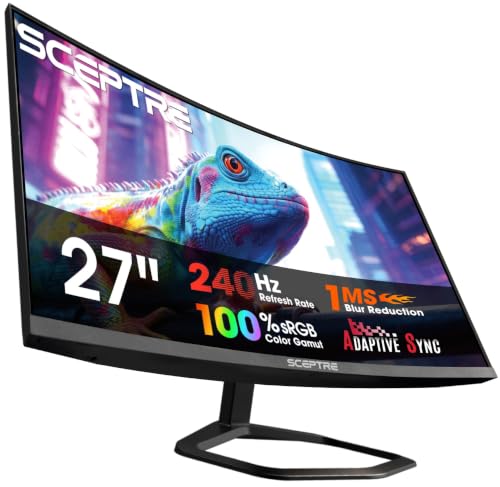
The Sceptre New 22-Inch Gaming Monitor, FHD 1080p (E225W-FW144) is another space-saving option offering 1080p resolution at 144Hz. Unlike many compact budget screens, it includes both DisplayPort and HDMI ports, ensuring versatile compatibility with modern graphics cards. It also features integrated stereo speakers and Blue-Light Shift settings for daily viewing comfort.
The minimal bezel design allows it to slot neatly into compact multi-monitor setups or budget battle stations. Readers planning full desktop overhauls on a tight budget should consult our guide on how to build a budget gaming battlestation. As with most low-profile integrated speakers, sound output is utilitarian and best reserved for basic notification chimes.
LG 24G414B-B 24-inch Ultragear IPS 1080p 144Hz 1ms
The LG 24G414B-B 24-inch Ultragear IPS 1080p 144Hz 1ms provides native 144Hz refresh speeds without requiring manual overclocking profiles. Built around an IPS panel with 99 percent sRGB coverage, it ensures stable color accuracy across wide viewing angles. It supports Nvidia G-Sync Compatibility, AMD FreeSync, and 1ms MBR blur reduction.
Unlike its 24G411A sibling, the 24G414B-B integrates built-in stereo speakers alongside a headphone output pass-through for gaming headsets. It also supports the LG Switch application, which enables easy window snapping and display quadrant management. The physical stand is basic, making a monitor arm a helpful addition for ergonomic setups.
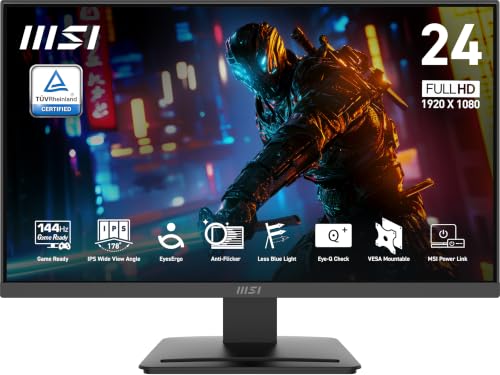
msi PRO MP243L E14 24-inch IPS 1920 x 1080 (FHD)
The msi PRO MP243L E14 24-inch IPS 1920 x 1080 (FHD) matches the 1500:1 contrast ratio of its 27-inch counterpart within a sharper 23.8-inch display format. It operates at 144Hz natively, backed by AMD FreeSync to eliminate visual stutter across shifting frame rates. The unit provides TÜV-certified flicker-free operation and low blue light hardware certification.
Input connections consist of HDMI 2.0 with HDMI-CEC functionality and a VGA input for older PCs. The smaller 24-inch size yields a cleaner image density of approximately 93 PPI, avoiding the coarse grain of 27-inch 1080p panels. It relies on a tilt-only stand, though a standard 100x100mm VESA pattern is included for arm mounts.
SAMSUNG 49-inch Odyssey G9 (G91F) DQHD, 144Hz
The SAMSUNG 49-inch Odyssey G9 (G91F) DQHD, 144Hz represents a massive leap in screen real estate, utilizing an ultra-wide 32:9 aspect ratio. With a Dual QHD resolution of 5120×1440, it is equivalent to two 27-inch 1440p monitors placed side by side without a center bezel. If you want broader screen setups, review our guide covering the best ultrawide monitors for gaming and work.
The display features an aggressive 1000R curvature matching human peripheral vision, DisplayHDR 600 certification, and AMD FreeSync Premium Pro. Running a 5120×1440 resolution at 144Hz places high demands on system graphics hardware, requiring a high-tier GPU and DisplayPort 1.4 connectivity. It also demands a deep, sturdy desk capable of handling its substantial width and footprint.
Key Technical Buying Criteria for 144Hz Monitors
Resolution and Screen Size Balance
Screen size directly dictates pixel density. A Full HD (1920×1080) resolution is sharp on screens up to 24 inches, but stretching 1080p across 27 inches noticeably lowers clarity. If you prefer a 27-inch screen or larger, 2560×1440 (QHD) provides vastly superior image sharpness and readable text.
Panel Types: IPS vs. VA
In-Plane Switching (IPS) panels are the standard for competitive gaming due to stable viewing angles and fast gray-to-gray transitions. Vertical Alignment (VA) panels produce deeper blacks and superior static contrast, typically between 3000:1 and 4000:1. However, budget VA panels often exhibit minor dark smearing during high-speed camera pans.
Variable Refresh Rate (VRR) Support
A 144Hz monitor refreshes up to 144 times per second, but your graphics card rarely outputs an unchanging frame rate. AMD FreeSync and Nvidia G-Sync Compatibility synchronize the monitor refresh rate to GPU output, eliminating screen tearing without the severe input lag of traditional V-Sync. Always verify whether adaptive sync works over HDMI, DisplayPort, or both.
Frequently Asked Questions
Do I need a DisplayPort cable to run 144Hz?
DisplayPort is the most reliable connector for high refresh rates and Nvidia G-Sync Compatibility on PC graphics cards. However, many modern monitors support 144Hz over HDMI 2.0 or HDMI 1.4 at 1080p. Check your specific graphics card ports and the monitor manual before buying additional cables.
Can my PC handle gaming on a 144Hz monitor?
A 144Hz monitor functions on any compatible PC, but you will only experience 144Hz smoothness if your system achieves up to 144 frames per second. Lightweight esports games like Rocket League and CS2 easily reach these numbers on modest hardware, whereas graphical AAA titles demand high-end graphics cards.
Does basic HDR10 support improve gaming visuals?
Entry-level monitors listing HDR10 or HDR Ready accept high-dynamic-range video signals but lack the hardware for genuine HDR performance. Without high peak brightness and local dimming zones, basic HDR modes often wash out colors or oversaturate highlights compared to well-calibrated SDR mode.
Final Decision Guide
If you want the clearest balance of competitive performance and pixel density on a budget, choose a 24-inch 1080p IPS display like the LG 24G411A-B 24-inch Ultragear Full HD or ASUS TUF Gaming 24” (23.8” viewable). For gamers with mid-tier hardware wanting sharper visuals, the 27-inch 1440p ASUS TUF Gaming VG27AQ3A 27 Inch 1440p 180Hz remains the standout all-around recommendation. Finally, flight simulator and racing enthusiasts with high-end rigs will get an unmatched panoramic experience from the SAMSUNG 49-inch Odyssey G9 (G91F) DQHD, 144Hz.





Write Your Review
No reviews yet. Be the first to share your experience!