

The best gaming mouse for aim depends less on maximum DPI than on predictable tracking, comfortable control, and a shape that suits your hand. The Logitech G305 is a lightweight wireless option, while the G703 adds an ergonomic shape and rechargeable battery.
For wired alternatives, the Logitech G203 and Razer DeathAdder Essential keep the feature set simpler, while the G502 Hero and Redragon M908 prioritize extra buttons and adjustable weights. This specification-based guide compares the supplied features, not independently measured performance.

Pros
- Up to 7200 adjustable DPI
- Nine programmable buttons with macro editing
- Ergonomic contouring with finger rest design
- Customizable seven-mode RGB backlighting
Cons
- Full macro customization requires separate software download
- Tethered wired connection limits freedom of movement

Pros
- High-precision HERO sensor up to 25,600 DPI
- Eleven fully programmable buttons
- Adjustable balance with five removable weights
- Dual-mode hyper-fast scroll wheel
- Tensioned mechanical switches for crisp clicks
Cons
- Tethered wired design restricts cable-free movement
- Full RGB customization requires Logitech Gaming Software
Pros
- High-precision HERO 25K optical sensor
- Low-latency LIGHTSPEED wireless connectivity
- Ergonomic body with rubber side grips
- Includes removable 10g tuning weight
- Crisp metal-spring primary button tensioning
Cons
- POWERPLAY wireless charging system sold separately
- Battery life limited to 35 hours with default lighting

Pros
- Lightweight 62-gram construction
- Wired and Bluetooth connectivity
- Up to 10000 DPI through software
- 1000Hz polling rate
- Customizable RGB lighting
Cons
- Expanded DPI settings require software
- Battery life is advertised, not independently verified

Pros
- Fast 1 ms Lightspeed wireless connectivity
- Efficient 12,000 DPI HERO optical sensor
- Up to 250 hours on one AA battery
- Built-in storage slot for the wireless USB receiver
- Lightweight build for rapid mouse movements
Cons
- Requires replaceable AA batteries instead of integrated recharging
- Compact dimensions may not suit users preferring large mice

Pros
- Four on-the-fly DPI speed settings up to 3600
- Driver-free plug-and-play operation
- Six-button design with side navigation controls
- Ergonomic contoured shape suited for palm grip
- Integrated multi-color lighting
Cons
- Sensitivity restricted to four predetermined DPI steps
- Lowest available DPI setting starts at 1200 DPI

Pros
- 18 programmable buttons including 12-key side grid
- Pixart PAW3327 sensor with up to 12400 DPI
- Includes eight-piece modular weight tuning set
- Five onboard memory profiles for rapid switching
Cons
- Macro remapping software is incompatible with macOS
- Lacks wireless connectivity options

Pros
- 8,000 DPI sensor with zero smoothing
- Crisp spring-tensioned mechanical primary buttons
- Six fully programmable buttons
- Customizable LIGHTSYNC RGB illumination
- Long 6.89-foot USB cable
Cons
- Tethered cable restricts placement compared to wireless mice
- Full button and lighting customization requires Logitech G HUB


Pros
- Ergonomic right-handed shape for comfortable handling
- On-the-fly DPI sensitivity adjustment buttons
- Five fully programmable buttons via Razer Synapse
- Ridged rubber scroll wheel provides tactile grip
- Reliable high-precision 6,400 DPI optical tracking
Cons
- Tethered wired cable limits placement flexibility
- Mechanical switch lifespan limited to 10 million clicks
- Button remapping depends on Razer Synapse software
How to Choose the Best Gaming Mouse for Aim
Prioritize a shape and weight you can control consistently, then check sensor specifications and connection type. Maximum DPI is a range setting, not a direct measure of accuracy; the listed Logitech HERO sensors specify tracking without smoothing, filtering, or acceleration.
Weight preferences vary with grip and movement style, so compare documented weights when available. The G703 weighs 95 g, and the M730 PRO weighs 62 g; weight is not specified here for several other models.
Wireless models reduce cable drag but require battery management, while wired mice avoid wireless charging or battery needs. For more setup context, see our guide to keyboards for speed gaming.
Recommended Mice and Their Trade-Offs
Logitech G305: Lightweight Wireless Control
The Logitech G305 pairs a HERO sensor rated up to 12,000 DPI with LIGHTSPEED wireless and a stated one-millisecond report rate. Its 3.4-ounce weight and single-AA battery design suit players who want wireless maneuverability without a rechargeable battery.
Logitech specifies up to 250 hours of continuous gameplay on one AA battery, though actual runtime depends on use. Its compact shape may not suit every hand or grip, so consider fit before choosing it as your main aiming mouse.
Two listed color variants have different ASINs and supplied ratings, but the blue model’s documented features match the white model’s core specifications. Compare the wireless gaming setup options if reducing desk cables is a broader priority.
Logitech G703: Ergonomic Wireless Option
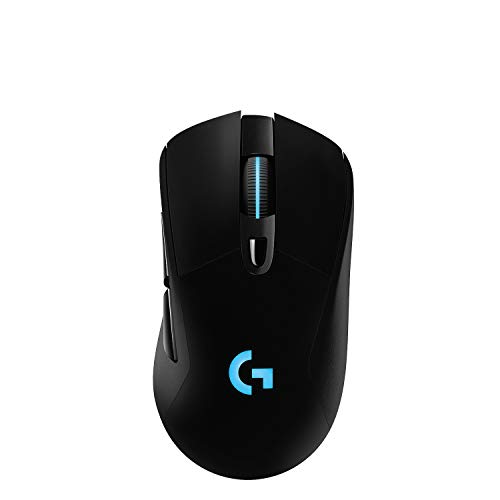
The G703 combines a HERO 25K sensor, LIGHTSPEED wireless, a 95 g weight, and up to 35 hours of play with default RGB lighting. Its rubber side grips and ergonomic design make it a fit to consider for players who prefer a fuller shape.
It includes a removable 10 g weight and six programmable buttons, with optional POWERPLAY wireless charging sold separately. The listed battery figure is shorter than the G305’s stated runtime, so battery life may matter when choosing between them.
Logitech G203: Straightforward Wired Pick
The G203 offers an 8,000 DPI optical sensor with zero filtering and smoothing, six buttons, and a USB Type-A connection. Its wired design avoids battery upkeep, and Logitech G HUB lets users customize sensitivity and button assignments.
This is a sensible option for players who want a basic, configurable wired mouse rather than wireless convenience or numerous side buttons. The supplied specifications do not state its weight, so players prioritizing a particularly light mouse should compare carefully.
Razer DeathAdder Essential: Ergonomic Wired Design
The DeathAdder Essential has a 6,400 DPI optical sensor, five programmable buttons, and a wired connection. Its ergonomic design and reprogrammable DPI buttons suit players who want a conventional shape and straightforward sensitivity changes.
Razer specifies mechanical switches rated for up to 10 million clicks, but that rating is not a guarantee of real-world lifespan. Its sensor’s maximum DPI is lower than the listed Logitech HERO models, though maximum DPI alone does not determine aiming quality.
Logitech G502 Hero: Wired Mouse with Adjustable Weights
The G502 Hero combines a HERO sensor rated up to 25,600 DPI, 11 programmable buttons, and a dual-mode scroll wheel. Its five removable 3.6 g weights allow balance adjustments, which may appeal to players who want to customize mouse feel.
That button count and weight system offer flexibility, but may be unnecessary for players seeking a simple aiming-focused layout. It is wired, so it avoids battery management but does not provide the cable-free movement of the G305 or G703.
Redragon M730 PRO: Lightweight Wireless or Wired Use
The M730 PRO is listed at 62 g and supports wired and wireless use, with a Pixart SG8925 optical sensor and 1,000 Hz polling rate. Its software supports DPI settings from 50 to 10,000, while five preset levels offer quick switching.
Redragon states up to 77 hours of rechargeable battery life at maximum, but the supplied information does not specify the conditions behind that figure. Its wireless connection details are not fully described, so check the seller’s current documentation for the connection mode you need.
Redragon M602: Budget Wired Mouse with Customization
The M602 offers adjustable DPI up to 7,200, nine programmable buttons, and software for remapping and macros. Its ergonomic shape and wired connection may suit players who want extra controls without requiring wireless functionality.
The product launched in 2015, and its listed maximum DPI is below several newer options in this roundup. DPI is not a standalone accuracy measure, but buyers seeking current sensor details should confirm the exact model’s documentation before purchase.
Redragon M908: Many Programmable Buttons
The wired M908 has a Pixart PAW3327 sensor, a stated 1,000 Hz polling rate, and 18 programmable buttons, including 12 side buttons. Its eight-piece weight set supports weight adjustments, making it more appropriate for button-heavy games than a minimalist aiming setup.
Redragon lists five preset DPI levels and software adjustment up to 12,400 DPI. Its many buttons and aggressive design may feel excessive for players who mainly need a simple mouse for aiming, and the listed programmable software compatibility centers on Windows.
BENGOO Wired RGB Mouse: Basic Plug-and-Play Features
The BENGOO mouse offers four DPI settings from 1,200 to 3,600, six buttons, and plug-and-play operation without a driver. It may suit a basic wired setup where simple sensitivity switching matters more than advanced software customization.
The supplied specifications do not identify its sensor model or polling rate, limiting direct comparison with the Logitech and Redragon options. Its listed operating-system support includes Windows XP through Windows 8, so check compatibility with your current system before buying.
Frequently Asked Questions
Does a Higher DPI Make a Mouse More Accurate?
Not by itself. DPI describes sensitivity settings, while sensor behavior, consistent tracking, comfortable control, and an appropriate in-game sensitivity also affect how easily you can aim.
Is a Wired or Wireless Mouse Better for Aiming?
Either connection can suit aiming. Choose wired if you prefer not to manage a battery, or consider a documented low-latency wireless model such as the G305 or G703 if you want to avoid cable drag.
Final Recommendation
For a lightweight wireless option, consider the Logitech G305; choose the G703 if its fuller ergonomic design and rechargeable battery suit you better. The G203 and DeathAdder Essential are simpler wired choices, while the G502 Hero fits players who want programmable controls and adjustable weights.
For a lower-feature wired option, compare the M602 or BENGOO while checking their documented limitations and system support. Choose the M730 PRO for its stated low weight and wireless flexibility, or the M908 when numerous programmable buttons matter more than a minimal layout.



Write Your Review
No reviews yet. Be the first to share your experience!