

Choosing the best gaming keyboards for beginners starts with understanding the trade-offs between tactile feedback, desk footprint, and price. Entry-level keyboards span basic membrane boards with quiet operation up to hot-swappable mechanical decks that support future switch modifications.
For players setting up their first battlestation, deciding between a compact 60 percent layout or a traditional full-size board influences how much mouse space you have. The following breakdown compares 10 beginner models based on verified hardware specifications, switch types, and build construction.
Quick Overview of Top Beginner Gaming Keyboards

Pros
- Compact 68-key footprint saves desk space
- Shared 2.4GHz receiver frees up USB ports
- Rechargeable batteries eliminate disposable battery swaps
- Broad support for PCs and gaming consoles
- Adjustable keyboard lighting and ergonomic contours
Cons
- Anti-ghosting is limited to 19 keys in USB mode
- Lacks dedicated software for macro or RGB remapping
- Loss of the shared dongle disables wireless for both devices
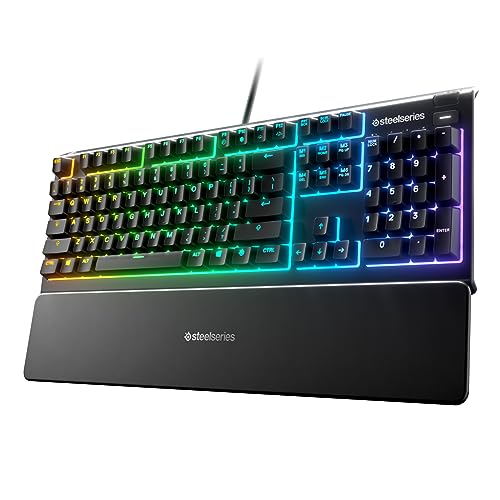
Pros
- IP32 water resistance guards against liquid spills
- Whisper-quiet switches rated for 20 million presses
- Included magnetic wrist rest for palm support
- Dedicated on-the-fly multimedia controls
- Broad compatibility with PC and major consoles

Pros
- Durable wear-resistant PBT keycaps
- Sturdy aluminum-magnesium alloy top plate
- Tactile mechanical switches for responsive feedback
- Convenient FN-layer media and lighting controls
Cons
- Lighting limited to single-color white LEDs
- Key rollover capped at six simultaneous inputs

Pros
- Dedicated one-touch lighting toggle button
- 19-key anti-ghosting for essential gaming inputs
- Full 104-key layout with multimedia shortcuts
- Plug-and-play setup across PC and consoles
- Adjustable backlighting brightness and breathing modes
Cons
- Simulates mechanical feel rather than true mechanical switches
- Anti-ghosting is limited to 19 keys

Pros
- Tri-mode connectivity via Bluetooth, 2.4GHz, and USB-C
- Single 2-in-1 USB receiver operates both peripherals
- Ten dedicated multimedia keys for direct playback control
- Mouse supports up to 1000Hz polling rate
- Keyboard battery rated up to 300 hours without RGB
Cons
- Configuration software is limited to Windows systems
- Mouse sensor tops out at 4800 DPI

Pros
- Versatile tri-mode wireless and wired connectivity
- Hot-swappable PCB supports 3-pin and 5-pin switches
- Large 8000mAh rechargeable internal battery
- Gasket mount with five-layer acoustic dampening
- Durable double-shot PBT keycaps
Cons
- Heavy build at over 3.3 pounds
- Driver software required for advanced macros and rhythm lighting

Pros
- Hot-swappable linear red switches
- Full-key anti-ghosting support
- Software macro editing and remapping
- Includes four spare replacement switches
- Twelve quick-access multimedia shortcuts
Cons
- Backlight LED colors cannot be changed
- Wired-only design without wireless functionality

Pros
- Space-saving 68-key layout with dedicated arrows
- Detachable Type-C cable for easy travel
- Quiet membrane operation suitable for shared rooms
- 26-key anti-ghosting for accurate key registration
Cons
- Uses membrane switches instead of authentic mechanical switches
- No integrated number pad for data entry

Pros
- Driver-free plug-and-play installation
- Double-shot keycaps prevent legend wear
- Six dedicated mouse DPI preset levels
- Multiple onboard RGB lighting modes
- Broad compatibility across major operating systems
Cons
- Mouse sensitivity peaks at 3200 DPI
- Full-size footprint requires substantial desktop space
- Wired design requires two open USB ports

Pros
- Durable spill-resistant build for simple cleanup
- Dedicated media and volume control buttons
- Tuned tactile keys with gaming anti-ghosting
- Integrated palm rest enhances typing comfort
- Customizable five-zone RGB via Logitech G HUB
Cons
- RGB illumination is limited to five zones
- Integrated palm rest cannot be removed
Individual Keyboard Breakdown and Analysis
60% Wireless Gaming Keyboard and Mouse Combo
This compact 68-key setup pairs a 60 percent layout keyboard with an optical mouse via a shared 2.4 GHz wireless USB receiver. The keyboard houses a 2000 mAh internal rechargeable battery, while the mouse relies on a 500 mAh cell, cutting clutter on tight desktop setups.
The keyboard provides 19-key anti-ghosting in USB mode, which handles common movement and combat key combinations in casual gaming. However, the compact profile eliminates the dedicated number pad and function row, meaning secondary layers require multi-key combinations that newcomers may need time to memorize.
SteelSeries Apex 3 Gaming Keyboard – Black
The SteelSeries Apex 3 is a full-size wired board built around proprietary whisper-quiet membrane switches rated for 20 million actuations. It features IP32 water resistance, protecting the internal electronics against minor drink spills during long sessions.
SteelSeries includes a detachable magnetic wrist rest and a dedicated volume roller with multimedia controls for quick adjustments. While its quiet membrane switches offer a soft bottom-out that prevents room noise, it lacks the crisp actuation point found on genuine mechanical hardware.
Logitech G413 SE Full-Size Mechanical
Logitech G413 SE brings standard mechanical performance to beginners using tactile switches mounted beneath durable PBT keycaps. PBT plastic resists shine and oil buildup over long-term use far better than standard ABS plastic.
The chassis features a brushed aluminum-magnesium alloy top plate that prevents deck flex during heavy typing. It utilizes white LED backlighting rather than per-key RGB and supports 6-key rollover, which is sufficient for gaming but lower than boards featuring full N-key rollover.
Redragon S101M-KS Gaming Keyboard and Mouse
This combo offers tri-mode connectivity spanning 2.4 GHz wireless, Bluetooth, and wired USB-C operation. The full-size keyboard includes 10 dedicated multimedia keys and RGB backlighting, paired with a mouse capable of up to 4800 DPI across five hardware presets.
With an advertised 300-hour battery life when backlighting is turned off, this bundle suits players who want cable-free utility without buying separate peripherals. The membrane switch construction keeps keypresses quiet, though key actuation feels softer than a dedicated mechanical alternative.
AULA F99 Wireless Mechanical Keyboard,Tri-Mode
The AULA F99 provides advanced mechanical features in a 96 percent, 99-key format that retains numeric keys while shortening horizontal width. It features gasket mounting, five layers of sound-dampening foam, and factory-lubricated linear switches for smooth, quiet keystrokes.
Beginners interested in customizing their setup will appreciate the hot-swappable PCB, which accepts 3-pin and 5-pin switches without any soldering. It includes an 8000 mAh battery and multi-device Bluetooth switching, though its custom software configuration has a slight learning curve.
Redragon K521 Upgrade Rainbow LED Gaming Keyboard
The Redragon K521 is a budget-friendly 104-key wired board tuned for membrane operation with a tactile, mechanical-style stroke. It features one-touch backlight control with fixed rainbow illumination zones, breathing modes, and 12 FN-based media shortcuts.
Its matrix supports 19-key anti-ghosting to avoid missed inputs on core gaming key clusters like WASD. The plastic casing keeps the unit lightweight, though users do not get true individual key lighting customization or mechanical switch modularity.
Redragon Mechanical Gaming Keyboard Wired
This wired model delivers true mechanical operation through hot-swappable linear red switches that require minimal actuation force. Redragon supplies four replacement switches and double-shot keycaps in the package, making minor switch repairs easy for first-time owners.
The keyboard offers full N-key anti-ghosting, ensuring every simultaneous key press registers correctly during complex gaming macros. Backlighting includes 11 preset illumination modes, though the LED colors are fixed per zone and cannot be reprogrammed to custom color palettes.
GEODMAER 65% Gaming Keyboard
The GEODMAER mini keyboard adopts a 65 percent layout with 68 keys, preserving dedicated arrow navigation keys within a minimal desk footprint. It connects via a detachable USB Type-C cable, allowing easy transport in a backpack alongside gaming laptops.
Using quiet membrane switches tuned for tactile imitation, it features 26 conflict-free keys and a Windows lock toggle to prevent accidental desktop drops. Keystroke resistance is smooth, but users cannot swap switches if a single key fails.
Gaming Keyboard and Mouse Combo
MageGee provides a full-size 104-key white aesthetic bundle with floating keycaps and integrated multi-color LED backlighting. The wired keyboard incorporates an ergonomic tiered key profile and non-slip feet to maintain stability during active gameplay.
The companion mouse supplies six hardware DPI sensitivity presets ranging from 600 to 3200 DPI with seven breathing colors. This plug-and-play membrane kit operates without proprietary drivers, though it lacks macro customization software for remapping inputs.
Logitech G213 Prodigy Wired RGB Gaming Keyboard
The Logitech G213 Prodigy is a full-sized gaming board using performance-tuned Mech-Dome membrane keys that emulate mechanical tactility. It features five individual RGB lighting zones manageable through Logitech G HUB software, along with dedicated media buttons and a volume rocker.
Spill resistance rated up to 60ml of liquid protects the keyboard against minor desktop mishaps, while the integrated palm rest supports wrist alignment. The non-detachable wrist rest does increase the desk depth required, which may restrict mouse movement on shallow desks.
Key Comparison Factors for Beginners
Selecting an initial keyboard requires balancing mechanical tactile feedback against the budget-friendly simplicity of membrane boards. Evaluating layout, switch construction, and rollover specifications ensures the keyboard matches your primary games and desk dimensions.
Mechanical Versus Membrane Switches
Membrane keyboards, like the SteelSeries Apex 3 or Logitech G213, rely on a flexible rubber dome beneath the keys to complete an electrical circuit. They are inherently quiet and naturally resist minor liquid spills, making them dependable for shared bedrooms or office spaces.
Mechanical keyboards use independent physical switches beneath each keycap, registering inputs earlier in the key travel. Options like the AULA F99 and Redragon K671 allow hot-swapping switches, which lets beginners swap out broken switches or change actuation feel without buying an entirely new board.
Form Factor and Desktop Space
Full-size 104-key models include the number pad and dedicated arrow cluster, serving dual roles for homework, data entry, and everyday computing. However, their broad horizontal width can force your mouse outward, restricting wide arm sweeps in competitive shooters.
Compact layouts, including 60 percent and 65 percent designs like the GEODMAER, eliminate the number pad to free up generous mouse tracking room. If your setup uses a compact desk or dual screen layout, optimizing peripheral space keeps wrists in a neutral position. For setup inspiration, consider reviewing our analysis on the best gaming desks for dual monitors to match your available desktop area.
Key Rollover and Anti-Ghosting
Ghosting occurs when multiple keys are pressed simultaneously and the internal matrix fails to register one or more inputs. Standard office keyboards often lock up after three simultaneous keypresses, causing movement stalls while sprinting and jumping in games.
Beginner gaming boards resolve this with dedicated gaming matrices, offering between 19-key anti-ghosting up to full N-key rollover. For fast-paced titles, look for at least 19 conflict-free keys across the WASD and modifier regions.
Frequently Asked Questions
Are red linear switches good for beginners?
Yes. Red switches feature a smooth, straight downstroke without a tactile bump or audible click. This low actuation resistance makes them responsive in fast-paced games, though their light touch can lead to accidental typos until you adapt to the sensitivity.
Do I need driver software for a beginner gaming keyboard?
Most entry-level keyboards operate via standard plug-and-play USB protocols with onboard shortcuts for lighting patterns and volume. Software suites like Logitech G HUB are only necessary if you plan to rebind individual keys, record macros, or synchronize RGB colors across multiple peripherals.
Is wireless latency noticeable on entry-level keyboards?
Modern 2.4 GHz wireless connections provide input response that feels virtually instantaneous for casual and intermediate gaming. Bluetooth connections, however, exhibit slight latency and are best reserved for typing tasks or secondary device pairing.
Final Recommendation
For players wanting true mechanical switches with room for future customization, the AULA F99 offers exceptional value through hot-swappable sockets and pre-lubed switches. If you prefer a full-size traditional layout with spill resistance and quiet keystrokes, the SteelSeries Apex 3 remains a reliable starter choice.
Gamers working with limited desk space or tight budgets will benefit most from the GEODMAER 65% or the Redragon K671 wired mechanical board. Evaluate your desk area and switch preferences to ensure your first peripheral matches your gaming habits.




Write Your Review
No reviews yet. Be the first to share your experience!