

The best nvme ssds for gaming depend mainly on your motherboard, desired capacity, and whether you prioritize game storage or heavy file transfers. The Kingston NV3 is the most straightforward capacity upgrade, while Samsung’s 990 PRO models target buyers who want higher documented PCIe 4.0 performance.
This is a specification-based comparison, not a report from independent drive testing. The SABRENT USB-C NVMe Enclosure & Reader is included as a useful accessory, rather than an internal SSD, because it can turn a compatible NVMe drive into portable storage.

Pros
- Read speeds reach up to 6,000 MB/s
- Includes Acronis cloning software for drive migration
- Standard M.2 2280 form factor ensures wide compatibility
- Backed by a 5-year limited warranty

Pros
- Screwless flip-open design for fast drive swaps
- Supports up to 10Gbps transfer speeds
- Accommodates four standard M.2 NVMe drive lengths
- Aluminum top provides direct thermal pad contact
- Bus-powered USB-C connectivity requires no extra cables
Cons
- Incompatible with M.2 SATA SSDs
- Constructed with an ABS frame rather than an all-metal enclosure

Pros
- Up to 7,450 MB/s sequential read speeds
- Up to 6,900 MB/s sequential write performance
- Generous 2TB storage capacity
- Enhanced power efficiency per watt over 980 PRO
- Compact M.2 2280 form factor
Cons
- Requires PCIe 4.0 hardware for maximum rated speeds
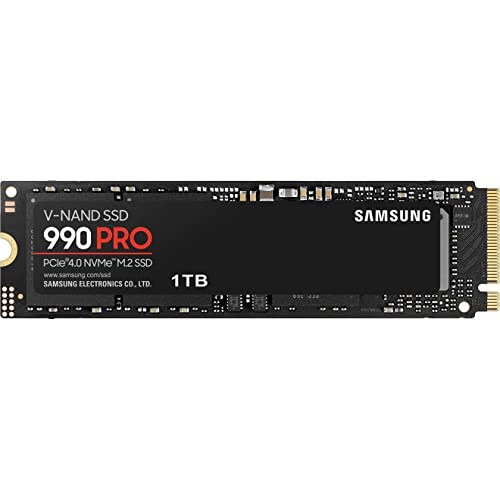
Pros
- Up to 7,450 MB/s sequential read speeds
- Up to 1,550K IOPS random write performance
- Improved power efficiency over the 980 PRO
- DirectStorage and PlayStation 5 system compatibility
- Samsung Magician software support for drive maintenance
Cons
- Laptop installation requires PCI-SIG D8 clearance
- Maximum throughput requires a compatible PCIe 4.0 motherboard

Pros
- Advertised transfer speeds reaching 5000MB/s
- Pre-installed heatsink fits PS5 expansion slots
- Integrated SLC cache support
- Five-year manufacturer warranty coverage
Among the internal drives, the Kingston NV3 suits mainstream gaming PCs that support PCIe 4.0 x4. The Samsung 990 PRO models offer higher advertised sequential and random performance, while the fanxiang S660 adds an integrated heatsink and PS5-focused positioning.
Comparison of the Listed NVMe Storage Options
| Product | Type | Interface or connection | Advertised sequential speed | Best suited to |
|---|---|---|---|---|
| Kingston NV3 1TB M.2 2280 NVMe SSD | Internal SSD | PCIe 4.0 x4 | Up to 6,000 MB/s read and 4,000 MB/s write | Mainstream gaming PC storage |
| Samsung SSD 990 PRO 2TB, PCIe 4.0 M.2 2280 | Internal SSD | PCIe 4.0 | Up to 7,450 MB/s read and 6,900 MB/s write | Large game libraries and demanding workloads |
| Samsung SSD 990 PRO 1TB, PCIe 4.0 M.2 2280 | Internal SSD | PCIe 4.0 | Up to 7,450 MB/s read and 6,900 MB/s write | High-performance systems with moderate capacity needs |
| fanxiang S660 PCIe 4.0 1TB NVMe M.2 SSD for PS5 | Internal SSD with heatsink | PCIe 4.0 | Up to 5,000 MB/s | PS5 expansion and compatible PCs |
| SABRENT USB-C NVMe Enclosure & Reader | External enclosure | USB 3.2 Gen 2, up to 10Gbps | Not specified | Portable storage, cloning, and troubleshooting |
Kingston NV3 1TB M.2 2280 NVMe SSD
The Kingston NV3 1TB M.2 2280 NVMe SSD is the most practical choice for a gaming PC that needs a conventional internal PCIe 4.0 upgrade. Its M.2 2280 format and PCIe 4.0 x4 interface are common on modern desktop motherboards and many compatible laptops.
Kingston lists sequential performance of up to 6,000 MB/s read and 4,000 MB/s write. Those specifications support faster game installation and file transfers than older SATA-based storage, although actual results depend on the host system, workload, and available PCIe generation.
The included Acronis cloning software can help users migrate an existing system drive, and the five-year limited warranty provides a defined manufacturer coverage period. Confirm your motherboard has a compatible M.2 NVMe slot before installation, because an M.2 SATA-only slot will not provide the required interface.
Samsung SSD 990 PRO 2TB, PCIe 4.0 M.2 2280
The Samsung SSD 990 PRO 2TB, PCIe 4.0 M.2 2280 is the strongest capacity and performance option in this comparison. Samsung specifies up to 7,450 MB/s sequential read and 6,900 MB/s sequential write performance, plus high random I/O figures for demanding workloads.
Its 2TB capacity is better suited to large game libraries, applications, and users who regularly move substantial files. The drive is also positioned for video editing, data analysis, and DirectStorage-compatible PC games, although software support and the rest of the platform determine how much of that capability is used.
This model makes the most sense when your system includes a PCIe 4.0 M.2 slot and your workload justifies a high-performance drive. Buyers should still check motherboard heatsink clearance and thermal provisions, particularly in compact cases or systems with limited airflow.
Samsung SSD 990 PRO 1TB, PCIe 4.0 M.2 2280
The Samsung SSD 990 PRO 1TB, PCIe 4.0 M.2 2280 offers the same advertised peak sequential speeds as the larger version while providing less usable space. It is aimed at gaming PC builders who want high-end PCIe 4.0 performance without selecting a 2TB drive.
Samsung lists up to 7,450 MB/s read and 6,900 MB/s write performance, with up to 1,400K read and 1,550K write IOPS in its supplied specifications. Samsung Magician software adds drive monitoring, firmware updates, health checks, and optimization tools.
The main limitation is capacity rather than interface performance. Modern game installations can consume substantial space, so this version is a better fit for a focused game library or as a fast system drive paired with additional storage.
fanxiang S660 PCIe 4.0 1TB NVMe M.2 SSD for PS5
The fanxiang S660 PCIe 4.0 1TB NVMe M.2 SSD for PS5 includes a heatsink and is advertised for PS5 expansion as well as PC use. Its listed performance reaches up to 5,000 MB/s, making it slower on paper than the two Samsung 990 PRO models and the Kingston NV3’s maximum read specification.
The integrated heatsink is useful for systems that need a drive-level cooling solution, but installation space still matters. Check that the heatsink fits the PS5 expansion bay or your motherboard’s M.2 area, and verify that another motherboard heatsink will not create clearance problems.
This option is most relevant to readers who want one NVMe drive for a PS5 and a compatible PC. The supplied data does not establish independent performance, endurance, or long-term reliability results, so those factors should not be inferred from the advertised speed alone.
SABRENT USB-C NVMe Enclosure & Reader
The SABRENT USB-C NVMe Enclosure & Reader is not an internal SSD, but it can make a spare M.2 NVMe drive useful as portable storage. It supports M.2 sizes 2230, 2242, 2260, and 2280, with USB 3.2 Gen 2 connectivity rated up to 10Gbps.
Its tool-free flip-open design is convenient for cloning, troubleshooting, temporary game storage, and moving data between compatible USB-C devices. The aluminum construction and included thermal pad are intended to improve heat transfer during longer transfers.
Compatibility is limited to NVMe drives, not M.2 SATA SSDs. USB 10Gbps also becomes the external connection limit, so an installed PCIe 4.0 NVMe drive will not deliver its full internal interface speed through this enclosure.
How to Choose the Best NVMe SSDs for Gaming
Check the M.2 slot and PCIe generation
Before buying, confirm that your motherboard or laptop supports an M.2 NVMe drive in the 2280 form factor. PCIe 4.0 drives can operate in some older or newer systems, but the platform may limit available bandwidth and advertised performance.
Choose capacity for your game library
A 1TB drive can suit a system drive and a moderate game collection, while 2TB provides more room for large installations and creative workloads. Capacity is often more useful than peak sequential speed when the drive will mainly store games.
Separate gaming needs from heavy file workloads
PCIe 4.0 performance can help with large transfers, application loading, and supported DirectStorage workloads. Game loading improvements vary by title and system, so advertised read speed should not be treated as a guaranteed frame-rate increase.
Plan for cooling and physical clearance
Check whether your motherboard includes an M.2 heatsink and whether a drive with an integrated heatsink will fit beneath it. The fanxiang S660 requires particular attention because its included heatsink may affect clearance in some installations.
Other Gaming PC Components to Consider
Storage is only one part of a balanced gaming system. Our guide to the best specifications for a gaming PC can help you evaluate the processor, graphics card, memory, and motherboard alongside an NVMe upgrade.
If you are choosing a complete system rather than upgrading storage, compare the recommendations in our guide to gaming PCs under $1500. That approach helps reveal whether the storage choice is balanced with the rest of the build.
Frequently Asked Questions
Are all of these products internal NVMe SSDs?
No. The Kingston, Samsung, and fanxiang products are internal M.2 NVMe SSDs. The SABRENT product is a USB-C enclosure designed to hold a compatible NVMe SSD externally.
Does a PCIe 4.0 SSD work in a PCIe 3.0 system?
Compatibility depends on the motherboard or laptop’s M.2 slot, but a supported PCIe 4.0 drive may operate at the host system’s lower PCIe generation. Its performance will be limited by that connection rather than the drive’s advertised maximum.
Which capacity is better for a gaming PC?
Choose 1TB when the drive will hold the operating system and a smaller game library. Choose 2TB when you want more room for large games, applications, and file-based workloads without relying on frequent transfers.




Write Your Review
No reviews yet. Be the first to share your experience!